Call :
+16505578269Email :
support@remedo.io


A practical guide for dental practices on building location pages that rank for local searches and turn every click into a booked appointment.




9+ years auditing Google Ads accounts
for dentists across the US, UK and
Canada. Google Ads & Analytics
certified. Lead author of Remedo’s dental
PPC playbook.

9+ years auditing Google Ads accounts
for dentists across the US, UK and
Canada. Google Ads & Analytics
certified. Lead author of Remedo’s dental
PPC playbook.


Editorial policy: We don’t accept paid placements in our blog content. Some links go to our own services — clearly marked. Read oureditorial standards and affiliate disclosure.

Every day, patients search for terms like "dentist near me" or "Invisalign in [city name]" with a clear goal in mind. They are not browsing � they are deciding. Instead of sending all that traffic to a generic homepage, high-performing dental practices create dedicated location-based dental pages that speak directly to that patient's area, needs, and expectations.
These pages are more than just SEO assets. When done right, they meet patients at the exact moment of intent, reflect local relevance, and make the next step feel easy and natural. They build trust quickly, improve conversion rates, and turn search visibility into real appointments. When done poorly, they feel repetitive, generic, and disconnected � leading to lower rankings, fewer inquiries, and lost opportunities to nearby competitors.
The difference is not the city name in the title. It is the depth, structure, and conversion logic behind every element of the page. This guide breaks down each of those elements so every local search becomes a real growth opportunity for your practice.
Personalization is at the core of location pages that actually convert. When your content reflects what someone in a specific area is looking for, it feels more relevant and easier to trust. Location-based targeting takes this further by aligning your services with the exact city, neighborhood, or community the patient is searching from.
In dental search, this matters even more. Patients are not just comparing services � they are looking for convenience, familiarity, and confidence that the practice understands their local needs. A page that clearly mentions the area, highlights nearby accessibility, and reflects real patient experiences from that location immediately feels more credible. High-performing practices use location pages to provide practical, decision-making information: clinic address, directions, parking, nearby landmarks, available treatments, and what to expect on a visit.
Effective location page design starts long before you write a single word. It starts with keyword research � real research, not guessing. Understanding search intent is the difference between a page that ranks and a page that converts.
Your core keywords follow predictable patterns: "Dentist in [City]", "Dental office near [Neighborhood]", "Family dentist [City]", "Emergency dentist [City]". Your location page should target one primary keyword � usually "[City] dentist" or "dentist in [City]" � without cramming every variation into the copy in a way that sounds robotic. Front-load the keyword naturally in your title, H1, and opening paragraph.
The real conversion gold is in long-tail keywords. These are more specific, lower-volume searches that indicate even higher purchase intent: "Affordable dentist accepting new patients [City]", "Invisalign provider near [Landmark]", "Emergency tooth extraction [City] same day", "Pediatric dentists open weekends [Neighborhood]". Patients who search these terms know exactly what they want. Use tools like Google Search Console, Semrush, or Ahrefs to find the queries already bringing people to your site � then build your content around proven SEO topic clusters that strengthen both service and location relevance.
Your page title and meta description are your first impression � and your first SEO signal. The title tag directly influences your rankings for primary keywords. The meta description acts as a small advertisement in search results: it does not directly affect rankings, but it affects click-through rate, which indirectly affects rankings. Every word counts.
Title tag formula: [City] Dentist | [Practice Name] | [Key Differentiator]. Keep it under 60 characters to prevent truncation and front-load the keyword. Example: "Denver Dentist | Bright Smiles Family Dental | Accepting New Patients"
Meta description formula: Expand on the title with a specific call to action, a trust signal, and your primary keyword. Aim for 145�155 characters. Example: "Looking for a trusted Denver dentist? Bright Smiles offers comprehensive family dental care with same-day appointments. Call now or book online."
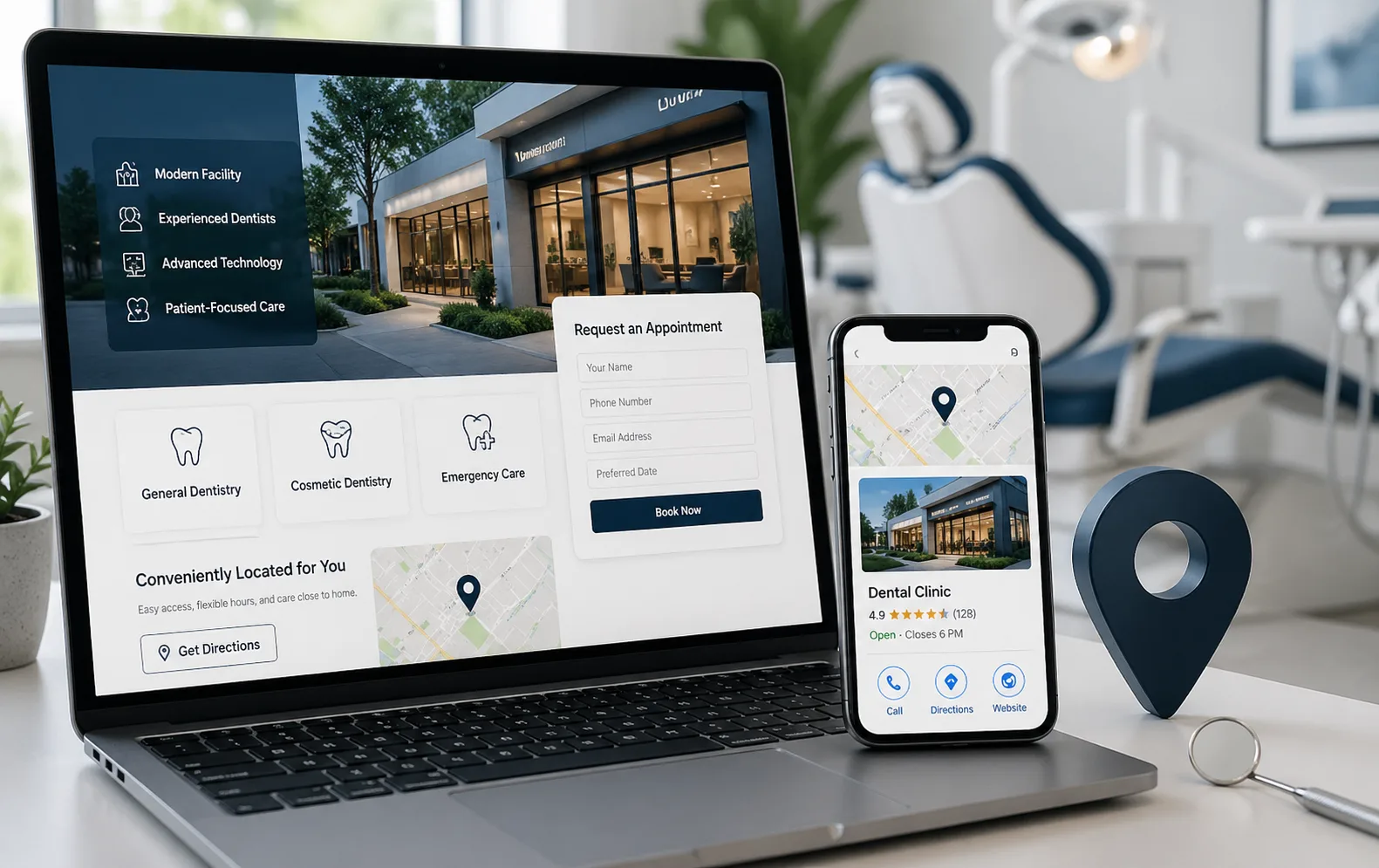
Patients decide within three to five seconds whether to stay on your page or bounce. A professionally built dental website design framework ensures your hero section is optimized not just for aesthetics but for patient conversion. Your hero section must immediately communicate four things: where you are, who you serve, why they should choose you, and what to do next � all before the patient scrolls.
Your hero CTA should include a phone number (click-to-call on mobile is non-negotiable) and an appointment booking button, both visible without scrolling on any device. These two elements alone are responsible for the majority of conversions generated from a location page.
The first 100 words of your location page are critical. They influence both search rankings and whether a patient keeps reading. Start by acknowledging what the patient is looking for, then naturally include your main keyword within the first two sentences.
Example: "Finding a dentist you can trust in [City] should feel simple. At [Practice Name], we have been caring for patients across [City] from our clinic in [Neighborhood] for over a decade. Whether you need urgent care, a routine visit, or cosmetic treatment, our team is here and currently welcoming new patients." This opening is natural, highlights location clearly, introduces services, and builds trust from the very first line.
One of the most common mistakes dental practices make is publishing location pages with fewer than 500 words. These thin pages rarely rank well and convert even worse. Google's Helpful Content guidelines explicitly reward content that provides genuine value to the user � not keyword-stuffed text masquerading as information. Your location pages should aim for a minimum of 800 words of genuinely useful content, with 1,200�2,000 words being the sweet spot for competitive dental markets.
Practice story rooted in the community: do not just say you serve the city � mention local landmarks and geographic specifics that help Google understand exactly where you operate. Include a services section with local context: briefly explain each service in terms of common problems your local patients face. If you are in a college town, sports-related dental emergencies may be worth calling out. If your community has a large senior population, dentures and periodontal care deserve more emphasis.
Insurance and payment information is massively underutilized on location pages. A significant portion of dental searches include insurance-related terms. List every plan you accept. If you offer financing through CareCredit or in-house payment plans, dedicate a section to it. This single addition can dramatically improve your conversion rate by removing one of the biggest barriers to booking. Office hours must be displayed in text � not just in images, since Google cannot read images. If you offer early, evening, or weekend appointments, make this prominent. Parking and transportation details are a high-value addition: patients in urban areas often hesitate because they are unsure about parking, and addressing this directly removes a real friction point.
We’ll review your last 90 days of search terms and show
you exactly where your budget is leaking — free, no
commitment.
You can have perfect SEO and flawless copy, but if visitors do not trust you, they will not book. Trust signals are the elements that transform a curious visitor into a scheduled appointment. They also feed directly into Google's E-E-A-T framework � Experience, Expertise, Authoritativeness, and Trustworthiness � which directly influences how Google evaluates and ranks your location pages.
Online reviews are the single most powerful trust signal in dental marketing. Your location page should feature an embedded or dynamically pulled Google Reviews section showing your current star rating and recent reviews, selected patient testimonials relevant to the services highlighted on that page, and a direct link to your Google Business Profile so skeptical visitors can read all reviews unfiltered. Make it current � stale testimonials from three years ago carry significantly less weight than reviews from last month.
Patients are making a healthcare decision. Prominently display dental school and graduation year, state licensure, specialty certifications (Board Certified, FAGD, MAGD, Invisalign-certified), and membership in professional organizations like the American Dental Association, your state dental association, or specialty societies. Continuing education highlights add legitimacy � if you have completed advanced training in implants, sedation, or pediatric care, patients should know.
For practices offering cosmetic services � veneers, whitening, Invisalign, dental implants � real patient before-and-after photos are conversion gold. They demonstrate your skill, help prospective patients envision their own results, and create an emotional connection that dry text cannot replicate. Always obtain written consent and use HIPAA-compliant release forms before publishing any patient imagery.
Patients choose dentists, not dental practices. Feature professional headshots and short bios of your dentist(s) and key team members. Warm, approachable photos � not stiff corporate headshots � reduce dental anxiety and meaningfully increase the likelihood of a first-time visitor booking an appointment.
Strong content brings patients in, but technical performance and usability are what keep them there and guide them to book. Your location pages need to work smoothly behind the scenes while feeling effortless to use on any device.
Schema markup is code added to your website that helps search engines understand the context of your content. For dental location pages, implement LocalBusiness/Dentist schema � telling Google your practice name, address, phone number, hours, and business type. Review schema enables star ratings to appear as rich snippets in search results. FAQPage schema, when added to your FAQ section, can generate expandable Q&A sections directly in search results, dramatically increasing your click-through rate. Test your markup using Google's Rich Results Test tool before going live.
NAP stands for Name, Address, Phone Number. Your NAP information must be identical across every digital touchpoint: your website, Google Business Profile, Yelp, Healthgrades, Zocdoc, Vitals, your state dental board directory, and every other directory listing. Even minor inconsistencies � "St." versus "Street," a suite number present in some places but not others � can confuse Google's local algorithms and suppress your rankings. Conduct an NAP audit using Moz Local or BrightLocal and correct every discrepancy.
Google uses page speed as a direct ranking factor. Run your location pages through Google PageSpeed Insights and aim for a score above 85. Common fixes include compressing images in WebP format, enabling browser caching, minimizing JavaScript blocking the render, and upgrading to a faster hosting provider if necessary.
A significant majority of local dental searches happen on mobile devices � many by people in pain searching from their couch or car. Your pages must be mobile-first, not just mobile-friendly. This means large tappable buttons (minimum 44�44 pixels for touch targets), click-to-call phone numbers using a tel: link, text readable without zooming (minimum 16px font size), no intrusive pop-ups that cover content on mobile load, and forms that are simple and auto-fill compatible. Test across multiple devices and screen sizes � what looks polished on a desktop monitor can be a frustrating experience on a four-year-old smartphone.
All the local SEO in the world means nothing if your location page does not convert. Here is how to structure the conversion pathway so every visitor has a clear, frictionless path to booking an appointment � regardless of where they are in the decision-making process.
Your location page should have multiple CTAs designed for different stages of the patient journey. The primary CTA above the fold should be a "Book Your Appointment" high-contrast button accompanied by your phone number. A mid-page CTA after your services section should offer a softer option � "Not sure which service you need? Call us for a free consultation" � capturing patients still in exploration mode. A sticky header or floating button keeps your phone number and booking option visible as patients scroll. Avoid "Submit" as button text � it is vague and passive. Use action-oriented language: "Schedule My Appointment," "Call Now," or "Request a Same-Day Appointment."
If you are still relying solely on phone calls, you are losing patients � particularly millennials and Gen Z patients who actively avoid phone calls. Integrate an online booking solution like Zocdoc, LocalMed, or your practice management software's booking widget directly into your location page. The fewer steps between "I want to book" and "appointment confirmed," the higher your conversion rate.
Your contact form should ask for minimal information � name, phone or email, preferred appointment time, and a brief message � and submit immediately with a clear confirmation. Live chat has become a meaningful conversion driver: patients with quick questions ("Do you take Delta Dental?") often will not bother calling but will engage in chat. AI-powered dental chatbots can handle common questions 24/7 and hand off to a human agent during business hours, ensuring no inquiry goes unanswered.
In 20 minutes, we’ll walk you through what your current agency is (and isn’t) doing — and what it’s costing you.
Rankings do not come from on-page work alone. Your location pages need authoritative backlinks and consistent citations to compete in local search. This is the off-page work that reinforces everything you have built on-page and signals to Google that your practice is genuinely embedded in the local community.
Make sure your practice is listed accurately on every relevant directory: Healthgrades, Zocdoc, Vitals, WebMD Health, 1-800-Dentist, Yelp for Business, Angi, your state and city dental society websites, and your local Chamber of Commerce. Each listing is a citation that reinforces your local presence and, in many cases, a backlink to your website. Use Moz Local or BrightLocal to audit and manage your listings consistently � do not just claim them and forget them.
Google rewards local businesses genuinely embedded in their communities. Sponsor a local youth sports team, participate in a community health fair, offer free dental screenings at a community event, or partner with a local school's oral health program. These activities generate press mentions, backlinks from local news sites and community organizations, and word-of-mouth referrals. Backlinks from .edu domains and community organization websites carry particularly high authority in Google's local ranking algorithm.
Partner with nearby businesses that serve overlapping patient audiences. An orthodontist who does not offer general dentistry might refer patients to your practice and link to your site. Pediatricians, ENT specialists, and local pharmacies are natural referral partners for dental practices. A relationship that generates both patient referrals and backlinks is a compound growth strategy � it improves both your offline patient flow and your online search authority simultaneously.
A well-designed FAQ section on your location page serves two powerful purposes simultaneously: it captures long-tail voice search and featured snippet traffic, and it removes the objections that most commonly prevent a visitor from booking. Patients with quick questions about insurance, pricing, availability, or what to expect often use FAQ-style searches � and if your page answers those questions clearly, Google may display your content directly in search results through rich snippets.
Target questions that real patients actually ask. Answer each one concisely � two to four sentences � and honestly. Do not use the FAQ section as a keyword-stuffing exercise. Google's algorithms are sophisticated enough to recognize manufactured content, and real patients will see through it immediately. Implement FAQPage schema so Google can potentially display your Q&As as expandable entries directly in search results.
The FAQ section is also where you proactively address the most common objections that prevent patients from booking: cost uncertainty, insurance confusion, dental anxiety, and scheduling flexibility. By answering these honestly and directly, you reduce friction at the exact point where most visitors abandon the booking process.
If you operate multiple dental offices, location pages become even more strategically important � and more complex to execute well. Many dental groups underestimate the complexity of multi-location marketing challenges, which can significantly impact rankings if not handled strategically. The core principle is simple: each office must have its own fully unique, fully optimized location page.
Do not create a single "Locations" page that lists all your offices � you are leaving traffic on the table. A patient searching for a dentist in one specific neighborhood should find a page optimized specifically for their area, with content that speaks directly to that community, that team, and that office's unique details.
Organize your site so that location pages are logically grouped and internally linked. A clear URL structure helps: /locations/chicago/, /locations/chicago/lincoln-park/, /locations/chicago/wicker-park/. Internal links between location pages and relevant service pages � linking your Chicago location page to your Chicago dental implants page, for example � distribute link equity and reinforce topical relevance for both pages.
Location pages are not one-time assets. The practices that consistently rank well and convert more patients treat these pages as ongoing projects. Search behavior changes, competition evolves, and patient expectations shift. Build a quarterly review process into your workflow and treat it as a non-negotiable maintenance task.
Even small, regular updates signal to Google that your page is actively maintained � which contributes to ranking stability over time. The practices that treat location pages as living assets consistently outperform those that treat them as a one-time publication and move on.

1. You Cannot Access Your Own Google Ads Account
2. Reports Show Clicks, Not Patients
3. No Negative Keyword List
4. Traffic Goes to Your Homepage
5. They Don’t Know Your Cost Per Patient
6. No Call Tracking Configured
7. Budget Never Changes
8. Everything Runs in One Campaign
9. No A/B Testing Has Been Run
10. They Become Defensive on Direct Questions
What a High‑Performing PPC Agency Looks Like
Book a FREE Consultation


