
Search visibility for dental practices no longer stops at Google rankings. Patients are increasingly asking AI-powered tools questions like “Who is the best Invisalign dentist near me?” or “Which dental clinic has the best reviews for implants?” and receiving direct, conversational recommendations instead of a traditional list of websites. That shift is changing how practices get discovered online.
LLM-powered search is becoming a new layer of local visibility. AI tools now summarize reviews, compare practices, recommend providers, and surface “best fit” clinics based on the information they can find and trust across the web. If your dental practice is not appearing in those AI-generated answers, you are missing visibility at the exact moment patients are making decisions.
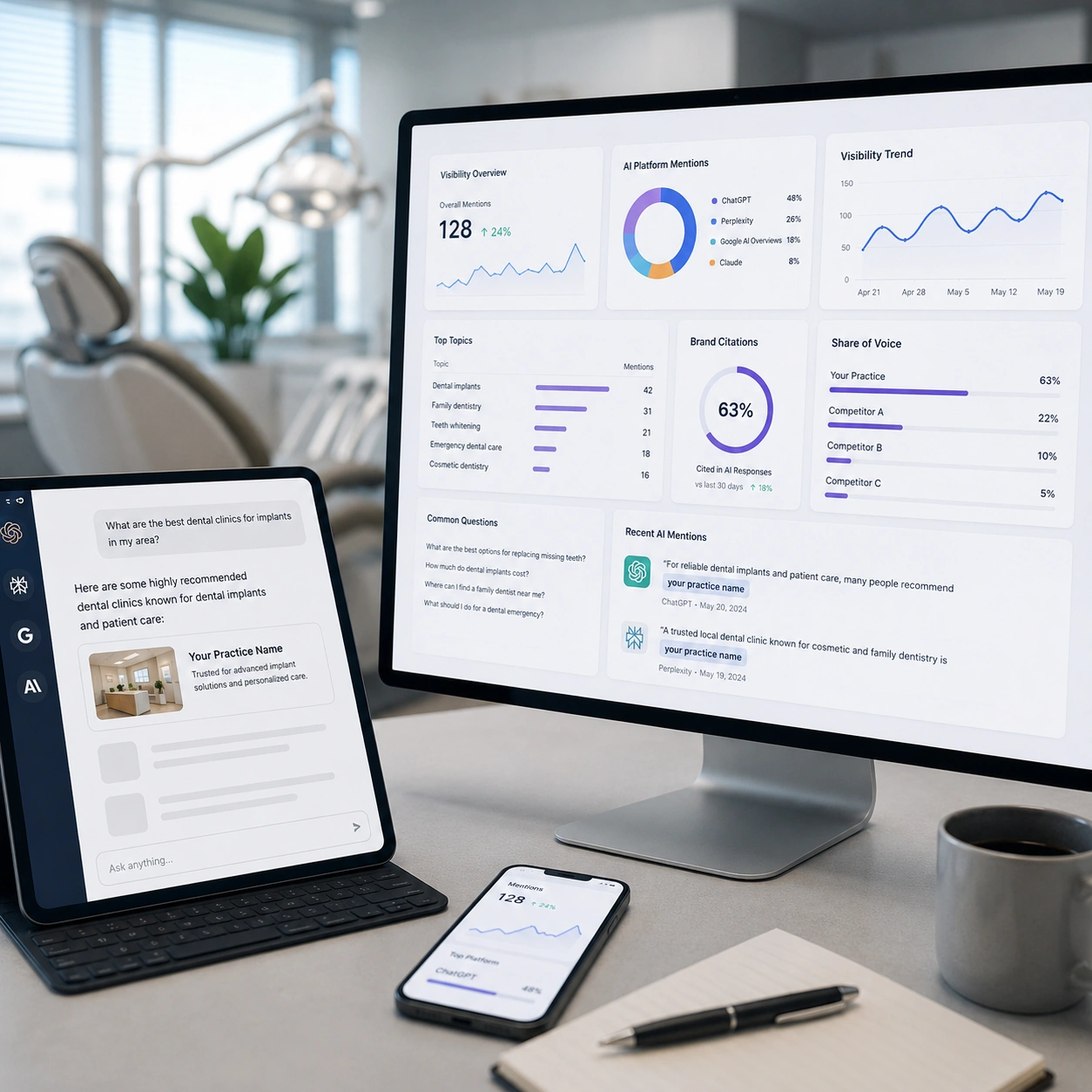
This is why tracking your presence in LLM-powered search matters. It is no longer just about monitoring keyword rankings in Google; it is about understanding whether AI platforms recognize, mention, and recommend your practice when patients ask high-intent dental questions. This guide explains how dental practices can start tracking that visibility, what influences AI recommendations, and how to improve the signals these systems rely on.
LLM stands for Large Language Model — the technology powering AI platforms like ChatGPT, Google AI Overviews, Microsoft Copilot, and Perplexity. Unlike traditional search engines that mainly display a list of websites, these systems generate direct answers by analyzing and summarizing information from multiple online sources.
For dental practices, that changes how online visibility works. When someone asks an AI tool, “Which dentist near me offers same-day crowns?” or “Who is the best Invisalign provider in my area?” the platform may respond with a short recommendation list, comparison, or summary instead of sending the user through pages of search results.
That is the key difference between traditional SEO and LLM-powered search. Traditional SEO focuses on helping your website rank on Google. LLM-powered search focuses on whether AI systems understand your practice well enough to confidently mention or recommend it inside the answer itself.
These systems evaluate much more than rankings alone. They pull signals from structured business information, website content, reviews, citations, topical authority, backlinks, and overall brand consistency across the web. The clearer and more trustworthy your digital presence appears, the easier it becomes for AI systems to understand and surface your practice.
AI is already changing how patients discover dental practices.
AI Overviews now appear across a growing number of health and dental-related searches, often showing summarized answers before traditional website results.
Patients are using conversational AI tools to research providers.
Many patients now use AI platforms to compare dentists, understand treatments, check reviews, explore costs, and shortlist practices before visiting a website.
Visibility is shifting from rankings to recommendations.
Traditional SEO helps your practice rank in search results. LLM-powered search helps your practice become part of the answer patients actually read.
In traditional search, Google ranks webpages and shows them to users. Your goal is to get your dental website ranked as high as possible so patients click through to your page. In LLM-powered search, AI systems read information from multiple sources across the web, synthesize it, and generate a completely new answer. Your goal is no longer just to rank — it is to become one of the sources the AI trusts, references, and recommends.
- Patient clicks a ranked website link
- Your website needs to rank in positions 1–10.
- Traffic flows directly through your URL
- Performance is tracked through clicks, impressions, and rankings in tools like Google Search Console.
- Patient reads an AI-generated answer or recommendation
- Your practice may be mentioned, summarized, or compared within the answer itself.
- A website click is not always guaranteed.
- Visibility depends on whether the AI system trusts your content, reviews, authority, and brand signals.
- Tracking requires a completely different methodology than traditional SEO.
The tracking challenge is real. There is no “AI Impressions” report inside Google Search Console and no dashboard showing how often AI systems mentioned your practice this week. Dental practices need to build their own monitoring process to understand where and how they appear across AI-powered search experiences.
Understanding what drives LLM recommendations is the foundation of everything that follows. These AI systems don't have a ranking algorithm in the traditional sense. They work by identifying sources that are authoritative, consistent, well-structured, and frequently referenced, then synthesizing what those sources say into a coherent answer.
Consistent, high-quality web presence
Your website, directory listings, review platforms, and local citations need to tell a consistent story. AI models pull from many sources simultaneously — inconsistency between them creates doubt and reduces the likelihood of a confident mention.
Structured, informative content
LLMs favor sources that give clear, organized answers. A practice website with well-structured service pages, FAQ sections, and patient education content is far more likely to be synthesized into an AI answer than one with minimal copy.
Third-party validation
Reviews on Google, Healthgrades, Zocdoc, and Yelp act as independent signals that AI systems weigh heavily. A practice with 300 detailed reviews describing specific treatments is significantly more likely to be recommended than one with 30 generic reviews.
Authority signals from credible publications
Being mentioned by local news outlets, dental association websites, health publications, or community organizations raises the probability that AI systems treat your practice as a trusted entity, not just a website.
Schema markup and structured data
Technical signals like Dentist schema, LocalBusiness markup, FAQ schema, and Review schema make it easier for AI crawlers to extract accurate, structured information about your practice. Without them, AI has to guess, and guesses get omitted.
LLMs are trained to avoid confidently recommending sources they're uncertain about. If your practice has thin content, inconsistent NAP data, or very few external references, the AI defaults to recommending well-documented alternatives, even if your clinical quality is superior.
There's no automated dashboard for this yet. Auditing your LLM presence requires a structured manual process—one you can run every month in under two hours. The goal is simple: find out whether AI tools are mentioning your practice, how accurately, and for which types of queries.
Create a list of 15–25 search queries that your ideal patients would realistically ask an AI tool. Organize them into categories based on search intent.
Service-based queries
- “Best dentist for Invisalign in [city]”
- “Who does same-day crowns near [neighborhood]?"
- “Emergency dentist open Saturday [ZIP]”
- “Pediatric dentist accepting new patients [city]”
- “Dental implants cost [city] recommendations.”
Comparison and trust queries
- “Most reviewed dentist in [city]”
- “Dentist near me that takes [insurance name]”
- “Top-rated family dental practice [suburb]”
- “Dentist with good reviews for anxious patients [city]”
- “Affordable cosmetic dentist [ZIP code]”
Don't just check one tool. Run your query list across these platforms and record the results separately for each:
Platforms to test:
- ChatGPT
- Google AI Overviews
- Perplexity
- Microsoft Copilot
- Gemini
However, performance often varies significantly between platforms, which is why cross-platform tracking matters.
For each query, on each platform, record information like query type, platform, position, etc.
Once your audit is complete, calculate a simple visibility percentage.
For example:
- 20 queries tested
- Across 4 AI platforms
- Total data points = 80
If your practice was mentioned 32 times, your LLM visibility score would be:
32 ÷ 80 = 40%
The goal is not perfect visibility across every query. The real goal is steady upward movement over time as your authority, content quality, reviews, and trust signals improve.
Regularly monitoring how AI platforms mention your practice is now becoming part of modern dental SEO. It’s normal for LLM visibility to fluctuate as AI models update, new content gets indexed, and patient search behavior changes. But if your practice consistently fails to appear in AI-generated answers, the issue is usually tied to weak trust signals, thin content, or inconsistent information across the web.
Simple improvements can strengthen your visibility over time:
- Refresh thin or outdated service pages with more detailed, patient-focused information
- Add FAQ sections that answer real treatment and cost-related questions clearly
- Keep your Google Business Profile, website, and local citations fully consistent
- Improve schema markup so AI systems can understand your services and location accurately
- Build stronger review signals with detailed patient feedback mentioning specific treatments
- Increase authority through local mentions, backlinks, and trusted healthcare references
- Monitor your LLM visibility monthly to identify what improves or weakens AI recommendations over time

.svg)

Harsh Bansal has spent 15 years pioneering, scaling, and redefining what dental marketing and data can truly unlock. He is at the forefront of AI-driven dental growth, helping more than 8,000+ dental practices and DSOs worldwide attract more patients, strengthen their market presence, and gain the financial clarity needed to drive sustainable growth.
Our healthcare marketing expert will get in touch with you

.gif)