
You only pay what you spend on your Google Ads, no commission or hidden charges
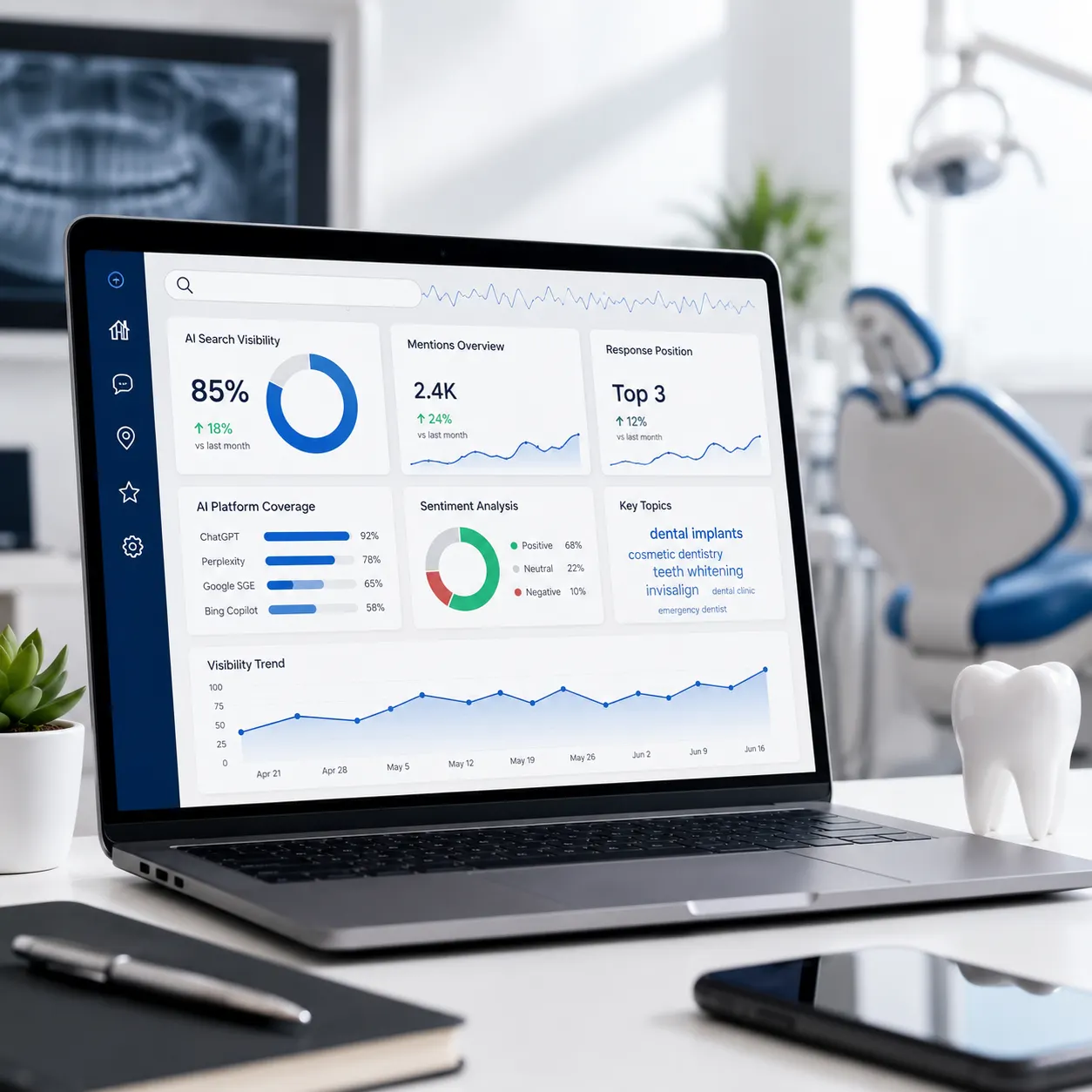
More patients are turning to AI before they choose a dentist, and that number is only growing. They ask ChatGPT who offers the best dental implants nearby. They ask Google's AI Mode which Invisalign provider has the strongest reviews. They ask Perplexity which cosmetic dentist they can trust. If your practice isn't being mentioned in those answers, you're invisible to a growing share of potential patients, even if your website ranks on the first page of Google.
AI-powered search is changing how patients discover dental practices. As AI search optimization becomes increasingly important, monitoring how your practice appears in AI-generated answers is no longer optional. Traditional SEO tools can tell you where your website ranks, but they can't tell you whether ChatGPT recommends your practice, how Perplexity describes your services, or if Google's AI Overviews are mentioning your competitors instead of you. That's exactly why AI search monitoring tools are becoming an essential part of modern dental marketing.
Here, the guide compares the 12 best AI search monitoring tools for dental practices, what each one does best, how much they cost, and which type of practice they're best suited for. By the end, you'll know exactly which platform fits your practice and whether it's worth the investment.
Ranking well on Google used to be the whole game. It still matters, and it isn't going anywhere. But a second layer of search has emerged alongside it, and it follows a completely different set of rules.
When a patient asks ChatGPT, Perplexity, Gemini, or Google's AI Overviews a question, they don't get ten blue links to browse through. Instead, they receive a direct, written answer that often recommends specific dental practices by name, using information pulled from reviews, local business profiles, and website content.
The challenge for dental practices is simple. Ranking highly on Google is no longer enough if your practice isn't appearing in AI-generated answers. This shift is closely tied to Answer Engine Optimization, which focuses on helping AI assistants reference your practice in their responses. A practice can rank at the top of Google's local results and still never be mentioned when someone asks an AI assistant the exact same question in a more conversational way.
That gap between being visible on Google and invisible in AI search is already costing many practices potential new patients, often without anyone on the team even realising it's happening.
AI search monitoring is the process of checking whether AI tools mention your dental practice when patients ask them relevant questions and, if they do, what exactly they're saying about you.
It also helps to understand a few terms that are often used interchangeably:
A simple example makes the difference clear. Your website might rank #3 on Google for "pediatric dentist Columbus, Ohio." That's traditional SEO. Now imagine a parent asks ChatGPT, "Which pediatric dentist in Columbus is good with anxious kids?" Your practice might be mentioned, not mentioned at all, or mentioned with outdated information about a dentist who left the practice years ago.
That's what AI visibility and citation tracking measure. They're completely different from traditional SEO rankings, and most dental practices aren't monitoring them yet.
Best for: Practices or agencies already running local SEO through Semrush.
Why it matters for dentists: If your practice's monthly SEO report already comes out of Semrush, the AI Visibility Toolkit adds AI-engine tracking to that same dashboard instead of forcing you to log into a second platform and reconcile two sets of numbers.
Key features: Tracks Google AI Overviews and ChatGPT citations alongside your existing keyword rank tracking, Google Business Profile insights, and local SEO data, all under one login.
Limitations: Weaker as a standalone purchase, because the real value comes from avoiding a second subscription rather than offering best-in-class AI tracking depth.
Verdict: A sensible, low-friction add rather than a reason to switch platforms on its own.
Best for: Larger dental groups or agencies already invested in Ahrefs.
Why it matters for dentists: Ahrefs already has one of the largest keyword and backlink databases in SEO. Brand Radar extends that same engine to show how often your practice gets cited across AI-generated answers, cross-referenced against your existing organic search performance.
Key features: AI citation tracking across Google AI Overviews and other major AI surfaces, benchmarked against your traditional keyword rankings, drawing on Ahrefs's enormous existing index of the web.
Limitations: Pricing (commonly cited from roughly $129/month up into the hundreds depending on plan) is built for agencies managing multiple client sites, not a lean single-practice budget.
Verdict: Excellent if you're already an Ahrefs customer; a harder sell to buy purely standalone for one practice.
Best for: Solo practices and small dental offices on a tight marketing budget.
Why it matters for dentists: This is consistently the most affordable genuine entry point into AI visibility tracking, which matters enormously for a single-location practice that doesn't have a marketing department, just an office manager trying to keep up.
Key features: Daily tracking across Google AI Overviews, ChatGPT, Perplexity, and Copilot; a Brand Visibility Index; and a GEO Audit that reviewers repeatedly call the most useful diagnostic at this price point, since it flags specific structural reasons your site isn't earning citations rather than a vague checklist.
Limitations: The entry Lite tier caps how many prompts (questions) you can track per month, which can feel tight once you want to monitor a full list of insurance- and procedure-specific questions.
Verdict: The single best starting point for a solo or two-doctor practice testing the waters.
Best for: Practices that want clear next steps, not just a dashboard full of numbers.
Why it matters for dentists: A busy office manager doesn't have time to interpret raw visibility data. Peec AI is consistently singled out for going a step further than pure monitoring, telling you specifically what content or structured data to fix.
Key features: Tracks core AI engines at a price point comparable to mid-tier competitors, paired with clearer, more actionable guidance than most tools in its price range.
Limitations: Smaller company and community of reviews than the bigger enterprise names, so support resources are more limited.
Verdict: A strong pick if your priority is "tell me what to do," not just "tell me the score."
Best for: Multi-location dental groups and DSOs.
Why it matters for dentists: A single practice rarely needs this much depth, but a DSO managing visibility across a dozen cities genuinely does. Profound is one of the more established enterprise names in this category, and it shows in both the data depth and the price.
Key features: Tracks visibility and citations across ChatGPT, Perplexity, Claude, Gemini, Copilot, Meta AI, and Google AI Overviews, with share-of-voice views against named competitors and AI crawler analytics showing which AI bots are actually visiting your site.
Limitations: Reviewers consistently note the dashboards can feel overwhelming without a dedicated person managing them, which isn't realistic if your "marketing team" is one office manager between patient calls.
Verdict: Built for scale. Worth it for a DSO; overkill for a solo practice.
Best for: Dental groups with a small but real in-house marketing team.
Why it matters for dentists: If two or three people on your team need regular dashboard access, such as a practice manager and a part-time marketing coordinator, Scrunch's multi-seat pricing model is often a better fit than platforms that charge per individual login.
Key features: Sentiment analysis (is the AI describing your practice positively or neutrally?), prompt sensitivity testing, citation tracking, competitor benchmarking, and SOC 2 Type II security credentials, which matter if your practice is cautious about vendors touching patient-adjacent systems.
Limitations: Entry pricing (around $250/month) is meaningfully higher than true budget options like Otterly or Rankscale.
Verdict: A solid mid-market choice once more than one person needs regular access to the data.
Best for: Lean teams wanting the broadest AI-engine coverage for the least money.
Why it matters for dentists: Rankscale is regularly recognised as one of the most affordable multi-engine AI tracking platforms available. It covers an unusually wide range of AI engines for its price, making it a good option if you want the broadest visibility without paying enterprise-level fees.
Key features: Tracks 17+ AI engines including ChatGPT, Claude, Perplexity, Gemini, Mistral, and Grok, with page-level citation tracking (showing exactly which URLs on your site are being referenced), sentiment tracking, competitor benchmarking, and a credit-based system that lets you flex usage up or down.
Limitations: Export functionality is restricted on the lower-priced plans, and it tracks output visibility only (what shows up in AI answers) rather than actual AI crawler visits to your site.
Verdict: Arguably the best value-for-coverage ratio on this list, especially for a practice testing AI visibility tracking for the first time.
Best for: Practices ready to actively monitor and act, not just glance at a monthly report.
Why it matters for dentists: Promptwatch's crawler log analysis is a genuinely distinctive feature. It connects what AI bots are actually reading on your site to what shows up in AI-generated answers about you, which is useful diagnostic information if your visibility seems stuck.
Key features: Real-time brand mention tracking across ChatGPT, Claude, Gemini, and Perplexity, citation-level data (including third-party mentions via news, Reddit, and YouTube), daily prompt refresh, and built-in content generation tools.
Limitations: Pricing starts around $95–99/month and climbs relatively quickly as you add tracked prompts, websites, and content generation, which can be a stretch for the smallest practice budgets.
Verdict: Worth it once you're past the "just checking" phase and ready to act consistently on what you find.
Best for: Larger dental groups with dedicated content and SEO teams.
Why it matters for dentists: Conductor has folded AI visibility signals directly into its broader content intelligence workflow. It suits larger dental organisations that already run structured, cross-team content planning rather than publishing occasional blog posts.
Key features: AI visibility signals integrated alongside traditional content workflow tools, technical SEO monitoring, content briefs, and strong cross-team collaboration features that consistently earn high marks for usability among enterprise reviewers.
Limitations: Requires a custom quote and is genuinely built for enterprise scale, so it isn't a good fit for a single practice or a small group.
Verdict: A strong choice for larger dental organisations that already run a mature content operation. It's less relevant for practices below that scale.
Best for: Very large, multi-location dental enterprises with dedicated SEO staff.
Why it matters for dentists: For a Fortune 500-style dental enterprise or a very large DSO, BrightEdge's AI Catalyst module offers some of the deepest tracking available for Google AI Overview appearances, which is valuable given how much dental-related AI Overview volume now exists.
Key features: AI Catalyst tracks brand visibility and citation presence across six or more generative platforms, including Google AI Overviews, ChatGPT, Claude, and Perplexity. It also provides AI Agent Insights showing which AI systems visit your site and where they stop.
Limitations: Enterprise only, with custom pricing that commonly starts in the tens of thousands of dollars annually. It also comes with a steep learning curve and typically requires a dedicated customer success team to get the most value from the platform.
Verdict: Best suited to the largest dental enterprises with the budget and internal resources to support it. It's not a realistic option for the vast majority of dental practices.
Best for: Dental groups running active PR or reputation management programs.
Why it matters for dentists: Most dental practices don't need this, but a larger group actively managing press relationships, community reputation campaigns, or crisis communications will find real value in Meltwater's ability to tie AI mentions back to the specific journalists and sources the AI is citing.
Key features: GenAI Lens monitors brand mentions and sentiment across ChatGPT, Gemini, Claude, Perplexity, Grok, and DeepSeek, and integrates with Meltwater's journalist database to help you reach out to the sources shaping what AI says about you.
Limitations: This is fundamentally a PR and media intelligence platform that has added AI tracking, not a dental- or local-business-first tool, and pricing is enterprise/custom.
Verdict: Best suited to dental organisations already investing in PR. Most solo and small group practices will find more practical value in platforms built specifically for reputation management and AI search visibility.
Best for: In-house marketers who both track visibility and produce their own content.
Why it matters for dentists: Quattr's biggest strength is closing the loop between identifying an AI visibility gap and helping you fix it. That's especially valuable if someone on your team regularly writes blog posts, service pages, or FAQs and wants one platform to both highlight opportunities and create content around them.
Key features: An AI Visibility Dashboard tracking citation rates, share of voice, and sentiment across major AI engines, content gap detection linked directly to Google Search Console data, and built-in tools to help draft and publish content that addresses those gaps.
Limitations: It's more of a general AI SEO platform than a dental-specific tool, so features like keyword research and internal linking automation may go beyond what many dental practices actually need.
Verdict: A strong choice for practices with dedicated in-house content resources. It's less useful if no one on your team is regularly creating content.
What is AI search monitoring for dental practices?
It's the process of tracking whether, and how, AI tools like ChatGPT, Perplexity, Gemini, and Google's AI Overviews mention your dental practice when patients ask relevant questions, so you can see and improve your visibility in AI-generated answers.
Why do dentists need AI visibility tools?
Because a growing share of patients now ask AI chatbots for dentist recommendations directly, and traditional Google Analytics or rank-tracking tools don't show you what these AI platforms are saying about your practice, or whether they're mentioning you at all.
Which AI search monitoring tool is best for small practices?
Otterly AI and Rankscale are generally the most accessible starting points for a solo or small dental practice, offering real multi-engine tracking at the lowest published price points in the category.
Can AI tools help my dental practice get cited in Google AI Overviews?
Monitoring tools themselves don't directly cause a citation, but they show you where you currently stand and what's missing, so you can take action. Improving schema markup, keeping reviews fresh, and creating direct answer content are some of the changes most likely to increase citation rates over time. Understanding Google AI Overviews can help you prioritize the optimizations that influence AI-generated recommendations.
Are AI search monitoring tools worth it for dentists?
For most practices, yes, at least at the entry-level price points, simply because the alternative is having no visibility at all into a rapidly growing patient discovery channel. The value scales with how consistently your team acts on the findings.
What is the difference between AI visibility and SEO ranking?
SEO ranking measures where your website lands in traditional search results. AI visibility measures whether an AI model actively names and recommends your specific practice inside a generated answer, a related but distinct thing, since AI models often draw from a different mix of sources than pure web rankings.
How can a dental practice improve AI search visibility?
Start with the fundamentals: accurate and detailed Google Business Profile information, clear and specific insurance information on your website, structured data (schema markup), recent reviews, and content written in a direct-answer, FAQ style that mirrors how patients actually phrase questions to AI tools. Following a comprehensive Generative Engine Optimization guide can further strengthen your visibility across AI-powered search platforms.
Do AI search monitoring tools help with local SEO?
Indirectly, yes. Several of the tools above (Semrush AI Visibility Toolkit, Ahrefs Brand Radar, SE Ranking) are built directly on top of existing local SEO platforms, so improving your AI visibility and your traditional local search visibility tend to move together rather than requiring two separate strategies.
Get in touch with our healthcare marketing expert