

You only pay what you spend on your Google Ads, no commission or hidden charges
Competitive analysis is one of the most overlooked parts of dental SEO. Many practices spend months publishing blogs, updating service pages, and optimizing their website, yet never stop to ask a simple question: what are competing dental practices ranking for that we're not? Without that insight, it's difficult to compete consistently in Google Search, no matter how much content you publish.
When your dental website ranks for the right treatment and local keywords, it puts you in front of patients who are actively looking for care right now. Learning how to improve your dental SEO rankings can help you increase visibility for the searches that drive new patient appointments. Those are the searches that turn into appointment requests, new patients, and real, sustainable practice growth. But when a competing practice ranks for a valuable keyword your site doesn't touch, they're picking up the very patients who could have booked with you instead.
That's exactly the problem a dental content gap analysis solves. It shows you the keywords competitors already rank for that you're missing, surfaces the treatment topics and patient questions people are actively typing into Google, and points out the holes in your existing content before they cost you another new patient. Close those gaps, and you'll see stronger search visibility, a sharper competitive position, and a website that shows up wherever people in your area are searching for a dentist.
Fortunately, most content gaps are fixable once you know where to look. Here are some essential considerations for finding and closing those gaps with a dental content gap analysis.
A dental content gap analysis is the process of finding the treatments, topics, and patient questions your website doesn't cover or could cover better to improve your visibility in search results. Simply put, it helps close the gap between the content your website already ranks for and the content your potential patients are actively searching for.
You start by reviewing your existing website and comparing it with competing dental practices in your area. First, you'll identify the treatment pages, keywords, and topics your competitors rank for that your website doesn't. Next, you'll uncover patient questions and search intent you're currently missing, from someone researching Invisalign to a patient looking for an emergency dentist nearby. Finally, you'll review your own pages that aren't performing well and identify ways to improve them so they have a better chance of competing in search results and attracting more qualified patients.
These terms often get used interchangeably, and it's easy to see why. They all help you understand how your practice compares with competing dental websites. However, each one answers a slightly different question. Knowing the difference helps you focus on the right strategy instead of chasing the wrong metrics.
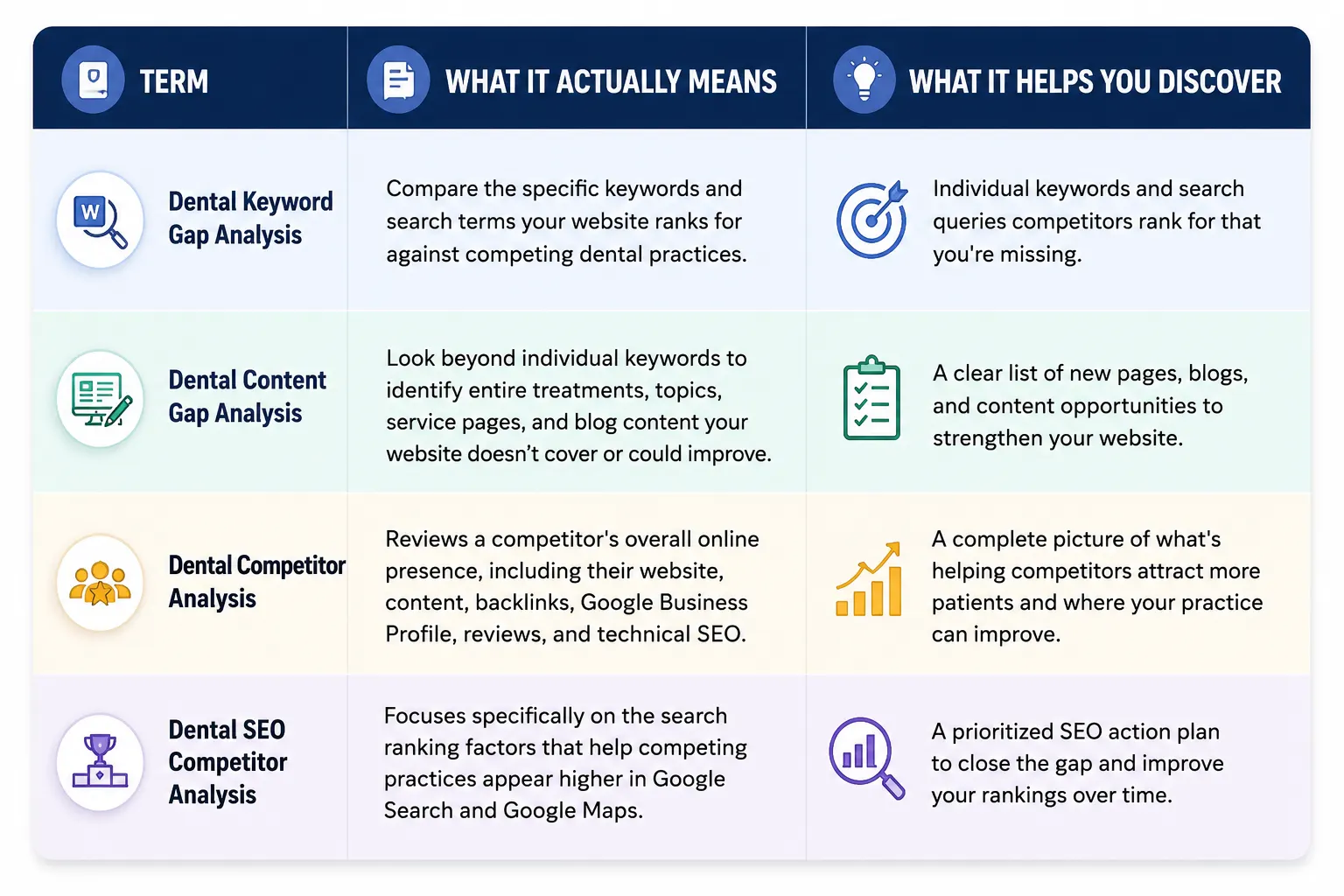
This is where many dental practices get it wrong before they even begin. They assume their competitors are the practice across town or the one they hear about at local meetings.
Google sees it differently. Your real competitors are the dental practices that consistently rank for the searches your future patients are making.
How to find your real SEO competitors
Practical tip: Don't ignore directory sites like Healthgrades, WebMD, Yelp, and Zocdoc. While you may not outrank them directly, the treatments and patient questions they cover can reveal valuable content opportunities for your own website.
You don't need an expensive SEO stack to find content gaps. One good tool is usually enough to uncover hundreds of keyword opportunities.
Here are the most popular options:
Free tools worth using
Compare your website with your competitors to find the keywords they rank for that you don't. Focus on three things: search volume (how many people search for it), keyword difficulty (how competitive it is), and search intent (whether patients are looking for information or ready to book).
As you review the results, group your keywords into categories such as:
Practical tip: Before prioritizing keywords, conduct effective keyword research to identify high-value opportunities. Then focus on keywords with strong search intent, realistic keyword difficulty, and enough search volume to drive qualified patients to your practice.
Before you go hunting for what's missing, it's worth knowing exactly what you already have and how well it's performing. A simple content audit in a spreadsheet gives you a clear baseline before you begin your content gap analysis.
For every page on your website, track:
This step matters because a content gap analysis isn't only about finding pages that don't exist yet. Sometimes the biggest opportunity is a page you already have that's underperforming. As you review your content, look for pages with low rankings, declining organic traffic, or outdated information. Improving an existing page is often faster and more effective than creating a brand-new one.
Practical tip: Flag pages ranking on page two or lower, or pages that haven't been updated in the last 12 to 18 months. These should be your first priorities before investing time in creating new content.
After reviewing your existing content, the next step is to understand how patients search for a dentist before choosing one. Every patient moves through stages, and their questions change the closer they get to booking.
The best way to pick up on this? Ask your own patients. Talk to your front desk team, skim consultation notes, read your Google reviews, and notice the questions patients ask on calls and during visits. These real conversations often reveal keyword gold that research tools miss.
Patients tend to search in three stages:
These questions point you toward fresh content ideas, high-intent keywords, and content that actually matches what patients are searching for.
Finding content gaps is only half the job. The next step is deciding which ones deserve your attention first. You don't need to create dozens of new pages overnight. Focus on the opportunities that are most likely to improve your rankings and bring in new patients.
As you prioritize, consider:
Once you've identified your highest-priority topics, organize them into a simple content roadmap. Decide which pages need updating, which new pages should be created first, and schedule everything in your content calendar. A clear roadmap keeps your SEO strategy focused and makes publishing much easier over time.
Before you start looking for content gaps, it helps to understand why your competitors are ranking higher in the first place. In most cases, it comes down to a handful of repeatable factors, not luck, not a bigger budget, and usually not better dentistry.
Competitors that rank well almost always have a dedicated, detailed page for each treatment instead of one page listing multiple services. A strong implant page explains the procedure, timeline, costs, recovery, and answers common patient questions instead of simply mentioning the keyword.
Ranking for searches like "[city] dentist" or "[neighborhood] dental implants" usually means the website clearly and naturally mentions those locations throughout the page, including the title, headings, and content.
Winning websites connect related pages together. The homepage links to service pages, service pages link to relevant blogs, and blog posts link back to the services they support. Taking time to build a stronger internal linking structure helps both Google and patients understand which pages matter most. This helps both Google and patients understand which pages matter most.
Adding real patient questions and clear answers to your service pages helps you rank for more long-tail searches. It also creates the type of content that Google and AI-powered search engines often use in their answers.
A steady flow of recent Google reviews, a fully optimized Google Business Profile, and consistent business information across the web all strengthen your local visibility. These signals don't replace great content, but they help it perform better.
This is often the biggest advantage. Pages that match your content to search intent by answering exactly what patients are looking for, whether it's pricing, recovery, treatment comparisons, or common concerns, consistently perform better than pages that simply include the target keyword.
Get in touch with our healthcare marketing expert