

You only pay what you spend on your Google Ads, no commission or hidden charges
A dental marketing retainer can be the foundation of a practice’s long-term growth. It gives your agency the time to understand your practice, your patients, your competitors, and what actually brings new patients through the door. But getting the retainer right is where many dental practices struggle. Pay too little, and you may end up with a limited scope and little room for strategy. Pay too much, and you may be spending heavily without knowing what you are getting in return.
This guide breaks down what a dental marketing retainer should cover, what you should expect each month, how pricing typically works in Singapore, and the key terms to look at before signing an agreement.
A dental marketing retainer is a monthly agreement where an agency delivers an agreed scope of marketing or SEO work for a fixed fee on an ongoing basis. It is different from a one-off project, such as a website redesign, a single ad campaign, or a technical SEO audit, which has a defined scope and end point.
Retainers for dental practices in Singapore typically fall into one of three models:
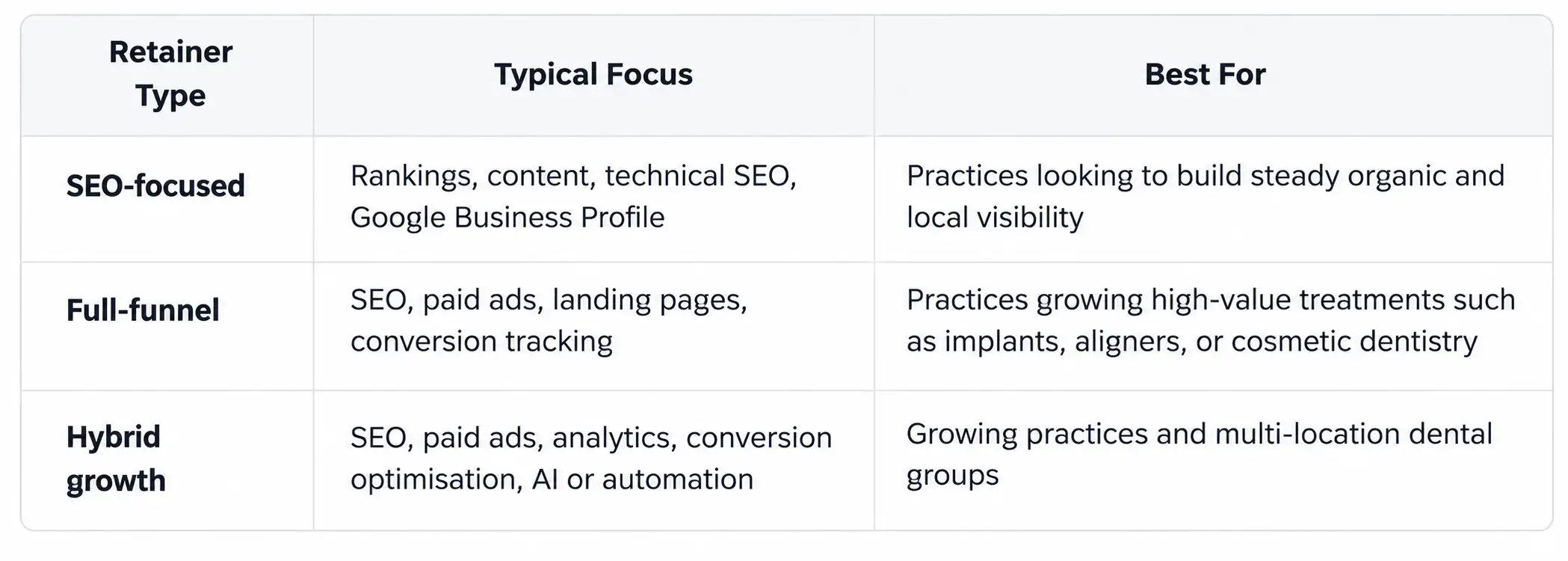
None of these models is automatically better than the others. The right fit depends on your goals, budget, treatment focus, and how competitive your market is. A general practice looking for steady local visibility may not need a full-funnel retainer. A clinic competing for high-value implant or aligner patients may need paid campaigns alongside SEO to support growth.
A dental marketing retainer is more than a monthly marketing bill. For a Singapore dental practice, it can cover everything from local search and Google Maps visibility to content, paid campaigns, social media, and patient inquiries. The tricky part is knowing what your practice actually needs and what should be included in the monthly fee.
Two agencies can charge a similar amount and still deliver very different work. One may focus heavily on rankings, while another may put more time into paid campaigns, content, reporting, or converting inquiries into appointments.
Before you sign a retainer, it helps to know what you are paying for, what your agency should be doing each month, and where the scope of work can make a real difference to your practice.
Singapore’s dental market is competitive, so a retainer should do more than keep your website busy. It should cover the channels that help patients discover your practice, build confidence, and take the next step.
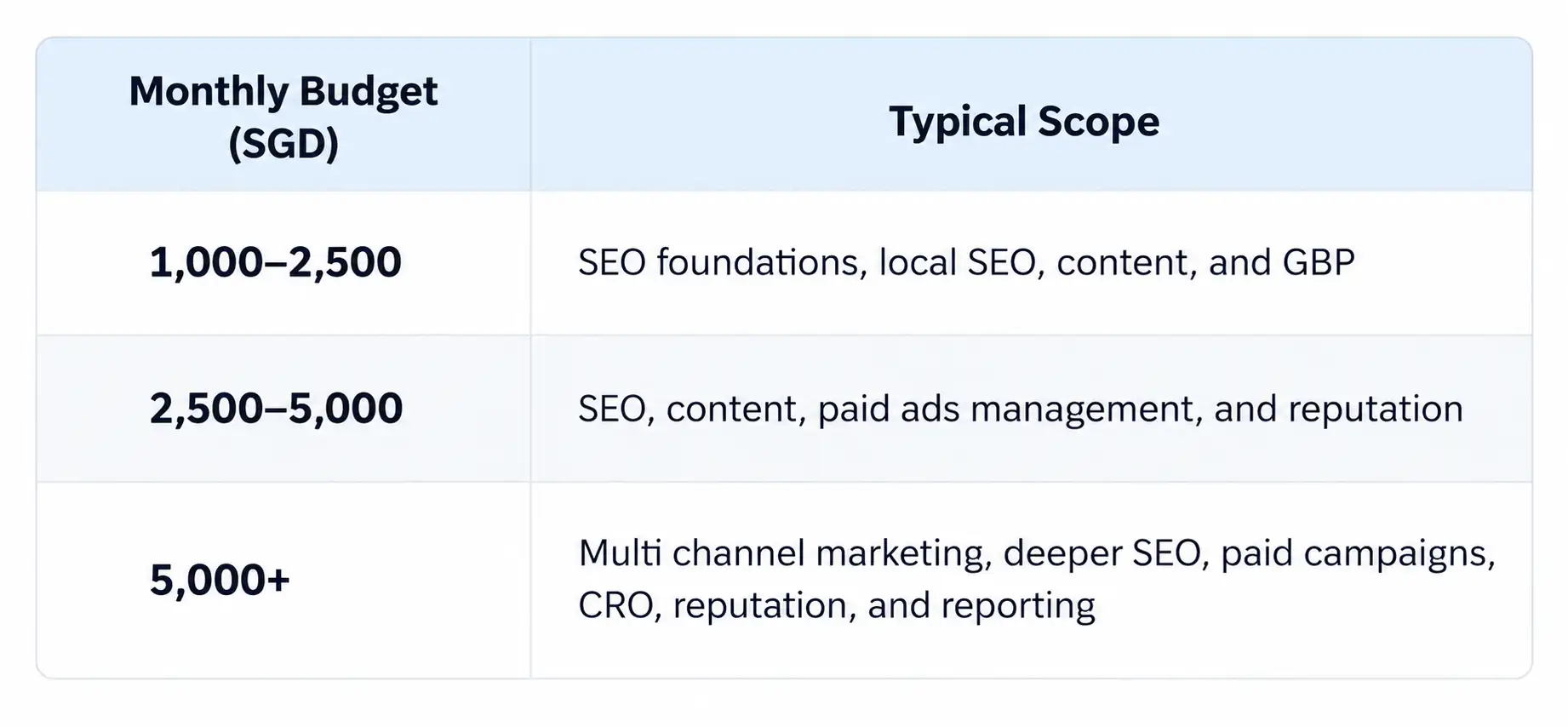
Google and Meta ad spend is generally separate from the agency’s management fee, so check that both figures are clearly stated in your proposal.
One more thing to ask your dental marketing agency about is AI search visibility. Patients in Singapore are increasingly using tools such as ChatGPT and Google’s AI Overviews when researching treatments and dental clinics. Your agency should have a clear view of how your practice can stay visible as patients move beyond traditional Google results.
If your monthly report cannot help you answer “Did we get more patients?" it needs a closer look, no matter how polished it looks.
A useful dental marketing report should go beyond organic traffic and rankings. It should show calls, form inquiries, WhatsApp inquiries, and booked consultations, with performance broken down by channel, landing page, and key treatments such as implants, Invisalign, or emergency dentistry. It should also explain what changed, what worked, what needs attention, and what the agency plans to do next.
Before signing a dental marketing contract, make sure you know exactly what you are committing to, what you own, and how you can leave if the partnership is no longer working for your practice.
Singapore has its own rules for healthcare advertising, and the dental marketing agency you choose needs to know them clearly. The Healthcare Services Act (HCSA) sets requirements around healthcare advertising, including claims, testimonials, and endorsements. The agency should know what is allowed, what needs care, and how to apply the rules to your clinic’s marketing. It is still worth checking the latest Ministry of Health guidance yourself.
Local knowledge matters just as much. Patients in Singapore might search for “dental implant cost Singapore,” “CHAS dental clinic,” or “dentist near [MRT station].” These are very different from the broad searches you might see in another market, so it's worth reviewing how local SEO for dentists works specifically in Singapore before agreeing to a scope of work. Your content should sound like it was written for patients here, not copied from a generic dental template.
Don't rely only on testimonials published on an agency’s own website. Ask for proof you can actually check.
What to request: Case studies that show where a practice started, what the agency did, and what changed. Look for results in patient terms, such as new calls, consultations, and cases, rather than just ranking screenshots. Ask if you can speak to a current dental client with a similar practice size or specialty. Independent reviews on platforms such as Clutch, Google Reviews, or LinkedIn can also give you a broader picture.
Practical checks you can run yourself: Search the agency’s name alongside “review” or “scam.” Check the clients they mention and see how their websites and local search presence look. You can also ask to see a live dashboard or sample report, with sensitive information removed if needed, to see how deeply they actually track results.
Some agencies sell you a call with a senior strategist and then quietly hand your account off to junior staff or freelancers with little to no dental experience. You deserve clarity on exactly who is doing the work and how you'll communicate with them.
What to clarify: who your main point of contact will be; who specifically handles strategy, content writing, technical SEO, and link building or outreach; how often you'll have check-in calls (a monthly strategy call plus ad hoc support is a reasonable baseline); and what their typical response time looks like over email or WhatsApp.
Good signs: named team members with relevant dental or healthcare marketing experience in the Singapore market; a clear, repeatable process: audit, then roadmap, then monthly sprints, then review; genuine willingness to jump on a quick call when something urgent comes up, like the site going down or tracking breaking.
Red flags: unclear answers like “our team will handle it” with no names attached; no clear process or roadmap to speak of; slow or inconsistent communication during the sales process itself, because it rarely improves after you've signed.
Get in touch with our healthcare marketing expert