

You only pay what you spend on your Google Ads, no commission or hidden charges



A dental website redesign rarely starts because a practice wants a better looking website. It usually starts because something feels stuck. Fewer enquiries than expected. Patients dropping off before booking. Competitors appearing more established online. Or simply the feeling that the website no longer reflects the quality of care being delivered inside the practice.
Think about how patients choose today. Someone searches for treatment options on their phone, opens three or four practices, and within minutes starts forming opinions. Before they speak to your reception team or meet your clinicians, they are already deciding whether your practice feels trustworthy, modern, and worth contacting.
That is why redesigning a dental website is not simply a visual update. Many practices first realise they need a redesign after experiencing why dental websites fail to convert. Done well, it can improve patient trust, increase appointment enquiries, create a smoother booking experience, and support long term practice growth.
The difficult part is understanding what is actually included in the cost.
One proposal may cover design alone. Another may include content, photography, search visibility improvements, booking functionality, compliance requirements, and technical setup.
This guide breaks down what dental practices in London are typically paying for and helps you understand where the investment goes before making any decisions.
If you asked five agencies for a quote today, chances are you would get five completely different numbers. One might quote a few hundred pounds. Another might come back with five figures.
So what does a dental website redesign actually cost in London, and why is there such a wide gap?
Based on current UK market pricing, practices can expect to invest anywhere from around £500 for a simple template-based refresh to £10,000+ for a fully bespoke website with custom design, content, booking functionality, and growth-focused features.
For London practices, costs often sit higher than the UK average because of stronger local competition, higher patient acquisition values, and greater expectations around patient experience.
The real difference is rarely the website itself. It is everything included behind it.
Here is a simple breakdown of the main pricing tiers and what each one typically covers:
For dental practices taking their first step online or keeping a close eye on costs, this is often the simplest way to get a foot in the door. It focuses on getting your practice live with the essentials in place rather than building a website designed for long-term patient acquisition.
What you typically get:
Who it suits:
Brand new associate dentists or small practices looking to launch quickly on a tighter budget. If competition is relatively low and the goal is simply to establish an online presence, this can work as a short-term starting point.
The honest warning:
In London, this level of website rarely creates meaningful patient growth through organic search alone. Competition is simply too established. A template website in areas such as Hackney or Chelsea can struggle to gain visibility unless supported by stronger SEO and digital growth activity later on.
This is where most established London dental practices tend to invest and, for many, it is the point where a website starts behaving less like a brochure and more like part of the business.
You are no longer paying simply to look professional. You are investing in a website built to reflect your practice properly, support patient enquiries, and remove barriers between interest and booking.
For practices that want to compete locally without stepping into enterprise-level budgets, this is often where the best balance sits between investment and impact.
What you typically get:
Realistic cost breakdown at this tier (London pricing):
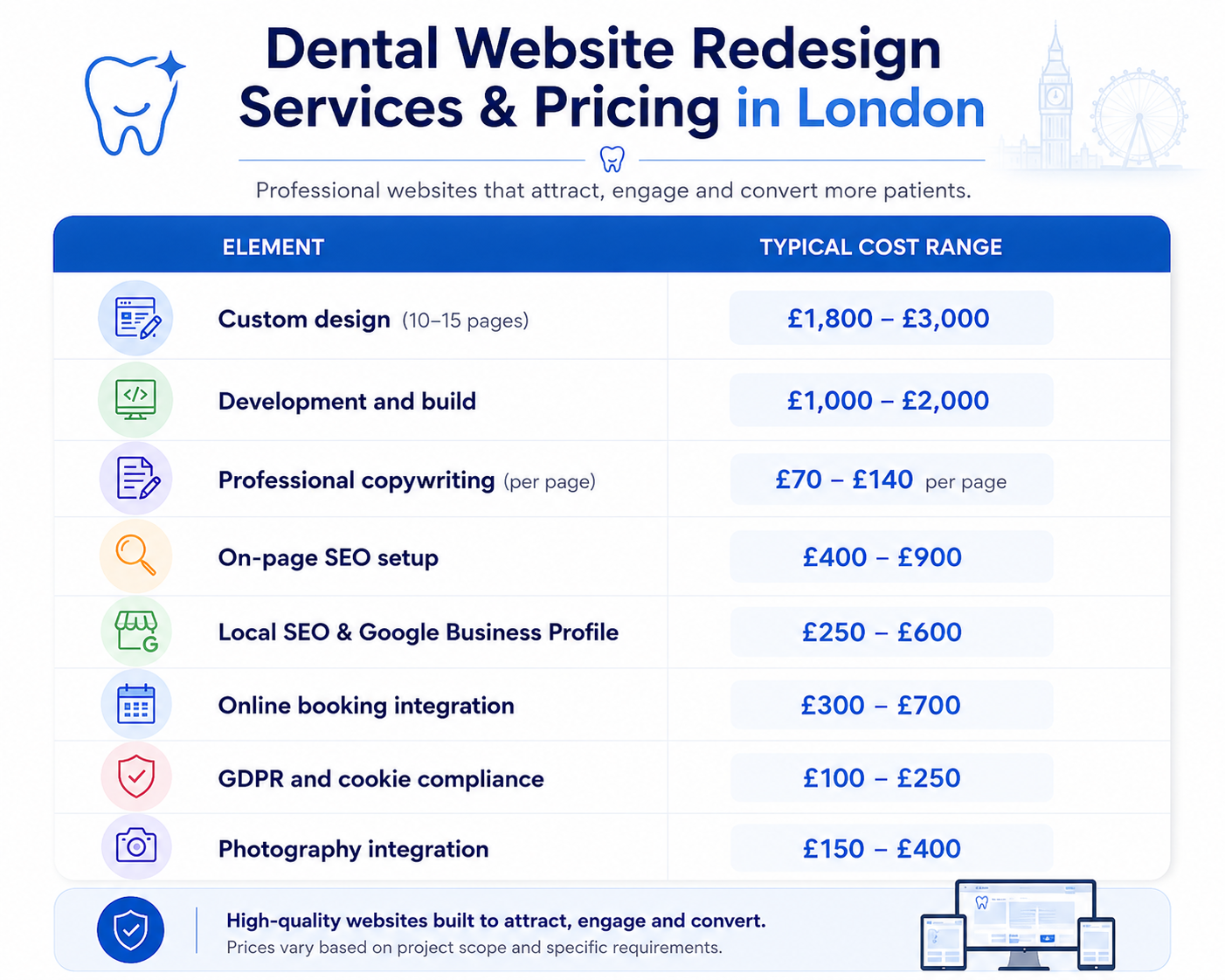
Total estimate: £2,500 – £6,000 for a London practice at this tier
Who it suits: Established practices wanting consistent new patient enquiries from Google, or practices that know their current site isn't working and want something that actually performs.
Being an established dental practice owner in London, you may get to a stage where you want your website to pull in the same direction as the level of care your practice already delivers or keep pace with where patient expectations and the market are heading. If your current website feels behind the curve while your practice is moving ahead, this redesign package is usually where things start to line up.
These websites are typically built for practices operating at the sharper end of the market such as premium cosmetic clinics, multi-location groups, specialist providers, and practices where one additional patient can represent several thousand pounds in production.
What you typically get:
Who it suits: Large private or cosmetic practices, multi-location groups, and any practice seriously targeting high-value treatments where each patient is worth thousands of pounds.
What Ongoing Costs Should You Expect After Your Dental Website Goes Live?
This is the part many dental practices underestimate.
Website proposals often focus on launch costs but say very little about what happens afterwards. The reality is that a website is not a one-off investment. It needs to be maintained, protected, and improved over time if you expect it to keep performing.
Once it is live, there are ongoing costs that keep everything secure, visible, and working properly.
Domain Name (£10 to £40 per year)
Your .co.uk or .dental domain needs renewing annually. Make sure you own it, not your agency.
Hosting (£50 to £300+ per year)
Hosting is where your website lives online. For a single London dental practice, managed WordPress hosting typically runs £50–£120 per year. Larger websites with more traffic, booking functionality, or additional integrations may require higher specification hosting.
Before signing, ask whether hosting is shared or dedicated. Faster hosting supports better patient experience and can influence search performance.
Website Maintenance (£50 to £200 per month)
Websites need ongoing care. Following a proper website maintenance plan helps keep your site secure, fast, and performing well. Maintenance usually includes security updates, plugin management, backups, technical fixes, and monitoring performance.
Some agencies include this within monthly retainers. Others separate it out. Either way, it should be part of your annual budget planning.
SSL Certificate (£0 to £100 per year)
This creates the secure padlock patients see in their browser.
Most reputable hosting providers now include SSL as standard, but it is worth confirming. For healthcare providers, trust and security signals matter.
SEO Retainer (£500 to £3,000+ per month)
Launching a website and expecting patients to appear rarely works in London. Search visibility in competitive areas often requires ongoing optimisation, content improvements, technical updates, and local search strategy.
London practices typically pay more for SEO than regional practices because competition is stronger and patient values are often higher.
As a simple example, if a practice invests £1,500 per month and consistently attracts new patients through search, acquisition costs can become highly efficient compared with paid channels over time.
The major purpose behind the whole investment is to create a website that works continuously for your practice by bringing in opportunities, supporting patient acquisition, and delivering long-term growth.
Your website is legally considered a form of advertising by the General Dental Council. That means it must comply with GDC's Principles of Ethical Advertising, and failure to do so can result in a fitness to practise investigation. Understanding GDC advertising compliance helps reduce the risk of regulatory issues.
Here's what the GDC requires to appear on your dental practice website:
For the practice:
For every dental professional mentioned on the site:
For CQC-registered practices in England:
Advertising standards:
GDPR:
When choosing the right web design partner, ask them directly: "Have you built dental websites before, and do you understand GDC advertising compliance?" If they look blank, move on. A non-compliant website can cause regulatory problems that cost far more than the website itself.
Our healthcare marketing expert will get in touch with you

.gif)