
You only pay what you spend on your Google Ads, no commission or hidden charges
Google Ads is an online advertising platform that allows businesses to advertise on the Google Network, including Google search, YouTube, and websites using Google Adsense. For dentists, Google Ads can help them reach their target patients, increase visibility, and grow their practice. However, it's vital to operate Google Ads strategically to ensure that campaigns are cost-effective and deliver the desired results.
Google Ads is an effective tool for growing dental practices because it allows us to reach the relevant people actively searching for dental services. When a patient searches for their need using a keyword or phrase such as "dentist near me" or "emergency dentist near me," you can show your Ad above the search results. And if your Ad is relevant to the patients' search query and is compelling, it's more likely to entice them to click on your Ad and go to your landing page or website. Further, if your landing page or website can convince the patients, they will book an appointment with you.
Google ads for dentists, especially the pay-per-click (PPC) advertising model, are highly effective in attracting more patients. Here are some of the key benefits:
Cost-Effective
PPC or pay-per-click simply implies that advertisers need to pay only when someone clicks on their Ad, no matter how many patients see your Ad. Compared to other formats of advertising, this is highly cost-effective.
Increased Visibility
As dentists can advertise above Google search results for target keywords, their visibility is instantly increased to a large volume of prospective patients, leading to more clicks and appointment bookings.
Instant Results
Google Ads brings instant results as the patients search for the treatments or services they need at that time, which means they are highly likely to make their choice fast and book an appointment. Other forms of advertising can take longer to bring results, as all the people watching the Ad may not necessarily need the treatments at that moment; they may consider as and when they need those treatments in the future.
Targeted Advertising
Dentists can show their ads to a custom patient audience, filtered on a vast range of factors such as geographic location, age, gender, search intent, and much more. It helps dentists further reduce their ad spend and increase the ROI.
Measurable Results
Analytics is at the core of Google Ads. Dentists can analyze their ad performance in depth using metrics like click-through rates (CTR), conversion rates, cost-per-click (CPC), and more. By gaining insights from these metrics, dentists can optimize their ad campaigns, reduce unnecessary spending, including CPC, and increase their ROI.
Flexibility
Google Ads is a highly flexible platform. Based on the performance analysis, dentists can make required changes or optimizations in real time. Making changes to ads, targeting, or budgets optimizes its performance instantly.
Here's the step-by-step process that dentists can follow to grow their practice using Google Ads:
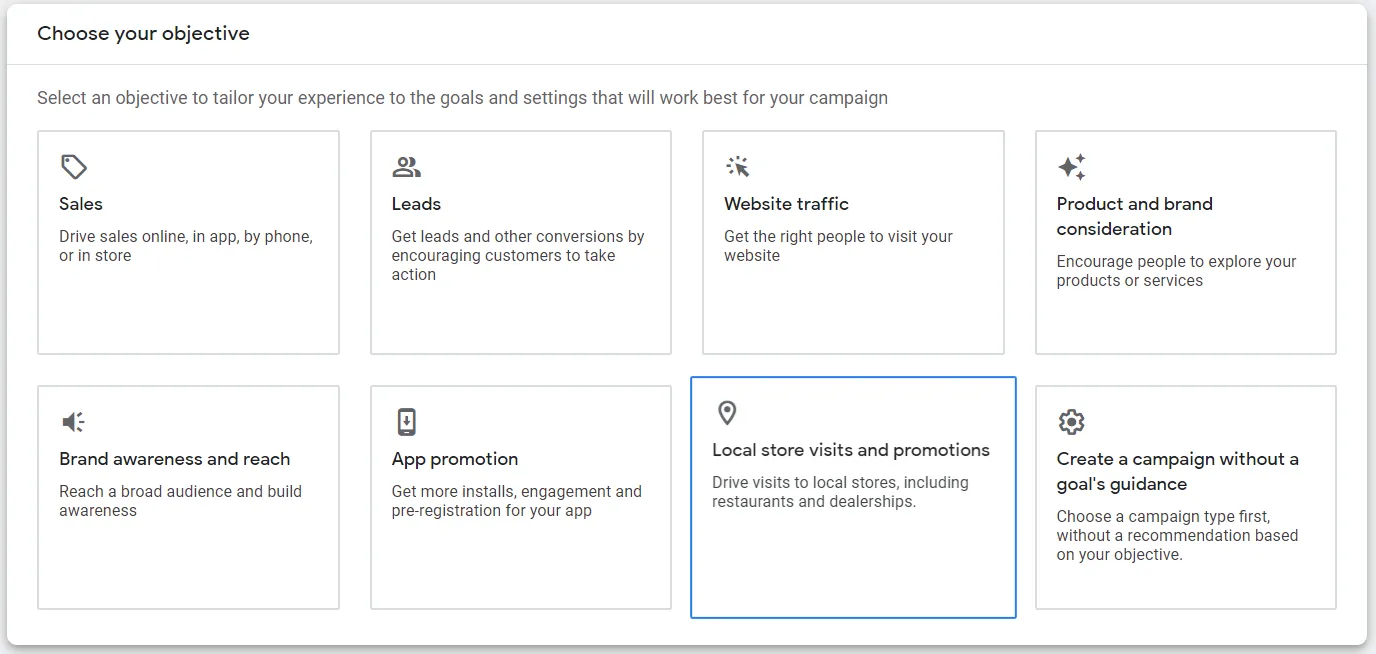
To begin with, dentists need to figure out the goals or objectives they want to achieve from Google Ads. Various types of campaigns in Google Ads can be leveraged to achieve different goals. Think about what's important for your practice growth. What outcome do you want to achieve? Do you want to spread awareness about your brand? Or do you want to attract patients looking for specific treatments? Or do you want to promote a special limited-time offer you are running at your clinic? You can create a focused and effective campaign by defining your goal clearly.
If you use Google Ads for the first time, you must register or sign up and create your account. Once you've set up your account, you can create campaigns based on your goal or objective, as shown in the image below:
Then, you can select the suitable campaign type for your dental practice, as shown in the image below:
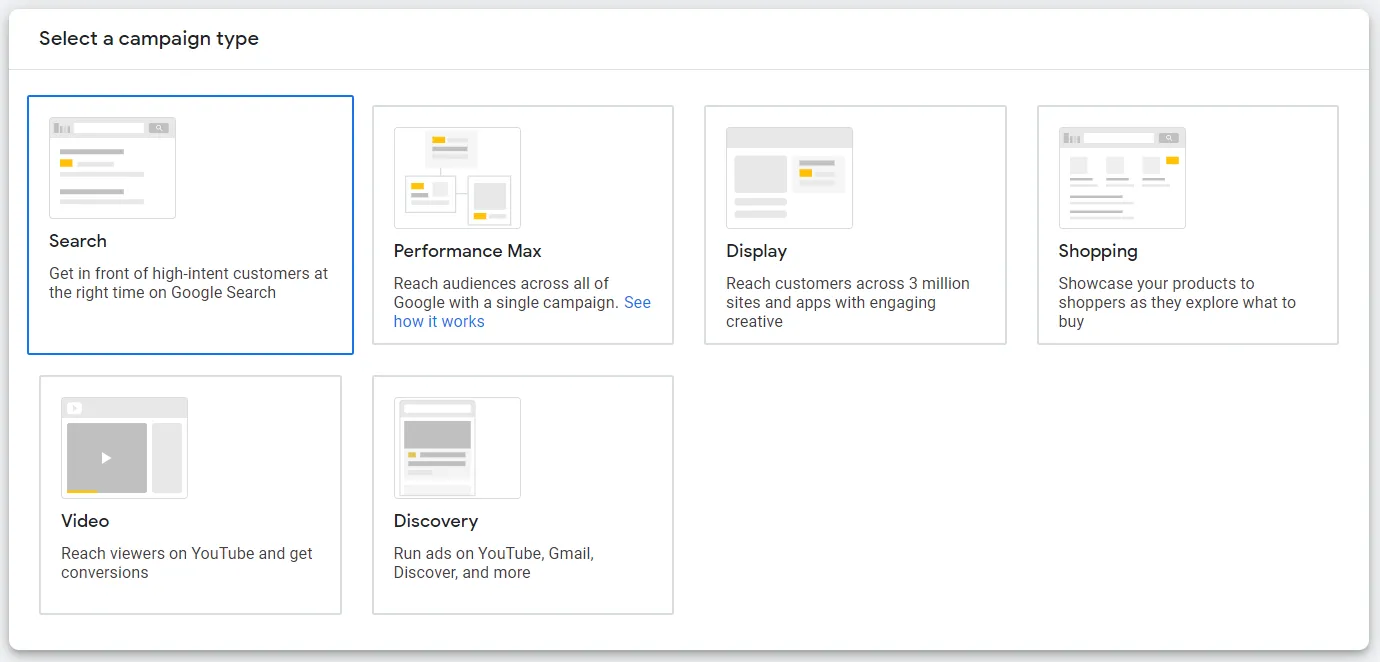
In further steps, you can specify your advertising goals, targeting options, ad formats, max CPC, daily budget, and much more.
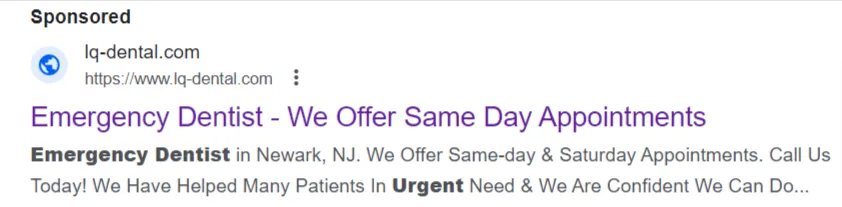
The next critical step is choosing the right keywords. Keywords are the search terms or phrases that trigger your ads to appear above the Google search results. An example is shown below:
You need to identify what your target patients will search on Google for treatments and services relevant to your dental practice. Start by brainstorming and making a list of keywords relevant to your services. Then, use the Google Keyword Planner tool to find the related keywords people are searching for in your location.
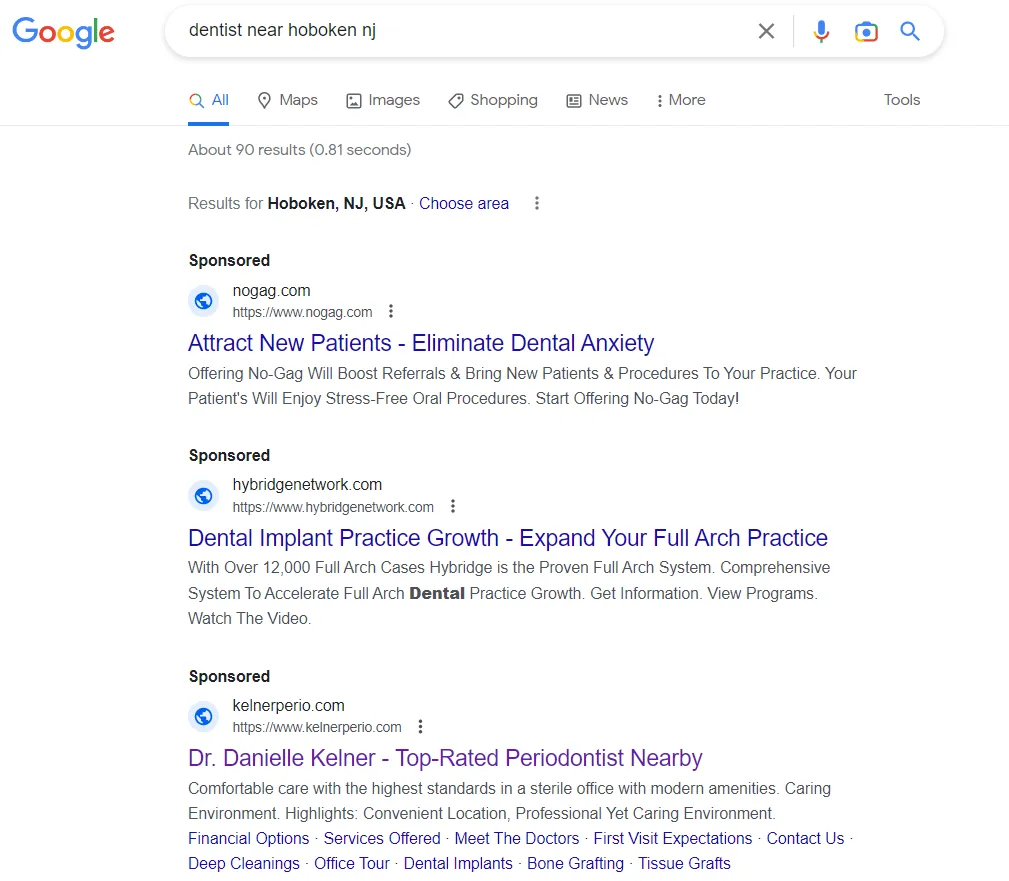
When choosing keywords, consider the search volume, competition, and relevance to your services. Dental practices can bifurcate keywords based on treatments or services in different ad groups for the best results. You can also get keyword suggestions while creating the Ad group and find keywords by scanning a website or checking what's working for similar treatments or services.
Once you've selected your keywords, it's time to create your ad copy, but first, you must thoroughly understand Google's ad policies and guidelines. Your ad copy should be concise, engaging, and persuasive, highlighting the unique benefits of your dental services. It's also important to include a strong call to action that encourages potential patients to take action, such as booking an appointment or calling your practice. In search ads, you must specify the landing page URL where you want to take prospective patients. Your ad copy should be relevant to your keywords and landing pages and not make false or misleading claims.

Setting a budget for your Google Ads campaigns is important to ensure you don't overspend. You can set a daily spending limit and the maximum cost-per-click (CPC) bid you are willing to pay. When setting your budget, consider your campaigns' goals and potential ROI. Also, it's important to monitor your campaign's performance metrics regularly and, if required, adjust your daily budget or max CPC to optimize your ROI.
The landing page is a critical step in your patients' journey towards booking an appointment with your dental practice. When patients click on your Google Ad, they are taken to your landing page on your website. Your prospective patients browse through your website and decide whether to book an appointment or to look for other dental practices.
Optimizing your landing page for conversions is important to achieve higher appointment bookings. The landing page should be easy to navigate, informative, and persuasive. It should also have a clear call-to-action (CTA) that tells patients how to book an appointment or contact the dental practice.
Finally, regular performance tracking and optimization are key to a successful ad campaign. Google Ads provides a range of performance metrics, including clicks, impressions, click-through rate (CTR), conversion rate (CVR), and cost per conversion. For example, if certain keywords generate a low CTR or high cost per conversion, you may need to tweak your ad copy, targeting, or bidding strategy.
Overall, Google Ads is an effective marketing tool; using it wisely can help dentists attract more patients to their practices. Leveraging the learnings from this comprehensive guide, dentists can create effective Google Ads campaigns to reach their ideal patients, drive more appointment bookings and ultimately grow their practices. Further, with strategic planning, testing, and optimization, dentists can maximize their Google Ads ROI and reach new heights of success in the competitive healthcare industry.
The steps above apply across the board, but what you're actually bidding on, and who you're bidding against, shifts a lot by specialty:
Dental Sleep Medicine: This is a smaller, less crowded auction than general dental keywords, but the patient is usually searching out of real discomfort (snoring, sleep apnea symptoms) rather than routine care, so ad copy that speaks to the specific symptom tends to outperform generic "sleep dentistry" phrasing. Sleep apnea and dental sleep medicine marketing covers the patient-education side of this well if you want more on messaging.
Periodontics: Periodontal keywords split between urgent (gum disease, bleeding gums) and elective (dental implants) intent, worth running these as separate ad groups rather than one blended campaign, since the ad copy and landing page that convert an urgent searcher look nothing like what convinces someone comparing implant providers. Periodontist marketing goes further into positioning for this specialty specifically.
Oral & Maxillofacial Surgery: Referral-driven procedures (wisdom teeth, jaw surgery) still get searched independently by patients who want a second opinion on cost or provider before committing, don't assume referral volume means PPC isn't worth it here. Oral surgeon marketing has more on this overlap.
Cosmetic & Emergency Dentistry: These sit at opposite ends of urgency. Cosmetic searches reward strong before/after visuals and a research-friendly landing page, while emergency searches reward speed above everything else: a call-only ad and a same-day-availability message will usually beat a beautifully designed page that takes an extra click to find the phone number.
Everything above is genuinely doable in-house, especially for a single-location practice with the time to check in on campaigns weekly. Where it usually breaks down isn't the setup, it's the ongoing optimization, which is easy to let slide once the initial campaign is live and results look fine.
A few questions worth asking before hiring anyone: How is performance reported, and how often? Is ad spend separate from the management fee, or bundled in a way that's hard to audit? What happens to the account and its historical data if you leave? Be cautious of anyone promising a specific number of new patients per month before seeing your market and current site, that's a guess dressed up as a guarantee. If you'd rather see how Remedo's approach compares directly, this breakdown lays out the difference against a general marketing agency.
Q: Why do my ads show call conversions when patients are actually booking online?
A: Usually a tracking setup issue rather than a real mismatch, call tracking and online booking conversions are configured separately in Google Ads, and it's easy for one to be set up correctly while the other isn't firing right. Worth a direct audit of both conversion actions rather than assuming the traffic itself is behaving strangely; Google's own conversion tracking documentation is the right starting point. If call handling specifically is the harder half to track cleanly, an AI receptionist that logs call outcomes automatically removes a lot of that ambiguity.
Q: How much should a dental practice budget for Google Ads?
A: There's no universal number, it depends on your market's cost-per-click and how many new patients you're trying to add per month, not a flat percentage of revenue. Start with a number you're comfortable testing for 4–6 weeks, and adjust once you can see actual cost-per-booked-patient rather than just cost-per-click.
Q: Should I use Google Ads or Facebook Ads for my practice?
A: Different jobs. Google Ads catches people already searching for a dentist right now, high intent, ready to book. Facebook/Instagram ads are better for building awareness and staying visible to people who aren't actively searching yet. Most practices that do well with paid ads eventually run both, but if it's one or the other to start, Google Ads usually gets a faster read on whether paid traffic converts at all.
Get in touch with our healthcare marketing expert