

You only pay what you spend on your Google Ads, no commission or hidden charges
One of the most consequential decisions a practice owner makes — one that shapes everything from staffing to scheduling to patient relationships — is whether to operate as a fee-for-service dentist or an insurance dentist. And yet, even dentists who've made that choice confidently often market their practice the exact same way, regardless of their model.
That's a costly mistake. A fee-for-service dentist and a dentist that takes insurance are not competing for the same patient with the same message. They're speaking to fundamentally different audiences, with different motivations, different objections, and different decision-making processes. Get your marketing aligned with your model and everything gets easier — new patient acquisition, conversion, retention, and revenue.
This guide breaks down exactly how the marketing playbook differs between the two — and how to execute each one effectively.
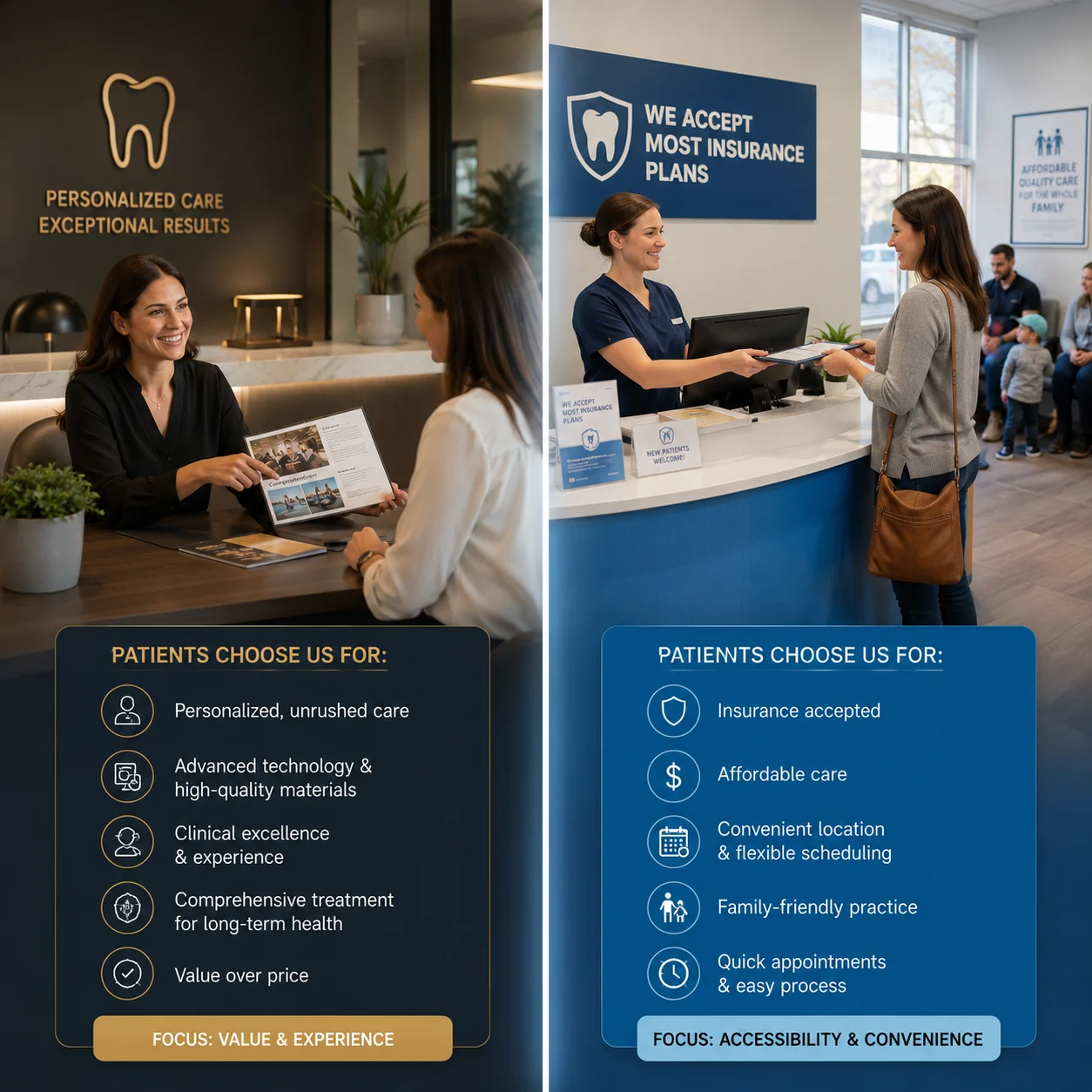
- A fee-for-service dentist markets on value, experience, and clinical outcomes — attracting patients who prioritize quality over cost
- An insurance dentist markets on accessibility, affordability, and convenience — attracting patients who lead with coverage questions
- Fee-for-service marketing relies heavily on brand positioning, education, and premium patient experience signals
- Insurance-based marketing relies on directory visibility, local SEO, volume, and clear communication about accepted plans
- The biggest marketing mistake is using a generic dental marketing strategy that doesn't reflect your practice model
A fee-for-service dentist is a practice that does not participate in insurance networks and charges patients directly for services at full, uncontracted rates. Patients may still submit claims to their insurance for partial reimbursement, but the practice has no contractual obligation to accepted insurance fee schedules.
Think of it like a boutique hotel versus a chain: both serve guests, but the boutique isn't competing on price — it's competing on experience, personalization, and quality. That positioning has to run through every piece of marketing it produces.
Practices focused on premium positioning often benefit from building a stronger digital reputation and visibility strategy to attract patients who prioritize quality and trust.
An insurance dentist — also referred to as an in-network provider — participates in one or more dental insurance plans, agrees to contracted fee schedules, and often appears in insurance directories as a preferred provider. Patients with dental practice insurance actively search for dentists that take insurance before choosing a practice.
The business model trades per-patient revenue for volume and a built-in referral channel through insurance directories. The marketing approach must reflect that trade-off.
Here's the core tension: patients searching "dentist that takes state insurance" and patients searching "best cosmetic dentist in [city]" are not the same person. They have different priorities, different triggers, and different barriers to booking.
Marketing the same message to both audiences is like a luxury car brand running ads that emphasize monthly payment affordability. It dilutes the brand, confuses the audience, and ultimately converts neither group as effectively as a targeted message would.
According to a 2023 consumer survey by PatientPop, the top three factors patients cite when choosing a dentist differ meaningfully by insurance status: insured patients prioritize plan acceptance, location, and price transparency, while uninsured or self-pay patients prioritize reputation, quality of care, and referrals from trusted sources. Your marketing must speak directly to the priorities of your actual target patient.
Understanding why modern dental patients carefully compare providers before booking can help practices create messaging that better aligns with patient expectations and decision-making behavior.
The cardinal rule of fee-for-service dental practice marketing: never apologize for your fees. The moment your messaging focuses on cost, you've entered a competition you can't win — because an insurance dentist will always appear cheaper on the surface.
Instead, anchor your marketing around the outcomes, experience, and expertise your patients receive. Words like "comprehensive," "personalized," "unhurried," and "exceptional" are not fluff — they're positioning signals that attract the patient who values those things.
Your brand is your most powerful marketing asset as a fee-for-service dentist. Every patient touchpoint — your website, your social media, your office design, your email communications — should signal the same premium, trustworthy experience.
Key elements of a strong fee-for-service brand:
- A professionally designed website with high-quality photography (no stock dental images)
- Detailed provider bios that highlight training, continuing education, and clinical philosophy
- Before-and-after galleries with genuine patient cases (with consent)
- Video content — even short, authentic clips — that puts a human face on the clinical expertise
Patients making a self-pay decision need to feel confident before they call. Your brand has to do the reassurance work that an insurance directory listing doesn't need to do. Many successful practices also combine these efforts with creative patient acquisition and branding campaigns to stand out in competitive local markets.
Fee-for-service patients research before they commit. They want to understand why a procedure costs what it costs, what differentiates your approach, and who you are as a clinician. Content marketing — blog posts, FAQs, YouTube videos, social media educational content — is exceptionally effective for this audience.
Topics that convert well for fee-for-service practices:
- "Why we don't participate in insurance — and what that means for your care"
- "What to expect from a comprehensive new patient exam at our practice"
- "The real cost of delaying dental implants"
- "How we use [specific technology] to make your treatment more comfortable and precise"
This content attracts patients actively seeking a higher-quality experience and positions your practice as the credible, expert answer to their search.
For a fee-for-service dentist, word-of-mouth referrals from existing patients are the single most powerful acquisition channel. A referred patient arrives pre-sold on your value, has lower price sensitivity, and stays longer.
Invest in referral-generating behaviors:
- Systematically ask happy patients to refer friends and family
- Build relationships with medical providers, specialists, and local professionals who can refer patients
- Create a patient experience so remarkable that people talk about it without being asked
For dentists that take insurance, insurance directories are often the number one source of new patients — and they're completely free. Yet most in-network dentists treat their directory listings as an afterthought.
Optimize every directory profile you're listed in:
- Ensure photos, hours, address, and accepted plans are fully accurate and updated
- Add a professional headshot and office photos wherever the platform allows
- Write a compelling, keyword-rich bio that includes your location, specialties, and patient approach
- Encourage patients to leave reviews on Zocdoc, Healthgrades, and Google — where directory patients often cross-reference before booking
Patients searching for dentists that take insurance — including state-specific Medicaid searches for "dentist that takes state insurance" — use highly local, intent-specific search terms. Your digital marketing must capture this traffic.
Local SEO priorities for insurance-based practices:
- Fully optimize your Google Business Profile with accepted insurance plans listed explicitly
- Create location-specific website pages targeting searches like "dentist accepting [plan name] in [city]"
- Ensure your NAP (name, address, phone) is consistent across every online directory
- Generate a steady stream of Google reviews — insurance patients rely heavily on review volume and recency
According to BrightLocal's 2023 Local Consumer Review Survey, 87% of consumers read online reviews for local businesses before making a decision. For an insurance-based practice where patients have multiple in-network options, reviews are often the deciding factor.
Practices that want to improve both patient volume and long-term visibility often work with specialized dental marketing experts to create more targeted campaigns.
Insurance patients are not looking for the most exclusive dental experience — they're looking for quality care at predictable, manageable cost. Your marketing language should reflect that.
Messaging that resonates with insurance-based patients:
- "We accept [major insurance plans] — check if we're in your network"
- "Same-week appointments available"
- "Flexible scheduling for busy families"
- "We handle all insurance paperwork for you"
- "Accepting new patients — all ages welcome"
This language removes friction and answers the first three questions an insurance patient has before they even read anything else.
Insurance-based practices run on volume. That means your marketing needs to be consistent, broad, and accessible across every channel your potential patients use.
High-impact channels for insurance-based dental marketing:
1) Google Local Service Ads — appear above organic search results with a "Google Screened" badge
2) Facebook and Instagram ads targeting local demographics with clear insurance messaging
3) Direct mail — still highly effective in family-dense suburban zip codes for dental practices
4) School and community partnerships — particularly powerful for practices serving families and children
Many practices participate in some insurance plans while operating fee-for-service for others. If that's your model, your marketing must speak clearly to both audiences without muddying either message.
The safest approach is audience segmentation: insurance-focused messaging on directories and paid search, value-focused messaging on social media, content marketing, and referral channels. Don't try to use a single campaign to serve both — it dilutes the impact for each.
Whether you're a fee-for-service dentist building a premium brand, an insurance dentist competing on accessibility and volume, or somewhere in between — your marketing only works when it's aligned with who you're trying to attract and why they should choose you.
Fee-for-service practices win with brand authority, education, and exceptional patient experience signals. Insurance-based practices win with directory visibility, local SEO dominance, and frictionless accessibility messaging. Neither strategy is superior — they're just different tools for different games.
The practices that struggle most are the ones trying to play both games with one generic message. Know your model. Know your patient. Market accordingly.
What is the difference between a fee-for-service dentist and an insurance dentist?
A fee-for-service dentist does not participate in insurance networks and charges patients directly at full rates, while an insurance dentist is in-network with one or more plans and accepts contracted, reduced fees. The business model, patient demographic, and marketing strategy differ significantly between the two — and practices perform best when their marketing is built specifically for their model.
How should a fee-for-service dental practice market itself?
A fee-for-service dental practice should focus its marketing on brand authority, clinical outcomes, educational content, and premium patient experience signals. Referral generation, high-quality website design, before-and-after case galleries, and content that educates self-pay patients on value and quality are the highest-impact channels for this model.
How do dentists that take insurance attract new patients?
Dentists that take insurance attract new patients primarily through insurance directory optimization, local SEO targeting coverage-specific searches, Google Business Profile management, and consistent online review generation. Paid advertising on Google Local Service Ads and Facebook with clear insurance acceptance messaging also performs strongly for this audience.
Can a dental practice use the same marketing strategy for both insurance and fee-for-service patients?
Using one generic marketing strategy for both audiences significantly reduces effectiveness for each. Insurance patients and fee-for-service patients have different priorities, search behaviors, and decision triggers. Practices serving both should segment their marketing — using insurance-focused messaging in directories and paid search, and value-focused messaging in content marketing, social media, and referral programs.
What makes dental practice insurance marketing different from fee-for-service marketing?
Dental practice insurance marketing centers on accessibility, plan acceptance, and convenience — capturing patients who lead their search with coverage questions. Fee-for-service marketing centers on quality, experience, and outcomes — attracting patients willing to pay out of pocket for a premium experience. The tone, channels, and calls-to-action for each approach are fundamentally different.
Our healthcare marketing expert will get in touch with you

.gif)