
You only pay what you spend on your Google Ads, no commission or hidden charges
"Google isn't dead." Not even close.
But it definitely isn't working alone anymore.
It still matters, and it will continue to matter for dental practices. Patients still use it to search for dentists, compare reviews, get directions, and visit practice websites. If your practice disappeared from Google tomorrow, you'd notice it very quickly.
What has changed is something much bigger.
Google is no longer the only place where patients decide who to trust.
A few years ago, getting found online mostly meant ranking well on Google. Today, a patient might begin with a Google search, open Google Maps, ask ChatGPT for recommendations, read AI Overviews, watch a YouTube video, browse Instagram, and compare reviews before deciding which practice to call. All of that can happen in less than fifteen minutes.
That changes the rules completely.
Being visible on Google is still important, but it's only one piece of a much larger patient journey. If your practice only shows up in one place, you're giving patients more opportunities to discover someone else.
The practices growing fastest aren't necessarily spending more on marketing. They're making sure they're visible wherever patients are actually looking. They're building trust across multiple platforms instead of relying on a single search result to do all the work.
This article offers you a clear, practical look at where dental patients are searching today, why Google is only part of the picture, and the steps you can take to make sure your practice stays visible wherever those decisions are being made.
For years, the patient journey was fairly straightforward. Someone searched on Google, clicked a few blue links, compared a couple of websites, and picked up the phone. That journey is changing quickly.
Search has shifted from "search and click" to "search and decide." Google now answers a large number of questions directly on the results page through AI Overviews, local map packs, knowledge panels, and People Also Ask sections, often before someone ever visits a website. Industry data from 2026 suggests that around two-thirds of Google searches in the U.S. now end without a click, and when an AI Overview appears, that number rises even further. Informational searches, such as "How much does a root canal cost?" or "What is Invisalign?" are affected the most.
However, that doesn't mean patients have stopped researching dentists. It means they're doing much more of that research before they ever reach your website. They read an AI-generated summary, browse a Google Business Profile, skim through reviews, watch a short video, and only then decide which practice deserves a phone call.
A few important changes have followed:
Demand for dental care hasn't gone anywhere. What has changed is how patients choose a practice. They now compare dentists across several platforms before making a decision.
If your practice only shows up in one place, it's much easier to be overlooked. Today, patients need to find you, trust you, and feel confident booking with you wherever they're searching.
Patients haven't stopped searching for dentists.
They've simply stopped relying on one place to make their decision.
More patients are asking AI tools like ChatGPT, Gemini, Perplexity, and Google's AI Overviews questions they would have typed into Google just a year or two ago.
Instead of searching:
"Best dentist near me."
They're asking:
"Can you recommend a dentist in Columbus who is good with anxious patients?"
or
"Who is the best Invisalign dentist near me that accepts Delta Dental?"
These patients aren't looking for ten blue links. They want a direct answer, a shortlist of practices, and a recommendation they can trust.
For dental practices, visibility now means being credible enough for AI to mention your practice in those answers.
When patients are ready to book, Google Maps is often where the real comparison begins.
They aren't just checking who's nearby. They're comparing ratings, reading recent reviews, looking through photos, checking opening hours, and deciding whether your practice feels trustworthy before they ever visit your website.
For many local searches, your Google Business Profile creates the first impression long before your homepage does.
Patients rarely rely on one review anymore.
Many compare Google Reviews alongside Healthgrades, Yelp, Zocdoc, RateMDs, or Facebook before making a decision, especially for cosmetic, implant, or specialist treatments.
Recent reviews, thoughtful responses, and a consistent online reputation often influence booking decisions just as much as your website.
Patients increasingly want to see the practice before they contact it.
They watch YouTube videos explaining treatments, browse Instagram to see real patient transformations, and scroll through Facebook or TikTok to get a feel for the team, the practice environment, and the overall patient experience.
For many people, seeing a dentist builds confidence much faster than simply reading about one.
People now search where it makes the most sense for the task.
They use Google Maps to find nearby dentists.
They ask ChatGPT for recommendations.
They watch YouTube to understand treatments.
They browse Instagram to see real results.
They read Reddit discussions for honest patient experiences.
In other words, patients haven't replaced Google. They've added several more places to their decision-making journey, and the practices that stay visible across those platforms are far more likely to win the appointment.
It might sound like a lot, but most of it comes down to doing the basics consistently.
Here's where to focus:
The important thing isn't doing everything at once. It's choosing a few priorities and improving them consistently, month after month.
Schema markup often sounds more technical than it really is. Think of it as adding labels behind the scenes that tell search engines and AI tools exactly what they're looking at. This page is about dental implants. This is an FAQ. These are your business hours. Patients will never see it, but it helps search engines and AI systems understand your website much more accurately. Most web developers can add it without making any visible changes to your site.
If you only have time to tackle three things this quarter, start here:
Ranking well used to be the whole game. It isn't anymore.
A patient might discover your practice through a map result, an AI-generated answer, a review on Healthgrades, or a video on YouTube long before they ever type your name into Google or land on your homepage. A practice can rank on page one and still lose the patient at the next step if the profile looks outdated, the reviews are thin, or a competitor simply looks more trustworthy at a glance.
Visibility today is a system, not a single ranking position. Google is one important piece of that system, but treating it as the only piece leaves real gaps for competitors to walk through.
For example: Consider two practices in the same town, both ranking on page one for "dentist near [city]." Practice A has a polished, well-optimized website but a Google Business Profile with photos from four years ago, a handful of unanswered reviews, and no video presence anywhere. Practice B has a decent but unremarkable website, but a Google Business Profile updated monthly, a steady stream of fresh reviews, and a few short YouTube videos explaining common procedures. In today's search landscape, Practice B typically wins more new patients, not because it ranks higher, but because it looks more current, more trustworthy, and more human at every point a patient actually looks.
This is the real lesson buried in the zero-click shift: ranking gets a practice noticed. Trust signals, spread across multiple channels, get a practice chosen.
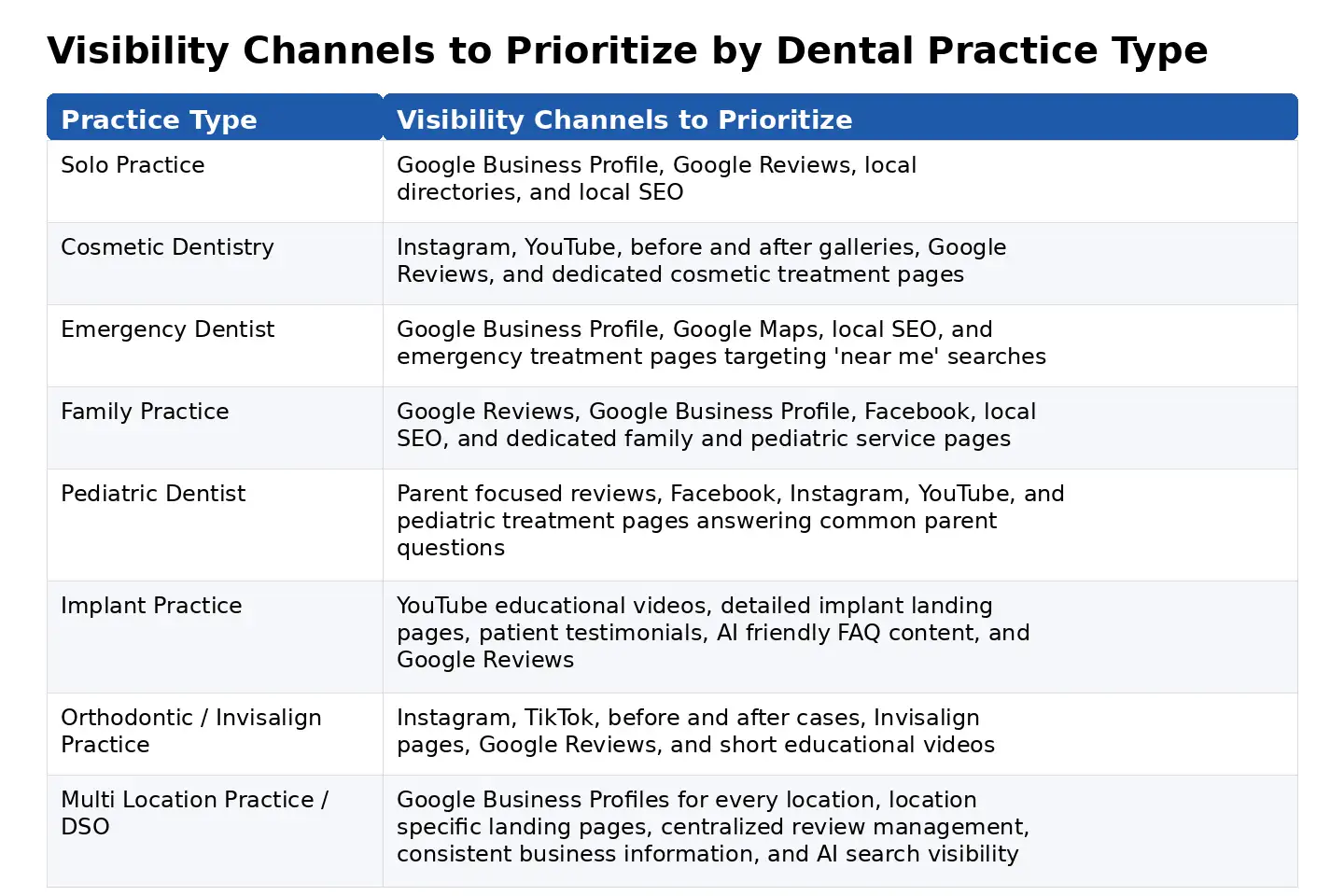
Not every practice needs to prioritise every channel equally. Here's a practical breakdown:
Get in touch with our healthcare marketing expert