
Google has given dental practices more ways to advertise than ever before — but more options doesn’t always make the decision easier. Many practices end up asking the same question: should we invest in Google Local Services Ads, traditional Google Ads, or both?
At first glance, they can seem similar. Both appear inside Google search results. Both promise more calls and new patients. And both are designed to increase visibility when someone is actively searching for a dentist nearby.
But underneath, they work very differently.
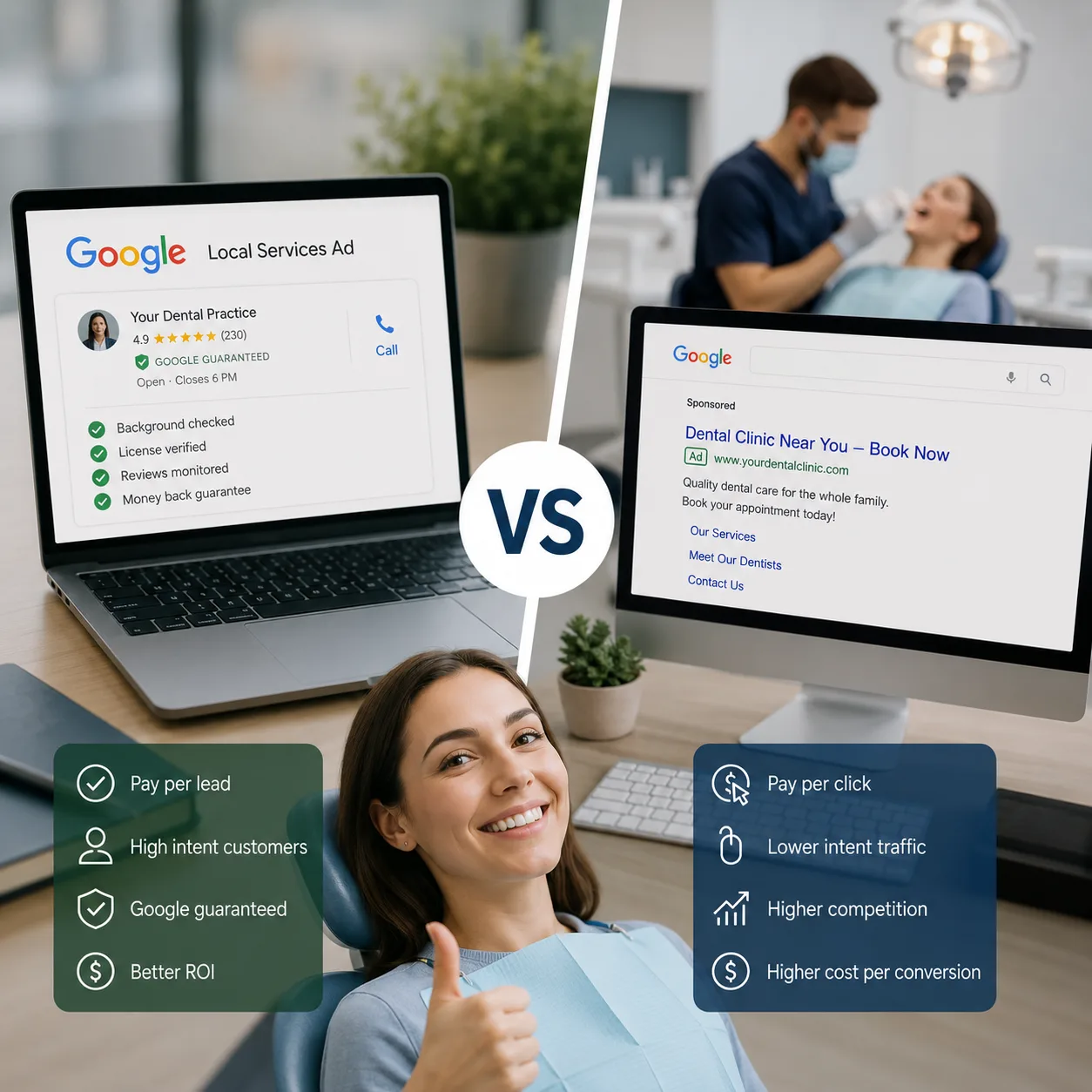
One is built around pay-per-click advertising and keyword targeting. The other is designed around verified local trust signals and pay-per-lead visibility. One gives you tighter campaign control, while the other focuses more on convenience and simplified lead generation.
That difference matters more than most practices realize — because the platform you choose directly affects lead quality, patient intent, cost per acquisition, and overall ROI.
Below, we’ll break down the real differences between Google LSAs and Google Ads for dentists, where each platform performs best, what most practices misunderstand about them, and how to decide which one actually makes sense for your growth goals.
If you’ve searched for a dentist on Google lately, you’ve probably noticed the search results don’t look the way they used to.
Before the map listings, before organic websites, and sometimes even before standard PPC ads, Google now shows a section filled with local dental practices, star ratings, phone numbers, and a small green “Google Guaranteed” badge. Those are Google Local Services Ads, better known as LSAs.
Right below them, you’ll usually see the more familiar Google Ads — the traditional pay-per-click search ads that dental practices have relied on for years to generate traffic and new patient leads.
At first glance, they can seem very similar. Both place your practice at the top of Google. Both are designed to generate new patient enquiries. And both can absolutely drive revenue when managed properly.
But the way they actually work is completely different.
One charges you for clicks, whether the patient books or not. The other charges you for direct leads like calls and messages. One gives you far more control over keywords, targeting, and strategy. The other focuses more on local trust signals, convenience, and simplified lead generation.
That difference impacts everything — lead quality, cost per patient, conversion rates, and overall ROI.
Google Local Services Ads (LSA)
LSAs work on a pay-per-lead model, meaning you’re charged when someone contacts your practice through the ad. Practices also go through Google’s verification process, which allows them to display the “Google Guaranteed” badge — a trust signal that can improve response rates for local searches. Many practices first explore this through a local dental advertising guide before deciding how aggressively to invest in LSAs.
Google Ads (Search Ads)
Traditional Google Ads operate on a pay-per-click model. You pay whenever someone clicks your ad, regardless of whether they call, book, or leave the website immediately. In return, you get much deeper control over keywords, targeting, ad copy, landing pages, and campaign strategy.
LSA for dentists has quickly become one of the most prominent ad formats in local dental search. Here's how the whole system works from start to first patient.
Before your LSA ads can run, Google puts you through a verification process. This includes a background check on the business and its owners, verification of your license, and in some states, verification of your malpractice insurance. It takes anywhere from a few days to a few weeks. Once you pass, your profile gets the green "Google Guaranteed" badge — a trust signal that carries real weight with patients who are searching for a new dentist.
LSA ads appear at the very top of the search results page, above even regular Google Ads. They show your practice name, star rating, general location, hours, and a click-to-call button. On mobile — where the vast majority of local searches happen — this format dominates the screen. Patients rarely need to scroll past it.
This is the biggest distinguishing feature of LSA. You don't pay per click — you pay per lead. A lead is counted when a patient calls, books online through your LSA profile, or sends a message. If someone clicks on your ad out of curiosity and doesn't contact you, you pay nothing. This makes LSA much more predictable from a budgeting standpoint.
You can also dispute leads. If you get a call that's clearly irrelevant — a vendor trying to sell you something, a wrong number, or someone calling for a service you don't offer — you can flag it through the LSA dashboard and Google will typically credit it back. This keeps your cost-per-lead honest.
Google ranks LSA profiles based on three main factors: proximity to the searcher, your review rating and volume, and your responsiveness. Practices that answer calls quickly, respond to messages, and maintain a strong Google review profile tend to rank higher. Unlike traditional Google Ads, you can't simply outbid a competitor to get the top spot — your reputation and responsiveness matter just as much as your budget.
Google Ads, also known as Google AdWords — has been the backbone of dental digital marketing for well over a decade. It's a far more complex and customizable system than LSA, which is both its strength and its challenge.
The foundation of Google Search Ads is keyword targeting. You choose which search terms trigger your ads — things like "dentist near me," "emergency dental appointment," "Invisalign provider," or "teeth whitening cost." This gives you fine-grained control over who sees your ads. You can target patients searching for specific procedures, run ads only in certain zip codes, and adjust bids based on time of day or device type. Practices looking to improve campaign structure often benefit from understanding patient audience targeting strategies to improve lead quality and reduce wasted spend.
Google Ads gives you significantly more creative flexibility than LSA. You can write custom headlines and descriptions, include callout extensions that highlight services like same-day appointments or financing options, add sitelinks to specific pages on your website, and include structured snippets listing treatments you offer. A well-crafted Google Ad can deliver a lot of information before a patient even clicks.
Unlike LSA — where patients interact with your Google profile — Google Ads traffic lands on your website. This means the quality of your landing page directly affects whether a click turns into a booked appointment. A poorly designed or slow-loading page will waste a significant portion of your ad spend. This is one of the hidden costs of Google Ads that many practices overlook: the investment in website optimization that's necessary for the ads to perform well. Many practices investing in paid search campaigns for dentists underestimate how heavily landing page quality impacts conversions.
Google Ads uses a pay-per-click model. Every time someone clicks your ad, you're charged — whether they book, browse, or bounce. In competitive dental markets, clicks can cost anywhere from $3 to $25 for general terms, with high-intent searches like "emergency dentist" or "dental implants" sometimes exceeding $50 per click in major metro areas. Because not every click converts to a patient, your actual cost-per-new-patient can be significantly higher than your cost-per-click suggests.
Running Google Ads well for a dental practice requires ongoing attention — keyword research, negative keyword management, A/B testing ad copy, bid adjustments, quality score monitoring, and landing page optimization. Most practices either hire a dental marketing agency or a PPC specialist to manage campaigns, which adds to the total cost. A bare-minimum management fee from a reputable agency typically runs $500–$1,500 per month, on top of ad spend. Many of the most common dental PPC campaign errors happen because practices underestimate how much ongoing optimization is required.
Looking only at cost per lead can be misleading. What actually matters for a dental practice is simple: how much revenue does a new patient generate compared to what it cost to acquire them?
And in dentistry, that math usually works strongly in your favor.
A typical new patient can generate anywhere from routine exams and cleanings to crowns, Invisalign, implants, or long-term restorative work over time. That means even a patient who starts with a basic appointment can become significantly more valuable over the years if retention is strong.
That’s why a $75 lead or even a $150 booked appointment is not automatically “expensive” in dental marketing terms. The real question is which platform brings the right type of patient at the best long-term return.
Google LSAs often perform best for:
- General dentistry
- Emergency appointments
- Family dentistry
- Practices focused on consistent new patient flow
Since LSAs work on a pay-per-lead model, practices avoid paying for a large number of non-converting clicks. The Google Guaranteed badge also builds trust quickly, especially for patients searching for a new local dentist for the first time.
Because LSAs appear right at the top of search results, they capture patients at a very high-intent moment — usually when someone is actively ready to call or book.
For practices focused on predictable lead flow and lower acquisition costs, LSAs often produce stronger overall efficiency.
Google Ads becomes much more powerful for elective and high-ticket procedures.
Searches like:
- “Dental implant cost”
- “Invisalign dentist near me”
- “Smile makeover dentist”
- “Full mouth restoration”
usually signal much stronger treatment intent and significantly higher case value.
This is where Google Ads has an advantage because it allows practices to target very specific searches and direct patients to highly focused landing pages built around that exact treatment.
That level of precision is difficult to achieve through LSAs alone.
Google Ads also supports remarketing, meaning practices can continue advertising to people who visited the website but didn’t book immediately. For longer decision-cycle treatments like implants or cosmetic dentistry, this can improve conversion rates significantly over time. Practices wanting a deeper understanding of Google Ads strategies for dental clinics often see better long-term performance with procedure-focused campaigns.
Advantages
- Pay only for real leads, not clicks
- Top-of-page placement above regular ads
- Google Guaranteed badge builds immediate trust
- Very simple to set up and self-manage
- No website needed to run ads
- Built-in review integration boosts conversions
- Dispute invalid leads for refunds
- Works extremely well on mobile
- Lower barrier to entry for smaller budgets
Limitations
- Limited targeting options — no keywords or demographics
- Can't customize ad copy or messaging
- Not great for procedure-specific campaigns
- Requires strong review profile to rank well
- Lead quality varies — some practices report inconsistency
- Not available in every market or specialty
- Less data and reporting than Google Ads
- Can't remarket to previous website visitors
Advantages
- Highly specific keyword and intent targeting
- Full control over ad copy and messaging
- Procedure-specific campaigns and landing pages
- Remarketing capabilities
- Rich reporting and analytics
- Works for any service or specialty
- Geographic targeting at zip code level
- Ad scheduling by time of day/day of week
- Scales well for multi-location practices
Limitations
- Pay for every click, converting or not
- Requires ongoing management expertise
- Agency/management fees add to total cost
- Needs a well-designed, fast-loading website
- Higher monthly spend to see meaningful results
- Results less predictable for newer practices
- Competition drives costs up in major markets
- Longer learning curve for Google's algorithm
Practices trying to improve performance while lowering wasted spend often evaluate the benefits and limitations of dental advertising campaigns before deciding how aggressively to scale Google Ads.
There’s no universal winner between Google LSA and Google Ads. The better option depends on your goals, budget, growth stage, and the type of patients you want to attract.
A simple way to think about it is this: LSA is usually better for broad local patient acquisition and simplicity, while Google Ads is stronger for strategic growth and high-value procedure marketing.
LSA Is Probably the Better Fit If…
- You’re focused on increasing overall new patient volume
- Your practice already has a healthy number of Google reviews and strong ratings
- You want more predictable lead costs without heavy campaign management
- Your ad budget is relatively modest
- Your front desk team responds quickly to calls and enquiries
- You want a simpler system that’s easier to manage day to day
- Your main goal is steady local visibility and consistent patient flow
Google Ads Is Probably the Better Fit If…
- You want to market specific high-value procedures
- Your website already has optimized service pages or landing pages
- You’re comfortable investing in ongoing campaign management and optimization
- You’re targeting implants, Invisalign, cosmetic dentistry, or other elective treatments
- You work with a PPC specialist or dental marketing agency
- You run a multi-location or specialty practice
- You want deeper analytics, targeting control, and campaign-level reporting
Newer or recently relocated practices often see faster traction with LSAs because the setup is simpler and visibility comes quickly once approved. You don’t need an advanced website strategy to start generating enquiries.
Established practices with stronger websites, larger budgets, and more aggressive growth goals often benefit more from Google Ads because of the added targeting precision and strategic flexibility.
For many dental practices, the strongest results come from using both platforms together rather than choosing only one.
LSA helps generate consistent local leads at a predictable cost, while Google Ads gives you the ability to aggressively target high-value treatments and specific patient intent. Used together, they often create a more balanced and profitable acquisition strategy.
For many practices, yes — and that’s usually where the best results happen.
Google LSA and Google Ads aren’t really competing platforms. They serve different purposes and help you reach patients at different stages of the decision process.
LSA is great for capturing patients who are ready to call now. Google Ads is stronger for targeting patients researching specific treatments like implants, Invisalign, or cosmetic dentistry before they book.
Running both helps your practice stay visible across more of the patient journey instead of relying on a single source of leads.
A lot of practices use LSA for steady day-to-day patient enquiries while using Google Ads more strategically for higher-value procedures. Over time, the budget split usually comes down to which platform is producing the better ROI for your specific goals.
If you’re newer to paid advertising or working with a smaller budget, starting with LSA first is often the simpler and more predictable option. Once that’s working consistently, Google Ads becomes much easier to scale strategically.
Absolutely. Your Google review rating and total review count are some of the biggest factors Google uses to decide which LSA profiles appear first. A practice with strong reviews and a consistent flow of new feedback will usually outperform a competitor with a weaker reputation. Simply asking patients for reviews after appointments can have a direct impact on lead volume over time.
Yes. Google allows practices to dispute leads that clearly shouldn’t count as valid enquiries, including spam calls, wrong numbers, or people asking for services you don’t offer. If the dispute is approved, Google credits the lead cost back to your account. Most practices don’t use this feature consistently enough, even though it can noticeably improve overall lead costs.
For dental implants, Google Ads is usually the stronger platform. Implant patients rarely make quick decisions. They spend time researching costs, comparing providers, reading reviews, and understanding treatment options before reaching out. Google Ads gives you more control to target those searches directly and guide patients to dedicated implant landing pages built around that treatment.
No — and that’s one of the reasons many practices start with LSA first. Patients can call your office, read reviews, check hours, and contact your practice directly through your Google Business Profile without ever visiting your website. You still need a complete and active Google Business Profile, but you don’t need a heavily optimized website to get started.
In most markets, dental LSA leads for general dentistry typically fall somewhere between $25 and $60 per lead, though competitive cities can run higher. More important than the lead cost itself is what happens after the call comes in. A practice with strong phone handling and good patient conversion can make even higher-cost leads extremely profitable over time.

.svg)

Harsh Bansal has spent 15 years pioneering, scaling, and redefining what dental marketing and data can truly unlock. He is at the forefront of AI-driven dental growth, helping more than 8,000+ dental practices and DSOs worldwide attract more patients, strengthen their market presence, and gain the financial clarity needed to drive sustainable growth.
Our healthcare marketing expert will get in touch with you

.gif)