.png)
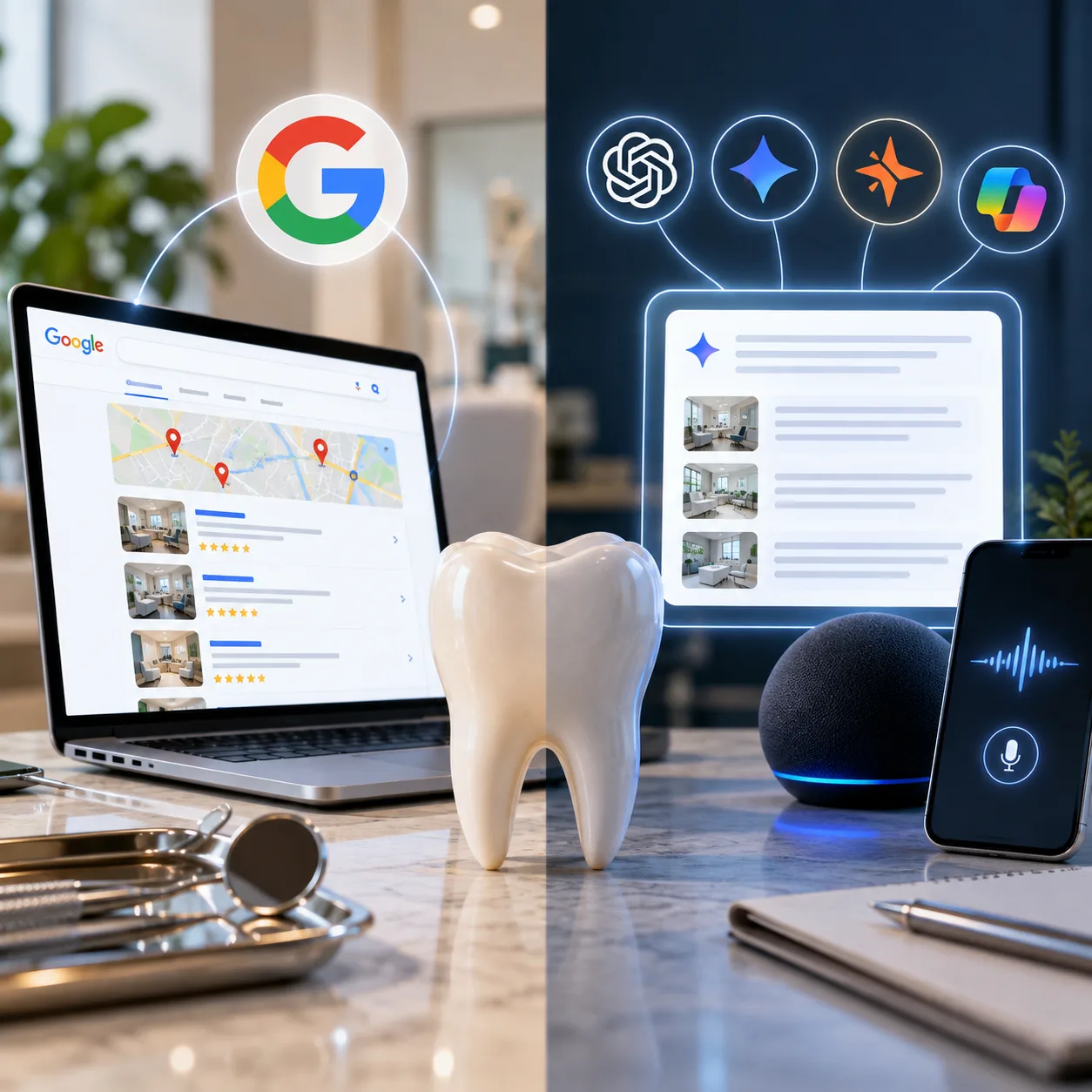
Google rankings vs. AI citations is becoming a real question for dental practices trying to figure out what visibility actually looks like today. Ranking well on Google can put your practice in front of patients actively searching for a dentist or treatment. But AI search is adding another layer, with patients asking tools like ChatGPT and Google’s AI features for recommendations and answers.
The right metric depends on what you want your marketing to achieve. Do you want to be the practice patients find when they search? The one AI tools recommend when they ask for options? Or, better yet, both?
While Google rankings and AI citations are connected, they are not two sides of the same coin. They reflect different ways patients discover and evaluate dental practices. Let’s look at what each one really tells you, why both matter, and where your practice should put its attention.
Finding a dentist is no longer as simple as typing “dentist near me” into Google and picking the first name that appears.
Patients now move between Google Search, Maps, reviews, social media, and AI tools before they decide where to book. And depending on what they are looking for, each one can play a different role in that decision.
Someone searching “how long do dental implants last” or “why does my tooth hurt” may get the answer right on the results page. With AI Overviews and other search features taking up more space, patients can get what they need without clicking through to a practice website.
Instead of sorting through pages of results, patients can simply ask, “Which dentist should I consider for dental implants?” or “What should I look for in a cosmetic dentist?” The answer may include a few practices worth checking out. That means your practice can become part of the consideration set before a patient ever visits your website. This makes tracking AI search visibility increasingly useful, especially when traditional traffic metrics do not show the full picture.
Patients want to know what is nearby, what other people think, and whether the practice looks like somewhere they would actually feel comfortable visiting. Your Google Business Profile plays a big role here, from reviews and photos to services, location, and basic practice information. Strong Google Business Profile strategies for dentists can help practices strengthen this part of the patient journey.
So, the patient journey has become a little less predictable.
Google still brings plenty of search traffic, but AI is changing how patients research, compare, and narrow down their choices. For dental practices, being visible now means showing up wherever that decision is taking place.
Both Google rankings and AI citations matter, but they play very different roles in how patients discover your practice.
Google rankings are strongest when a patient already knows what they need. Someone searching “dentist near me,” “emergency dentist,” or “Invisalign dentist” has already raised their hand. Your job is to make sure your practice is there when they do. Google helps you capture that existing demand and turn it into calls, inquiries, and appointments.
AI citations work a little differently. A patient might ask ChatGPT, Gemini, or another AI tool, “How should I replace a missing tooth?” or “What should I look for in a cosmetic dentist?” They may not have a practice in mind yet. When your practice is mentioned in that answer, you have a chance to enter the conversation much earlier and influence what the patient considers next.
That is the real distinction: Google helps you capture demand, while AI can help shape it. One puts your practice in front of patients who are already searching. The other can put your name into the conversation while they are still figuring out what to do.
Building consistent AI brand mentions across relevant sources can therefore become an important part of strengthening how your practice is represented beyond traditional search.
Google rankings and AI citations can both put your dental practice in front of potential patients, but they do not carry the same weight or work in quite the same way.
Google still has a bigger audience. Patients searching for “dentist near me,” “emergency dentist,” or “dental implants” are already looking for care, which makes those searches especially valuable. Strong rankings and local visibility help your practice capture that existing demand.
AI citations are a different game. Patients may ask an AI tool for the best dentist for a particular treatment before they have even decided which practice to consider. Being mentioned in that answer can put your name on the shortlist much earlier in the decision-making process.
That does not make one metric more important than the other. Google is still where much of the demand gets captured, while AI is becoming another place where that demand is shaped. For most dental practices, the smarter approach is to build strong Google visibility while making your website, reputation, expertise, and online presence strong enough to earn attention from AI search as well.
This is where local SEO strategies for dental practices remain important. A strong local foundation can help your practice stay visible when patients move from AI-driven research back to Google Search and Maps.
Not sure whether your practice is getting noticed beyond traditional Google rankings? A dental search visibility audit can show you where you stand. We’ll look at how your practice appears across Google, local search, and AI-powered search, then identify the gaps that may be keeping you from being found by the right patients.
At Remedo, we look beyond rankings alone. Our strategic blend of AEO, GEO, and dental SEO helps your practice win where modern patients search, putting your name in front of them on Google and in the AI conversations shaping their choices.
My competitors already rank #1 on Google. Should I still worry about AI citations?
Yes, and this is actually where the opportunity can be bigger. Ranking #1 locally does not guarantee that a practice will be mentioned in an AI-generated answer. The two work differently and can draw on different information. If your competitors are not creating clear, well-structured content that makes their expertise and key information easy to understand, you may have an opportunity to earn visibility in AI answers even while they hold the top local ranking.
Is it better to invest in Google rankings or AI citations for a smaller, newer practice?
For most newer practices, Google rankings should come first. That’s because local SEO helps establish the fundamentals patients and search systems need. This may include accurate business information, relevant content, reviews, and a strong local presence. Once that foundation is in place, you can build on it to improve your visibility across AI search as well.
How long before AI citation efforts actually show results?
There is no fixed timeline for earning AI citations. AI platforms use different systems and sources, so visibility can change depending on the query, platform, competition, and strength of your online presence. Rather than expecting a specific number of weeks, focus on consistently building useful content, accurate business information, credible sources, and a strong digital presence.
Do I need a specialized agency for AI citation work, or can I do this in-house?
The core work can usually be started in-house. Direct answers, clear FAQ sections, visible author credentials, useful content, and basic structured data are all things a practice can improve on its own. A specialized agency becomes more useful when you want to scale content production, monitor AI visibility, or build AI search into a broader SEO strategy.

.svg)

Dr. Ruchir Mehra has spent nearly a decade at the crossroads of clinical insight and cutting-edge technology, reshaping how dental practices think, operate, and grow. He brings a rare fusion of medical precision and AI-driven innovation, helping practices and DSOs move from instinct to intelligence, and from scattered operations to scalable, compliance-first growth engines that perform.
Our healthcare marketing expert will get in touch with you

.gif)