
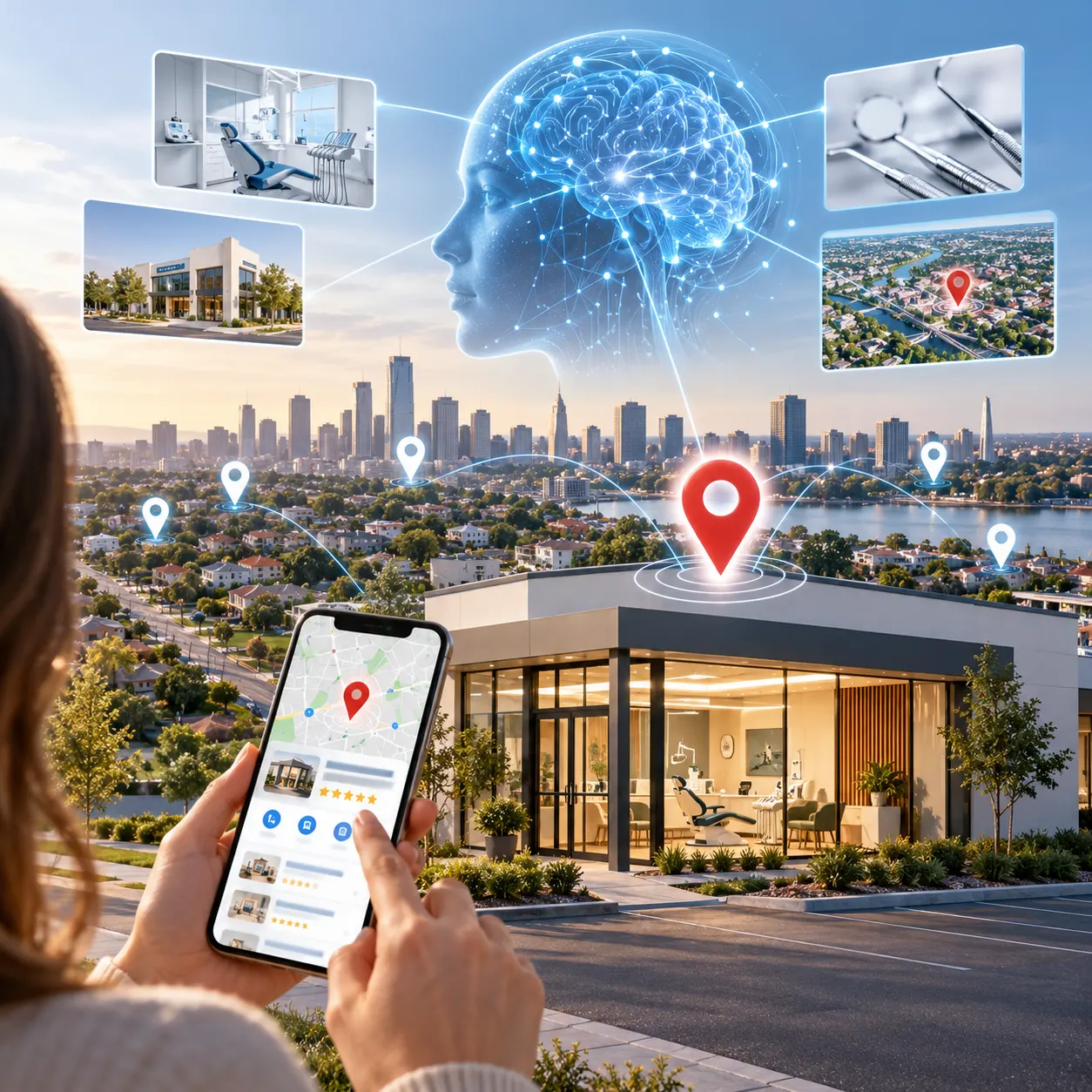
For a dental practice, location has always been part of the decision. A patient with a dental concern usually wants a practice nearby, convenient to reach, and easy to fit into their routine. For years, local dental marketing revolved around familiar signals: your practice address, Google Business Profile, local keywords, map rankings, and proximity to the patient. Those still matter. But AI search is changing how patients discover a dentist because it can interpret a location in the context of what the patient is actually looking for.
For years, “near me” searches were largely about finding the closest practice on a map. Now, when someone asks, “Which dentist is near me?” AI has more to consider than which practice sits closest on the map. It may need to connect your location with your services, surrounding areas, patient experiences, and the information available about your practice.
That makes local visibility a little more nuanced than simply putting your address on every page.
In this guide, we’ll look at how AI understands dental practice locations, which local signals help it place your practice in the right context, and what you can do to make your location work harder for the patients you actually want to attract.
Location does not always appear in a patient’s first question. It can enter the conversation as their search becomes more specific.
A patient might begin with “How do I choose a good dentist?” and then narrow the question to “Which dentists are close to me?” A follow-up might ask, “Which of those practices are convenient from my area?”
Each question gives AI a different piece of the patient’s decision. The first is about choosing a practice. The next brings location into the picture. The final question makes proximity part of the decision itself.
For dental marketers, that means local visibility should support the entire conversation, not just the final “near me” query. Your website and online presence should give AI enough useful, accurate information to understand where your practice fits when location becomes relevant.
Your patients may change the question as they get closer to choosing a dentist. Your online presence needs to keep up.
AI needs more than an address to understand where a dental practice belongs. It has to connect your practice with a real place, the surrounding area, and the information patients see about you across different sources.
Five areas can make that connection clearer: structured location data, your Google Business Profile, consistent business information, local context, and genuine patient feedback.
When AI is trying to identify your practice, clear location data gives it less room to interpret.
Relevant Schema.org markup can explicitly identify your practice as a Dentist or other appropriate local business type and provide details such as your address, coordinates, opening hours, map location, and areas served.
Essential Schema Properties for AI Location Discovery:
However, Schema does not guarantee an AI recommendation. Its value is that important facts about your practice are clearly defined rather than buried in ordinary page copy.
When AI needs to understand which dental practices are associated with a particular location, your Google Business Profile can provide important context.
Keep your practice category, address, phone number, website, hours, services, and other profile details accurate and current. Make sure the information agrees with your website and reflects the practice patients actually visit.
Your photos also give patients useful visual context. Exterior images, signage, reception areas, treatment rooms, and team photos can help someone recognise the practice when they arrive.
However, above all else, accuracy matters. When your online information consistently points to the same practice, address, and location, AI has a much clearer picture of where your practice belongs.
AI may encounter your practice in more places than your own website and Google profile. Healthcare directories, local listings, professional profiles, and other websites can all contribute to the information available about your business.
That makes consistency important.
Check that your name, address, phone number, and website are correct across the sources that matter to your practice. Pay particular attention to old addresses, duplicate profiles, incorrect phone numbers, and listings left behind after a move or rebrand.
You do not need every website to format your address identically. “Main Street” and “Main St.” are not inherently a problem.
The real concern is conflicting information that could make two listings look like different businesses or leave uncertainty about which location is current.
AI also needs to understand how your practice fits into the area around it.
Patients rarely describe their location using only a formal address. They may refer to a neighborhood, major road, nearby landmark, shopping area, parking location, or transit stop.
Useful local content can provide that context. Explain how patients reach your practice, where they can park, which major roads are nearby, and which surrounding communities you genuinely serve.
You can also create location-specific pages for important nearby areas when there is a genuine reason to do so. Each page should offer useful information about that community rather than simply replacing one neighborhood name with another.
The best local content gives AI context it can understand and patients information they can actually use.
Reviews can give AI another layer of information about your practice.
A patient might naturally mention that your office is easy to find, parking is convenient, the staff is welcoming, or appointments run smoothly. Those details help describe the practice in a way an address or business category cannot.
For example:
“The office was easy to find, parking was simple, and the staff made the whole visit feel straightforward.”
That review connects the practice with specific aspects of the patient experience without sounding like a marketing copy.
There is no need to ask patients to insert neighborhood names, services, or keywords into their reviews. Genuine language gives AI a more credible picture of what patients actually associate with your practice.
None of these elements guarantees that an AI system will recommend your practice.
What they can do is make your practice easier to identify, place, and understand across the information AI may encounter online.
Your dental practice can stay at the same address for years and still have conflicting location information online. That happens when outdated listings, old profiles, or inconsistent business details make it harder for AI to connect every online mention back to your practice.
Your address may appear differently across Google, healthcare directories, your website, and social profiles. Minor formatting differences are fine, but old addresses, incorrect suite numbers, or outdated phone numbers can create genuine confusion.
Your practice can also become harder for AI to identify when doctors retire, move to another practice, change ownership, or open a new location. Old profiles and directory listings may continue linking a dentist to their previous practice long after they have moved. Keeping your doctor profiles and practice information current helps AI connect the right dentist with the right practice and location.
Patients do not always describe your location using your official city name. A practice in Plano may serve patients searching from Frisco, North Dallas, or nearby communities.
Make those genuine connections clear through surrounding neighborhoods, major roads, landmarks, and service areas rather than relying on the city name alone.
When AI search gets your practice location, services, or patient experience wrong, the damage rarely shows up as one dramatic drop in leads. It happens quietly. A patient chooses another dentist, a high-value case goes elsewhere, or your marketing spend brings in less business than it should.
The hardest patient to measure is the one you never had. If an AI assistant does not identify your practice as a good fit, you may never make the shortlist. A patient asks for a dentist nearby, sees another practice recommended, and calls them instead.
Your practice loses the opportunity before that patient ever reaches your website or front desk.
Even a small piece of unclear information can make a patient hesitate. If someone asks whether your office has on-site parking, serves their neighborhood, or offers a particular treatment and gets a vague or outdated answer, they may simply keep looking.
You may have the right answer. The problem is that the patient did not find it when they needed it.
Your location is only one part of how patients understand your practice. AI also needs clear information about the kind of dentistry you provide.
If outdated listings or thin service information make a cosmetic practice look like a general family office, the wrong patients may come through while patients looking for veneers, implants, or full-mouth rehabilitation overlook you. Your online presence should reflect the practice patients will actually walk into.
You can spend thousands of dollars on Google Ads, social media, SEO, and other patient acquisition efforts and still lose a patient during the final decision.
A prospective patient sees your ad, checks your practice through an AI assistant, and finds conflicting information about your location, services, or reputation. The marketing brought them to your brand. Unclear information gave them a reason to leave.
In today's AI era, getting your local presence wrong can come with a surprisingly high price tag. You have already paid to get noticed. Do not let confusing information finish the job for your competitor.

.svg)

Harsh Bansal has spent 15 years pioneering, scaling, and redefining what dental marketing and data can truly unlock. He is at the forefront of AI-driven dental growth, helping more than 8,000+ dental practices and DSOs worldwide attract more patients, strengthen their market presence, and gain the financial clarity needed to drive sustainable growth.
Our healthcare marketing expert will get in touch with you

.gif)