
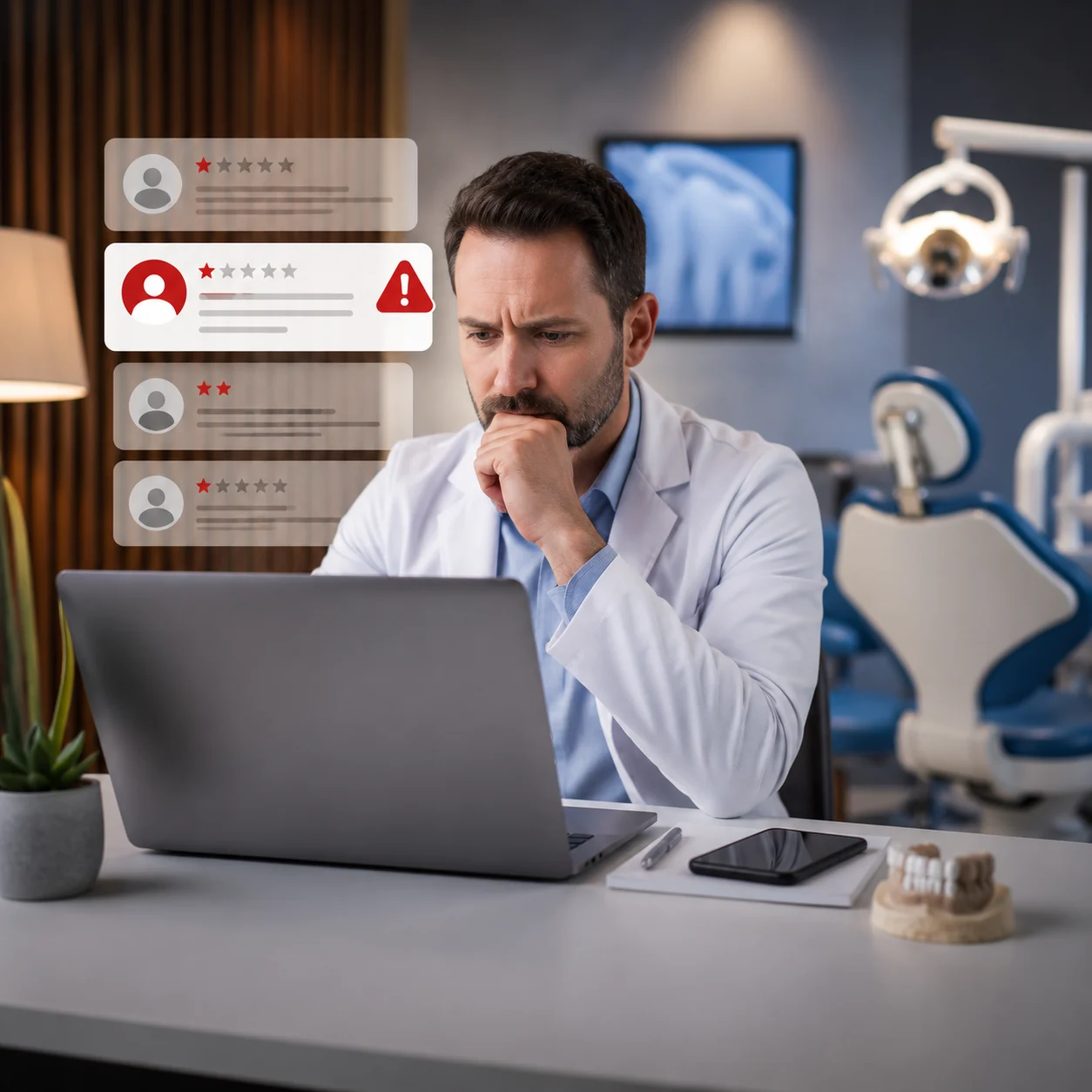
You check your dental practice’s Google Business Profile between patients and notice a new one-star review. The reviewer claims they were overcharged, describes an interaction your team does not recognize, and you cannot find their name anywhere in your patient records.
It is frustrating, especially when a review does not appear to come from a real patient. But fake or misleading reviews can create a real problem for dental practices. Prospective patients often use Google reviews to decide which practice to call, and even one suspicious review can raise questions about your team, pricing, or patient experience.
Sometimes, there is an obvious reason for a suspicious review. A former employee may leave one after a difficult exit. A patient may post about the wrong practice by mistake. A competitor may try to hurt your reputation. Or someone may simply post something that never happened. Whatever the situation, your first reaction might be to respond immediately and set the record straight. That is usually when you need to slow down and think carefully. A public response can easily reveal more than you intended, especially when patient privacy is involved.
Fortunately, you do have options. You can check whether the review appears genuine, report reviews that violate Google’s policies, respond without confirming or revealing private patient information, and take steps to build a stronger review profile over time. This guide outlines practical steps to help you identify potentially fake reviews, report reviews that violate Google’s policies, respond without compromising patient privacy, and protect your dental practice’s reputation and local search visibility.
Not every negative review is fake. A patient may have had a genuinely poor experience, and their feedback deserves to be taken seriously. The concern is when a review describes an experience that never happened, comes from someone with no clear connection to your practice, or appears intended to mislead other patients.
There is no foolproof way to confirm that a review is fake. Instead, look for several warning signs before deciding what action to take.
Start with your practice management system. Check whether the reviewer’s name, phone number, appointment, or other details match anyone in your records.
If nothing matches, the review deserves a closer look. However, do not assume it is fake immediately. Patients may use a different name on Google, or a family member may have posted the review.
A review saying “worst dentist ever” or “avoid this place” without explaining what happened provides very little context.
Genuine patients usually mention something specific about their experience, such as a treatment, wait time, billing issue, or interaction with your team. Vague language alone does not prove a review is fake, but it can be a warning sign when combined with other concerns.
Take a look at the reviewer’s profile. Is it brand new? Does it have no photo, no other reviews, or very little activity?
You may also notice a profile leaving one-off reviews for unrelated businesses in different cities. That kind of unusual activity can make a review more suspicious.
Pay attention if your practice suddenly receives several similar reviews within a short period.
If they have similar wording, the same star rating, or arrive within hours or days of each other, you may be dealing with coordinated review activity or review bombing rather than genuine patient feedback.
Be cautious if the reviewer mentions another dental practice by name or repeatedly compares your practice with a competitor.
A genuine patient may mention another practice, especially when discussing pricing or treatment options. But if the review reads more like an advertisement for a competitor or an attempt to damage your reputation, it deserves closer attention.
Consider who may have a reason to post the review.
A former employee, rival practice owner, or someone involved in a personal dispute with your team may have a conflict of interest. That does not automatically make their review fake, but the connection is important when assessing whether the feedback reflects a genuine patient experience.
Some reviews have little or nothing to do with dental care.
A complaint about politics, a neighboring business, or an unrelated issue with the building does not provide meaningful feedback about your patient experience. It may also violate Google’s policies if the content is unrelated to the business. Understanding Google’s review policies can help you determine whether a suspicious review has a legitimate policy violation that can be reported.
Some reviews are easier to flag because of what they contain. Look for threats, hate speech, sexually explicit material, spam, or promotional links.
These issues may give you a clearer reason to report the review because the content itself may violate Google’s review policies.
One warning sign does not automatically make a review fake. A new Google account does not prove someone is dishonest, and not finding an exact patient match does not prove the person never visited your practice.
Look for patterns. If the reviewer has no identifiable connection to your practice, the account looks unusual, the details do not match your records, and similar reviews appear at the same time, you have stronger reasons to investigate and report the activity.
Most importantly, do not try to prove your case publicly. Even if you are certain the reviewer was never a patient, confirming or discussing someone's patient status or treatment can create privacy concerns. Keep your public response general and handle the details privately.
If a review looks fake, your first instinct may be to get it off your dental practice’s profile as quickly as possible. But before reporting it, take a few minutes to document what looks wrong and check your patient records.
Google does not remove a review simply because a dentist or practice believes it is untrue. The review needs to violate Google’s content policies. That means your best chance of removal is to show what policy the review appears to violate, rather than simply saying, “This person was never our patient.”
The easiest place to report a suspicious review is your Google Business Profile. If you are also working to improve your overall profile, these Google Business Profile strategies for dentists can help you maintain a stronger and more complete local presence.
For example, a review promoting another dental practice may raise a spam concern. A review containing threats or offensive content may fall under a different policy category.
Do not choose a random reason just because you want the review removed. Select the option that most closely matches what is actually happening.
Before reporting the review, take a screenshot and keep a record of what you found.
For a dental practice, useful evidence might include:
You do not need to publish any of this information in your response to the reviewer. Keep it for your own records and for any report or appeal you may need to submit.
Do not assume the process ends with the first report. If Google determines that the review does not violate its policies, eligible businesses can submit a one time appeal through Google's Reviews Management Tool.
When you appeal, focus on the specific policy issue. Explain why the review appears to violate that policy and provide the relevant evidence. Simply repeating that the reviewer is not in your patient records is unlikely to be enough on its own.
You can also use the Reviews Management Tool to check the status of your report and see whether the review is eligible for an appeal.
Dental practices should also be alert to a more serious situation: someone demanding money, discounts, treatment, or another benefit in exchange for removing or changing negative reviews.
If someone contacts your practice with this type of demand, do not pay or negotiate just to make the reviews disappear. Save the messages, screenshots, and other evidence, then use Google's reporting process for review extortion scams.
Some fake reviews may contain serious accusations that go beyond an ordinary negative patient complaint. If you believe a review is defamatory or creates another legal issue, speak with a qualified attorney about your specific situation.
Do not threaten the reviewer publicly or reveal private patient information while trying to defend your practice. For a dental practice, protecting patient privacy is just as important as protecting your reputation.
The safest approach is simple: document the review, report the policy violation, appeal when appropriate, and keep your public response professional.
You may know a review is fake, but that does not mean you should publicly prove it. For dental practices, patient privacy comes first. Keep your response calm, brief, and professional.
In short, stay calm, protect patient privacy, respond professionally, and let Google handle the removal process.
Maintaining a healthy review profile also matters beyond individual complaints. Consistent, authentic feedback can influence how prospective patients perceive your practice and how patient reviews affect SEO. A strong review profile can support your broader local visibility while giving potential patients more confidence when comparing practices.
Likewise, protecting your Google presence is an ongoing process. If your practice ever experiences a profile-related issue beyond an individual review, such as a suspension, understanding Google Business Profile suspension recovery can help you approach the problem systematically.
Finally, reviews are only one part of local search visibility. A complete local strategy can also help your practice compete for positions such as the Google local pack, where prospective patients often compare nearby dental practices before making a decision.

.svg)

Dr. Ruchir Mehra has spent nearly a decade at the crossroads of clinical insight and cutting-edge technology, reshaping how dental practices think, operate, and grow. He brings a rare fusion of medical precision and AI-driven innovation, helping practices and DSOs move from instinct to intelligence, and from scattered operations to scalable, compliance-first growth engines that perform.
Our healthcare marketing expert will get in touch with you

.gif)