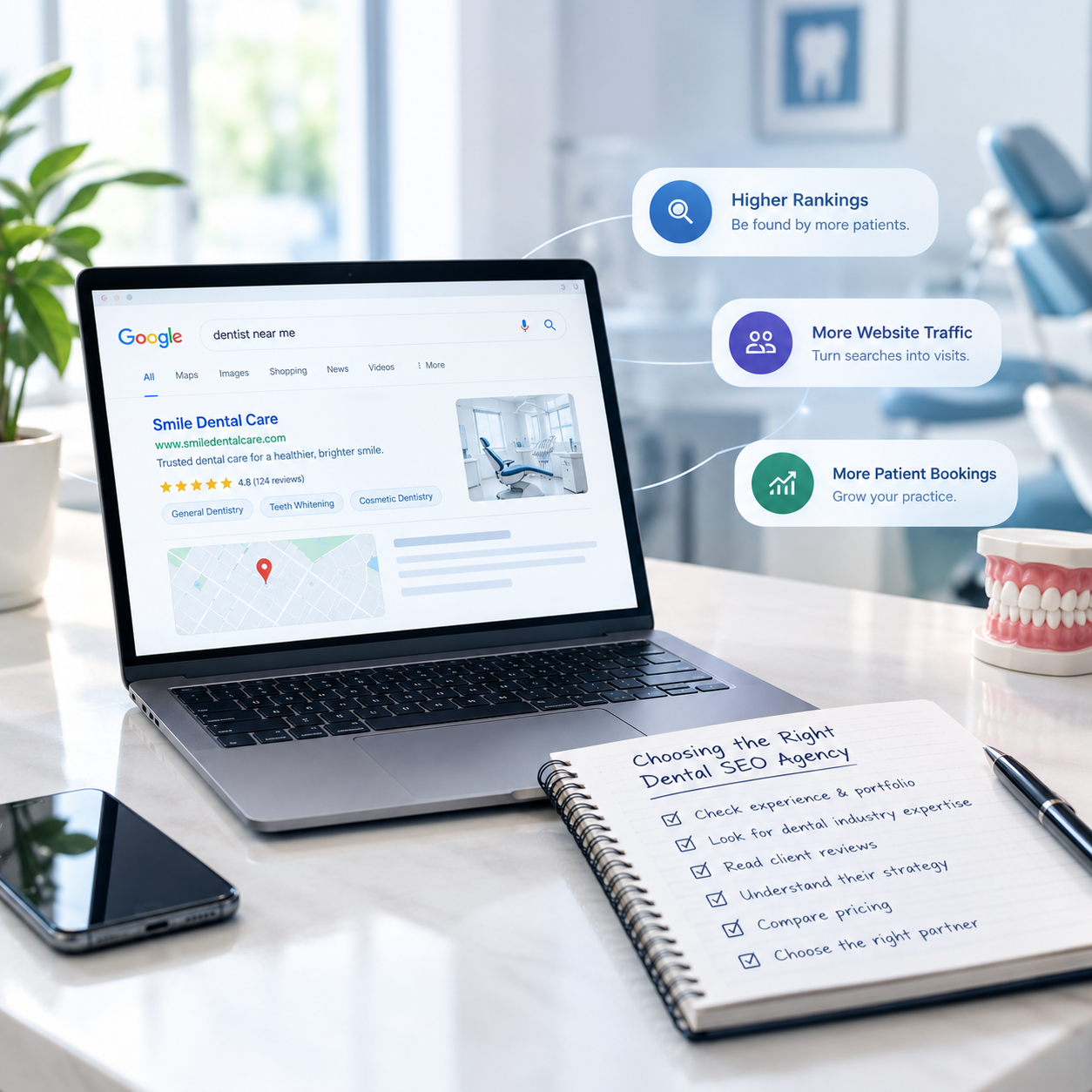
Hiring a marketing agency is one of the few vendor decisions that compounds over years, because SEO work builds (or damages) your site's authority slowly, and a bad eighteen-month engagement can leave you further behind than when you started. Here's a step-by-step process for getting it right, including the verification and contract steps most guides skip.
- Step 1: Define what you actually need. Before contacting anyone, get clear on your current state: current rankings for your core treatments, current monthly new-patient volume from online channels, and your actual budget range. Put this on a single page. An agency can't scope accurate work against a vague brief, and you can't evaluate a quote's fairness without knowing roughly what the market charges for what you're asking for.
- Step 2: Build a shortlist the right way. Look for dental-specific case studies, not just generic "we do SEO" marketing. Ask colleagues at other practices (ideally non-competing, different city) who they use and whether they'd rehire them. If you want a structured way to compare the agencies on your shortlist against each other, see our evaluation framework for choosing the best agency.
- Step 3: Verify before you call. Before the discovery call, do your own checking. Look up whether the practices in an agency's published case studies still rank well for the terms claimed. Check reviews across more than one independent platform, not just the one the agency links to. Look at the agency's own website: does it practice what it sells, with genuinely current content and reasonable technical health?
- Step 4: The discovery call, what to ask. How do you measure success, bookings or rankings? What's your experience with practices our size and in our specialty? How do you handle compliance for our market (FTC in the US, GDC and GDPR in the UK, HCSA and MOH in Singapore)? What's your approach to AI search visibility as patient research increasingly starts in ChatGPT or Google's AI Overviews rather than a traditional search results page? Who will actually be doing the work, the person on this call, or a team we haven't met?
- Step 5: Read the proposal like a contract, not a pitch. Every proposal should itemize scope by channel (SEO content and technical work, link building, PPC management and ad spend, website maintenance, reputation management), separate recurring fees from one-time setup costs, and specify what happens to your site, content, and data if you leave.
- Step 6: Lock down the contract terms before you sign. This is the step most hiring guides skip, and it's where practices get burned on the way out, not the way in. Confirm in writing: the notice period required to cancel (30 and 60 days are both common; anything longer than 90 should come with a clear justification); that you, not the agency, own your domain, website files, content, and historical analytics on exit; whether your Google Ads and Meta Ads accounts are created under your own business manager (they should be, so they move with you); whether the contract auto-renews and how much notice that renewal requires; and what transition assistance the agency commits to if you leave, such as a defined handover window and exported reporting history.
- Step 7: Check references properly. Ask for at least one reference from a practice of comparable size in a comparable market, and actually call them without the agency present. Ask the reference specifically about communication responsiveness and what happened when something went wrong, not just whether rankings improved.
- Step 8: Negotiate scope, not just price. If a quote is above your budget, the productive conversation is usually "what would a reduced scope at this price look like" rather than asking for a discount on the same scope.
- Step 9: Set your first 90-day review point. Agree upfront on what you'll both look at in 90 days: typically early technical and on-page progress, content published, and any early ranking or booking movement, since meaningful gains usually take three to six months to fully show. Put the review date on the calendar before you sign, not after.
Common hiring mistakes to avoid
- Choosing based on price alone, without comparing scope.
- Signing a long contract with no review point and no documented notice period.
- Skipping reference checks and independent case-study verification because the proposal looked polished.
- Not confirming in writing who owns the website, content, and ad accounts on exit.
- Not asking who will actually do the work versus who's on the sales call.
- Treating SEO and paid ads as interchangeable rather than complementary.
For a UK-specific version of this process, see our questions-to-ask-before-hiring guide.