Every month, more dental practices start offering Invisalign and clear aligners. The demand is growing fast, and so is the competition in local markets.
Most clinics already have access to the same treatment options, similar technology, and comparable clinical outcomes. But the practices that consistently attract more aligner patients aren’t just the ones with the most experienced providers; they’re the ones with a clear, conversion-focused Invisalign marketing strategy.
This article explores the most effective marketing strategies for growing Invisalign and clear aligner demand in competitive local markets. Learn how leading dental practices attract higher-intent patients, increase consultation bookings, strengthen local visibility, and turn interest into treatment starts through smarter, more targeted marketing approaches.
Filling your Invisalign schedule in a competitive market takes more than a service page and the occasional Facebook post. Successful practices build structured systems that attract the right patients, build trust before the first call, and guide them confidently toward booking.
Below are ten practical ways to build an effective Invisalign marketing strategy in 2026.
One of the biggest mistakes practices make is sending Invisalign traffic straight to their homepage.
A patient clicks expecting information about straightening their teeth and lands on a general dentistry page discussing cleanings, crowns, and insurance. Within seconds, they leave because nothing feels relevant to what they came for.
A dedicated Invisalign landing page often converts significantly better because it aligns directly with patient intent. Professional Invisalign marketing can also improve user experience and increase consultation bookings.
Your page should include:
Instead of “Book a Consultation,” consider offering a Free Smile Assessment. It feels lower commitment and often increases first-time inquiries.
Most testimonial content misses the mark because it only highlights the final result.
Instead of asking patients to say, “I love my new smile,” capture the experience in stages:
Day One: Why they started treatment and what made them hesitant
Mid-Treatment: How Invisalign fits into everyday life
Final Reveal: The outcome and what they would tell someone considering treatment
This approach works because prospective patients do not just want proof that Invisalign works. They want to understand what living with treatment actually feels like.
Journey-based content consistently feels more authentic and builds more trust than polished before-and-after photos alone.
Many Invisalign prospects hesitate before they ever contact a practice.
They are unsure whether they qualify, concerned about cost, and reluctant to commit to what sounds like a sales appointment.
Replacing “Book a Consultation” with Get Your Free Smile Assessment lowers resistance immediately.
Your intake form can ask:
Practices using lower-commitment entry offers often generate stronger inquiry-to-booking performance.
Short-form video has become one of the most powerful discovery tools for cosmetic dental treatments, and there's no better home for it than TikTok and Instagram Reels.
Promotional clips tend to underperform. Educational and myth-busting content performs far better. A well-planned dental social media marketing strategy helps distribute this content consistently and reach more local patients. Strong examples include:
Time-lapse transformation videos in particular consistently generate exceptional reach; even practices with under 1,000 followers regularly see 50,000-plus views once one of these videos lands. This kind of content builds the authority that makes your paid ads convert at a higher rate later on.
Invisalign prospects are often unsure whether their case is even suitable for clear aligners. A short interactive quiz on your website — "Am I a candidate for Invisalign?" — walks a visitor through a handful of simple questions about crowding, spacing, and bite concerns, then routes them to book a free smile assessment based on their answers.
This is a practical, low-cost way to bring AI-style personalization into your patient funnel. It increases time spent on your page (a positive SEO signal), captures a warm lead before they've spoken to anyone, and reduces the number of unqualified consultations your team has to triage manually.
If you are introducing a new Invisalign promotion, flexible financing option, or expanding into Invisalign Go services, one social post rarely creates enough momentum on its own.
Instead, build a short campaign that warms patients up before launch:
This approach works because patients rarely make treatment decisions instantly. A structured rollout builds familiarity, increases confidence, and creates stronger consultation demand.
Traditional SEO is still essential, including blog content that answers questions patients are already typing into Google, internal links that funnel authority to your service page, and basic technical SEO like site speed and mobile usability. Investing in dental SEO services helps ensure your Invisalign pages remain visible as competition continues to grow.
But 2026 adds a new layer: AI search optimization. Patients are increasingly asking ChatGPT, Gemini, and Perplexity which Invisalign provider to choose in their area. Clear FAQ sections, structured data (schema markup), and genuinely informative, well-organized content make it far more likely that these AI tools cite your practice as the answer. Practices that ignore this are handing visibility to competitors who format their content for both human readers and AI summarization.
Patients rarely book Invisalign because they landed on a page with the best headline. They book because they leave the page feeling informed, reassured, and confident enough to take the next step.
Your Invisalign page should answer the questions patients are already thinking about: Am I actually a candidate? What does treatment look like in real life? What will it cost? What happens if my case is more complicated?
Want stronger conversion rates?
Invisalign patients see your team roughly every six to eight weeks for tray changes and progress checks across an average 12 to 18-month treatment. This creates a natural opportunity to build a relationship and to generate referrals and reviews along the way.
A simple automation flow might look like:
This kind of system increases lifetime value and is one of the lowest-cost ways to generate new patients. Practices with active referral programs commonly see 15 to 25% of new Invisalign patients arrive through existing patient referrals, which means that blended acquisition costs are meaningfully lowered.
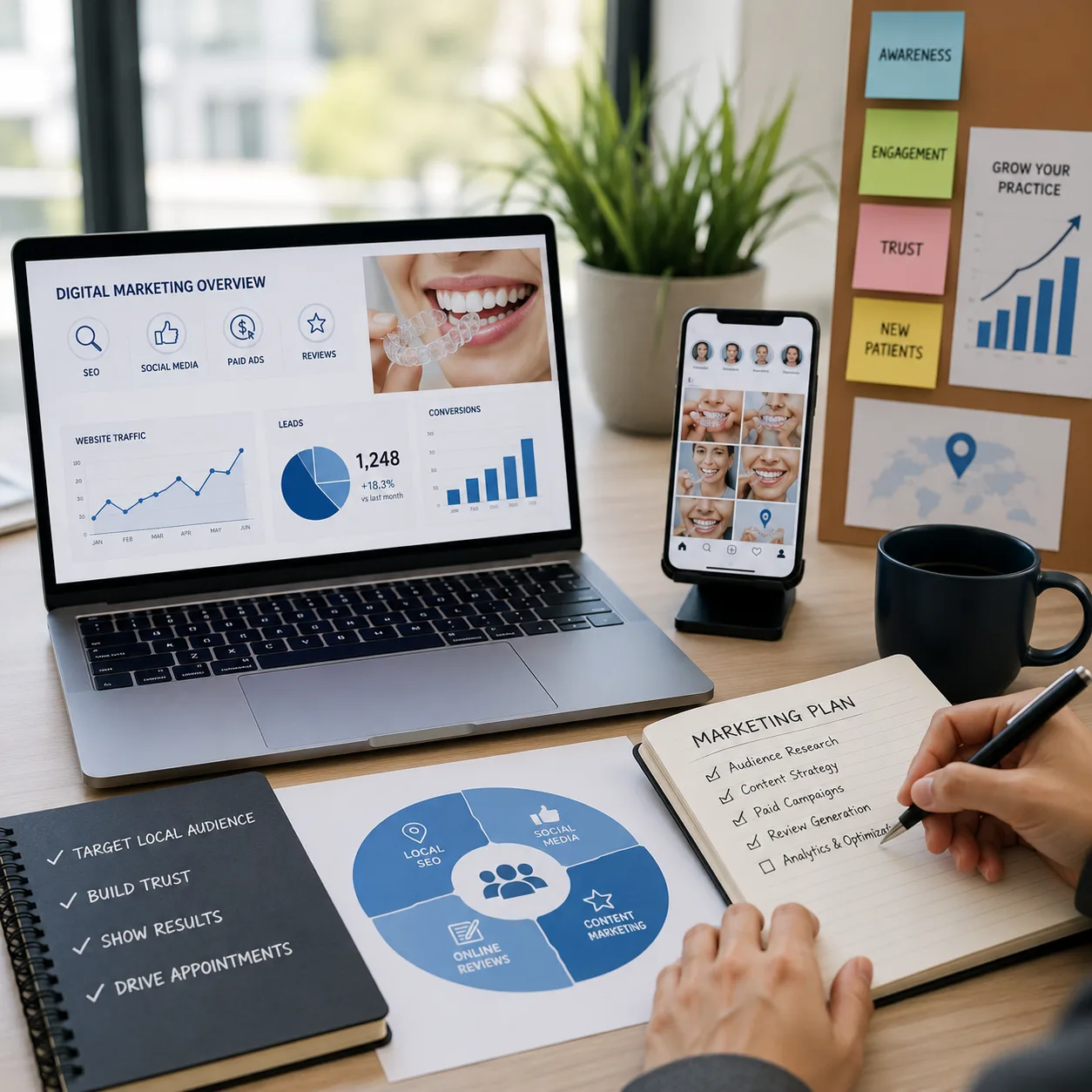
Still measuring success by clicks and impressions? Those numbers might look good on a dashboard, but they do not tell you whether treatment starts are actually growing.
The practices consistently filling their Invisalign schedule focus on a smaller set of numbers that connect directly to revenue and patient decisions.
Track what matters:
These numbers show you exactly where patients are moving forward and where they are dropping off. Once you know what it truly costs to generate one Invisalign treatment start, you can stop guessing, optimize with confidence, and grow more predictably.
The most effective Invisalign campaigns do not rely on a single platform. They combine multiple channels that each serve a different purpose across the patient journey, including discovery, education, trust building, and conversion.
Below are the channels delivering some of the strongest results for dental and orthodontic practices.
Search advertising captures people who are already looking for a solution. Someone searching “Invisalign near me” or “Invisalign cost in [city]” is actively evaluating treatment options rather than casually browsing.
That makes Google Ads one of the fastest channels for filling your consultation calendar and one of the highest converting acquisition channels when campaigns are structured correctly. Well-managed Google Ads campaigns can consistently drive qualified Invisalign consultations from patients actively searching for treatment.
Local intent targeting is essential. Focus your campaigns within a realistic driving radius (typically 10 to 15 miles in dense urban markets and wider in suburban or rural areas), and build a strong negative keyword list to filter out searches like "DIY," "at home," "jobs," "free," and competitor terms you do not want to pay for.
High-intent keywords often include
Local Services Ads, which operate on a pay per lead rather than pay per click model, now appear above standard Google Ads in many dental searches and are worth testing alongside traditional PPC campaigns where available.
Where Google captures demand, Meta helps create it. Invisalign is naturally visual, and few platforms showcase smile transformations better than Instagram and Facebook.
Short 15 to 30-second videos featuring real patients, including before and after reveals, treatment walkthroughs, attachment placement, and progress updates, consistently outperform static creative and tend to create stronger engagement.
Pair these with native lead generation forms that collect patient information directly inside the platform without adding extra friction.
Retargeting website visitors who did not convert with testimonial-driven content also helps recover missed opportunities.
Audience segmentation matters:
These decisions are driven by very different motivations, and using the same creative for both often limits performance.
Practices that consistently create short-form video content are earning stronger visibility, building trust earlier, and staying top of mind with prospective Invisalign patients long before the first consultation is ever booked.
TikTok, Instagram Reels, and YouTube Shorts continue to create levels of organic discovery that paid campaigns alone struggle to match.
Patient testimonials under 60 seconds remain one of the strongest trust builders, while treatment walkthroughs such as iTero scans, tray fittings, and attachment placement help remove uncertainty and make the Invisalign experience feel more familiar before patients ever reach out.
SEO takes longer than paid media to build momentum, often requiring four to six months before meaningful movement begins. Unlike paid traffic, however, organic visibility continues generating patient opportunities without paying for every individual click.
Practices appearing in the top local results consistently capture a significant share of Invisalign search demand. Combining local optimization with local SEO for dentists helps improve long-term visibility in competitive markets.
Your Google Business Profile deserves ongoing attention.
Today, strong review volume and authentic patient feedback matter just as much as the star rating itself.
Most Invisalign prospects do not book on their first interaction. A structured follow-up sequence supported by healthcare email marketing helps move interested patients toward action while keeping your practice top of mind.
A simple nurture flow may include:
Practices using automated nurturing systems consistently see stronger consultation conversion compared with practices that rely on manual follow-up alone.
Speed matters too.
Responding to a lead within minutes significantly improves the likelihood of conversion. If someone researches Invisalign at night and does not hear back until the following afternoon, there is a good chance another practice has already earned their attention.
Our healthcare marketing expert will get in touch with you

.gif)