
You only pay what you spend on your Google Ads, no commission or hidden charges
There is a problem that quietly costs dental practices thousands in wasted marketing spend every single month — and most practice owners never see it coming. They invest in SEO. Their rankings improve. Their website traffic grows. And then they check their appointment numbers, and something doesn't add up. More visitors, yes. More bookings? Barely. The website is attracting people, but something is stopping them from picking up the phone or pressing the booking button. That gap between traffic and conversions is one of the most expensive and most fixable problems in dental marketing.
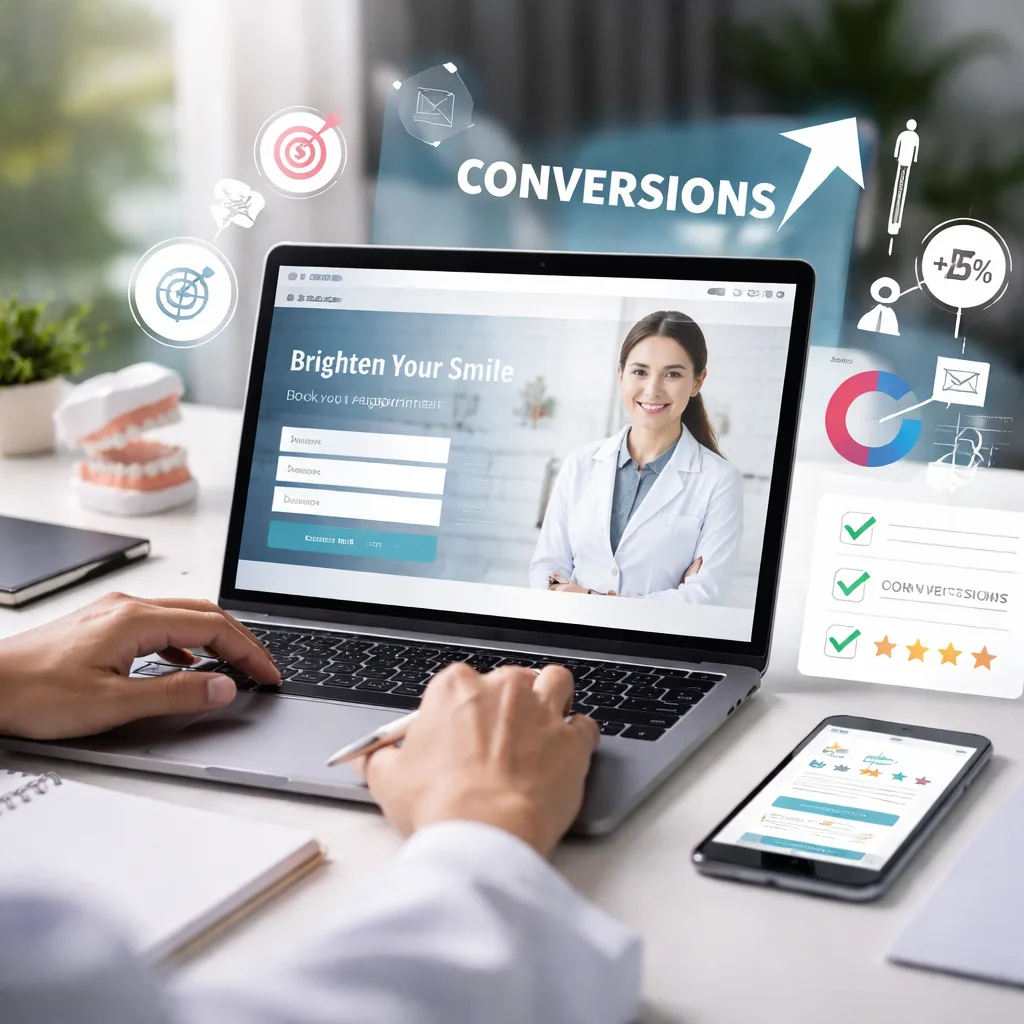
Here is what the data shows. The average dental and cosmetic website converts at around 3.1% of visitors, according to a study of over 100 million data points globally. The top-performing dental practices, with websites built around conversion as well as ranking, achieve 10% or more.
That difference translates into a much stronger return on every pound invested in bringing traffic to the site. For a practice receiving steady monthly visitors, even a modest improvement in conversion rate can lead to a noticeable increase in patient inquiries—without needing additional spend on SEO, advertising, or social media.
This guide covers twelve specific, evidence-backed improvements dental practices can make to their SEO landing pages to convert more visitors into booked patients. Every recommendation is grounded in real conversion data. None requires rebuilding your entire website. Most can be tested and implemented within two weeks. Let's get into it.
Ranking gets you the visitor. Converting gets you the patient.
A dental SEO landing page is not just your homepage. It includes every page a patient can land on through search — treatment pages, location pages, and even blog content. If you're unsure whether your site structure supports this, reviewing these essential website pages for clinics can help identify missing conversion opportunities. All of these pages bring traffic, but traffic alone does not grow a practice. What matters is what happens after the patient arrives.
Many practices focus heavily on improving rankings, assuming that more traffic will naturally lead to more bookings. In reality, that is only half the equation. A page that attracts visitors but does not guide them towards taking action creates lost opportunities. Even small gaps in user experience, clarity, or trust can stop a patient from making contact.
The difference becomes clear when you look at performance. A page that converts well can generate significantly more inquiries than a higher-ranking page that does not. This means the real return on SEO is not just measured by how many people visit your site but by how many of those visitors actually become patients.
In simple terms, traffic creates potential. Conversions turn that potential into real appointments, revenue, and growth. Practices that focus on both are the ones that see consistent and measurable results from their marketing efforts.
A large percentage of visitors never scroll beyond the first section of a page. That single behavior should shape how every dental landing page is structured. If your booking button, phone number, or next step is not visible the moment a patient lands on the page, many will leave without ever seeing it.
The first visible section needs to do the heavy lifting. It should clearly explain what the page is about, reflect what the patient is looking for, build initial trust, and guide them towards taking action. For a treatment page, this could mean a simple, patient-focused headline, a short credibility statement, and a clear booking option placed prominently. A strong structure like this is a core part of effective dental website design that prioritizes conversions.
This becomes even more important on mobile, where most searches now happen. If a user has to scroll, search, or think too much to find how to contact you, the likelihood of conversion drops quickly.
Action
Check your key landing pages on a mobile device. If the phone number or booking option is not visible straight away, adjust the layout so patients can take action without needing to scroll.
There is a tension in dental SEO copywriting between writing for search engines and writing for human beings. The best dental landing pages resolve this tension by doing both simultaneously and the headline is where it matters most.
A headline like "Dental Implants in [City]" satisfies a keyword requirement. A headline like "Restore Your Smile Permanently With Dental Implants" speaks to what the patient actually wants. The latter converts better and—with good implementation—can rank just as effectively when the keyword appears in supporting elements like the H2, body copy, and metadata.
A useful test: read your headline aloud. Does it sound like something a human being would say to another person? Or does it sound like a keyword? Rewrite it until it sounds like a reassurance or a promise. Then ensure your target keyword appears naturally in the H1 or an early H2 — not stuffed in artificially, but as part of a sentence that makes sense to a patient reading it for the first time.
Studies show that personalised messaging can increase conversions by over 200%, and the same principle applies to headlines. Specific, patient-focused language consistently performs better than generic phrasing.
Action:
Audit the H1 on your top three treatment pages. Does each one speak to a patient outcome or address a genuine concern? Rewrite any that are purely keyword-led. Test the new headline against the old using an A/B testing tool and measure the impact on time-on-page and conversion rate.
Most dental treatment pages have a single booking button somewhere near the header. This is not enough. Different patients are ready to act at different points on the page—some at the very top, having already made their decision, and others only after reading through the treatment explanation, cost section, and FAQs. A patient who reaches the bottom of your implants page and feels ready to book should not have to scroll back to the top to find the booking button.
A well-structured dental landing page places a call-to-action at a minimum of three points: at the very top (above the fold), after the mid-page treatment explanation, and again at the bottom after the FAQ and social proof sections. Each CTA should use specific, action-oriented language rather than generic labels. "Book Your Free Implant Consultation" is far more compelling than "Contact Us." "Speak to Our Team Today" creates engagement without pressure. "Check Availability" reduces the commitment implied by "Book Now" for patients who are still hesitant.
Adding a sticky booking bar, a fixed strip at the top or bottom of the screen containing a phone number and booking button that remains visible as the patient scrolls, is one of the single most impactful structural changes a dental website can make. This type of functionality is often implemented effectively through professional dental website development to ensure seamless performance across devices.
Practices implementing sticky headers consistently report meaningful uplifts in click-through rates to contact forms and phone calls.
Action: Check each of your top landing pages for CTA frequency. Every page needs at least three: top, middle, and bottom. Add a sticky booking bar if you don't have one. Replace all instances of "Contact Us" with specific, benefit-led language relevant to the treatment on that page.
Despite the growth of online booking, the telephone remains the most common way patients contact a dental practice, particularly for high-value treatments where they have questions before committing. Globally, the majority of dental appointments are still initiated by a phone call. Yet many dental websites display their phone number in small text in the footer, without making it a clickable link on mobile devices.
Your phone number should live in your fixed site header so it is always visible. It should be large enough to read at a glance, particularly on mobile screens. On any mobile device, tapping the number should open the phone dialer immediately. A number that looks clickable but requires copying and pasting instead is a friction point that costs bookings quietly and consistently.
Consider placing your phone number within the body copy of treatment pages at the precise moments a patient might have questions. For example, you can put it immediately after a pricing section. A line like "Have questions about your treatment options? Call our team directly on [number]" catches patients at the moment of hesitation and offers them a direct, human route to reassurance.
Action:
Test every phone number on your website from a mobile device. Tap it. If it does not open the dialer immediately, fix the link to a tel: format right away. Ensure the number is visible in a fixed header on every page. Add it contextually within the body of high-value treatment pages.
Missing pricing information is one of the most common and most damaging conversion gaps on dental treatment pages. Patients researching high-value treatments want to understand the likely cost before taking the next step. When no pricing or guidance is provided, many leave the page to find a practice that offers more clarity. In most cases, they do not return.
The solution does not have to be a fixed price list. Providing enough context to guide expectations is often sufficient. A simple starting price, a typical cost range, and a brief explanation of what affects the final cost can help patients feel informed and comfortable. This keeps them engaged while also setting realistic expectations before they inquire. Transparent communication is a key component of effective dental marketing services that focus on attracting the right patients.
Clear pricing information also builds trust. Patients are more likely to contact a practice when they feel the information is transparent and straightforward. It can also improve the quality of inquiries, as patients who understand the likely investment are better prepared to proceed.
Action
Add a pricing or cost guidance section to your main treatment pages. Include a starting price, a general range where possible, and details about any available payment or financing options. Monitor how this impacts inquiry levels over time.
Patients choosing a dental practice are making a personal decision. They are trusting someone with their health, comfort, and often their appearance. Generic stock images — polished models, abstract visuals, or overly staged clinic scenes — do little to build that trust. Most patients recognize these images immediately, and they can make a website feel less authentic.
Real photographs of your team, your clinic, and your work create a far stronger connection. They help patients understand who they will meet and what to expect. Strong visual storytelling combined with a well-written trust-building about us page helps patients feel more confident before contacting your practice. Before-and-after images are especially effective, as they show real outcomes in a way that is easy to understand and highly reassuring. A well-presented gallery can significantly influence a patient’s decision to inquire.
Video can strengthen this further. A short, simple introduction from the dentist helps patients feel more familiar and comfortable before they visit. Even a brief, well-shot video can improve engagement and build confidence.
Action
Start by replacing stock images on your main pages with real practice photography. Where possible, arrange a professional photo session to capture your team and environment. Consider adding a short introduction video to your homepage or key treatment pages to build trust early.
Trust is the primary conversion factor in dental patient decision-making. Before a prospective patient books a consultation, they need to feel confident that your practice is qualified, experienced, and well-regarded. Your landing pages need to demonstrate that confidence proactively, not just through your own words but also through verifiable external signals.
Professional registrations and licensing information should be clearly visible, alongside specific training, certifications, and professional memberships relevant to each treatment. These signals show that your practice meets standards beyond the baseline. Years of experience and a genuine case volume statistic—"Our team has placed over 800 dental implants"—carry more weight than abstract claims of expertise.
Patient review scores should appear prominently on treatment pages. Research shows that practices averaging four stars or more receive three times more inquiries than lower-rated competitors. Display your aggregate review rating and total review count near the top of key pages, as this communicates at a glance that many other patients have trusted you and been satisfied with the experience.
Emergency dental searches convert at 89% higher rates than general dental terms, according to local SEO data — precisely because intent is at its peak. Your emergency page, in particular, should be loaded with trust signals and conversion mechanisms, since patients in discomfort make faster decisions but also abandon pages that don't immediately reassure them.
Action: Create a "Why Choose Us" or "Our Credentials" section on your homepage and key treatment pages. Include professional memberships, certifications, years in practice, and your aggregate review rating. Display these above the fold where possible. Ensure all credentials shown are currently held and accurately described.
When a patient lands on your website, they often come with a number of questions in mind, which may include cost, treatment time, comfort, suitability, and what happens next. Whether they stay on your page or leave often depends on how clearly those questions are answered. An FAQ section is not simply an SEO tactic, although it is an effective one for capturing long-tail, question-based searches. It also acts as a direct conversion tool by addressing concerns, reducing hesitation, and helping patients feel more confident about making contact.
The most effective dental FAQ sections answer questions about cost ("How much does it cost?"), timeline ("How long will treatment take?"), comfort ("Will it hurt?"), suitability ("Am I a good candidate?"), and next steps ("How do I get started?"). Write answers in plain, conversational language — as though a knowledgeable colleague is speaking to a slightly nervous patient face-to-face. Avoid clinical jargon. Avoid vague hedging. Give genuinely useful answers that demonstrate expertise without intimidating the reader.
From a technical SEO perspective, adding FAQ schema markup to each section allows your answers to appear more prominently in search results. This can improve visibility and make your content more accessible across different search formats.
Action
Add a minimum of five FAQs to each main treatment page based on real patient questions. Ensure the answers are clear and relevant. Where possible, include structured FAQ markup and test it before publishing.
Page speed is a conversion killer that most practices underestimate. Research consistently shows that a one-second delay in page load time reduces conversions by 7%. At three seconds, which is common for many dental websites on mobile, a large number of visitors leave the page before seeing any content. For a practice investing in SEO to drive traffic, slow load times can quietly reduce a significant portion of that traffic before it has a chance to convert. If you want a deeper understanding, this guide on how load time impacts conversions explains the direct relationship between speed and patient inquiries.
The most common causes of slow dental websites include large, uncompressed image files, videos embedded directly into pages instead of being hosted externally, outdated plugins running unnecessary code, basic hosting without proper caching, and scripts that delay page loading. These issues are common and can usually be improved without rebuilding the entire website. You can also improve performance with focused site speed optimization strategies tailored for dental practices.
Google’s Core Web Vitals, including Largest Contentful Paint, Cumulative Layout Shift, and Interaction to Next Paint, are direct ranking signals as well as conversion factors. A slow site does not just affect conversions; it can also impact rankings, reducing the traffic available to convert in the first place.
Action
Run your website through Google PageSpeed Insights and review your mobile performance. If your score is low, start with image compression, as this often delivers the quickest improvement. This simple step can significantly improve load speed and overall performance.
The strategies above are proven and can deliver measurable improvements when applied. However, the most important principle is that conversion optimization is not something you complete once and leave. It is an ongoing process of testing, measuring, and refining, because patient behavior evolves, competitors improve, and what works well today may need adjusting over time.
A/B testing landing page changes have been shown to increase conversions by around 12% on average, even when some tests do not deliver clear results. The value lies in consistent improvement over time. Practices achieving higher conversion rates typically reach that level through regular refinement rather than a single redesign.
Tools such as heatmaps and session recordings can provide useful insight into how visitors interact with your pages. They show where patients click, how far they scroll, and where they lose interest. This makes it easier to identify areas that may need improvement based on real user behavior.
Building a simple habit of reviewing performance regularly can make a significant difference. Even small, consistent changes can lead to meaningful improvements over time.
Action
Install a heatmap or analytics tool on your website and review key pages regularly. Set aside time each month to assess performance, make small improvements, and track the results.
Get in touch with our healthcare marketing expert