

You only pay what you spend on your Google Ads, no commission or hidden charges
Across the UK, Invisalign has become one of the most recognised and competitive cosmetic dental treatments, but patient demand alone does not guarantee practice growth. Patients today do not choose a provider by scrolling until they find the cheapest offer. They compare clinics, read reviews, explore before and after results, assess trust signals, and often make their decision long before submitting an enquiry.
In such a competitive and high-value market, being an Invisalign provider is no longer enough. Practices must actively shape how prospective patients discover and perceive them. Marketing becomes a powerful influence, guiding decisions from the very first Google search through to the consultation and treatment journey. Every touchpoint, from your website and local visibility to paid campaigns and patient communication, contributes to how your practice is positioned.
Find out how much Invisalign marketing really costs in the UK, what drives those costs, and how practices can invest strategically to attract the right patients, strengthen market visibility, and create long-term, sustainable growth.
Before discussing budgets, it is worth understanding what Invisalign marketing actually includes because it is rarely a single activity. Most successful Invisalign campaigns combine multiple channels that work together to generate awareness, enquiries, and booked consultations.
PPC is one of the fastest ways to promote Invisalign treatment. A well-planned Google Ads strategy for Invisalign clinics can help practices maximise qualified enquiries while controlling advertising costs. Your practice appears in Google search results when someone actively searches terms such as “Invisalign near me” or “Invisalign provider in [city]”, and you only pay when someone clicks.
There are usually two costs involved: campaign management and ad spend. In the UK, many practices spend anywhere from £800 to £3,000+ per month on advertising, alongside agency or management fees if outsourced. However, the Exact Cost may vary depending on competition, location, and how aggressively you want to grow.
SEO focuses on improving your website, so it appears higher in organic search results for Invisalign-related terms. This may involve creating treatment pages, improving website structure, targeting local search intent, and building authority over time.
SEO tends to be a longer-term investment than paid advertising, but it can reduce patient acquisition costs over time. Many UK practices invest in dental between £500 and £2,500+ per month, depending on market competitiveness and campaign scope.
Social advertising promotes Invisalign through platforms such as Instagram and Facebook. Unlike search ads, these campaigns reach people before they actively begin searching and are often used to build awareness, showcase smile transformations, and generate consultation interest.
Budgets vary widely, but practices commonly invest £300 to £2,000+ per month, depending on campaign goals and audience size.
Driving traffic only works if visitors convert. Invisalign marketing often includes dedicated landing pages, treatment information, online booking journeys, before and after galleries, and conversion optimisation.
Website improvements can range from small one-off updates to larger investments, depending on how much redevelopment is required.
Content marketing includes creating blogs, patient FAQs, treatment guides, videos, photography, and before-and-after content to educate patients and support decision-making.
Content can be delivered as one-off projects or ongoing retainers and is commonly used to strengthen both SEO and conversion performance.
Not every Invisalign enquiry converts immediately, which is exactly where email marketing becomes valuable. It helps re-engage existing patients and nurture prospective patients who are still considering treatment through educational content, personalised follow ups, and timely reminders that keep your practice front of mind.
Most Invisalign patients do not book after seeing an advert. They book after seeing proof. Reviews, patient experiences, and real treatment outcomes help turn curiosity into confidence. Building a strong review profile and consistently showcasing authentic patient results gives future patients the reassurance they need to take the next step and choose your practice over the alternatives they are comparing.
Many practices choose to outsource strategy and execution to specialists offering Invisalign marketing services, ensuring every marketing channel works together to generate consistent patient enquiries. Agency support may include campaign management, reporting, creative production, optimisation, and ongoing performance reviews.
Each channel has a different cost structure and serves a different purpose. Some drive faster results, while others build long-term visibility. For most UK practices, the strongest Invisalign growth comes from combining immediate demand generation with sustainable long-term marketing assets.
There is no fixed amount every practice should spend on Invisalign marketing because growth goals, competition, and local demand vary significantly across the UK. A practice looking to generate a handful of additional Invisalign cases each month will invest very differently from one aiming to establish itself as a recognised Invisalign provider in its region.
That said, marketing investment should remain commercially sensible. Since Invisalign is a premium elective treatment, practices often benefit from proven high-ticket dental treatment marketing strategies that focus on maximising patient lifetime value rather than simply reducing acquisition costs. Across industries, businesses often allocate a percentage of annual revenue towards marketing activity, but for higher value elective treatments such as Invisalign, practices typically think less in terms of spend alone and more in terms of patient acquisition and return on investment.
Your budget should reflect where your practice currently stands and where you want it to go.
For practices at an earlier stage, investment often focuses on building the foundations, such as website performance, local visibility, reviews, and treatment pages. Growth-focused practices may layer in paid advertising, content creation, and ongoing optimisation to accelerate demand.
The strongest Invisalign marketing strategies are rarely built around spending more than competitors. They are built around investing intentionally, tracking what generates consultations, and creating a system that consistently turns interest into treatment starts.
Here's what three types of UK dental practices typically spend, and what they can realistically expect in return.
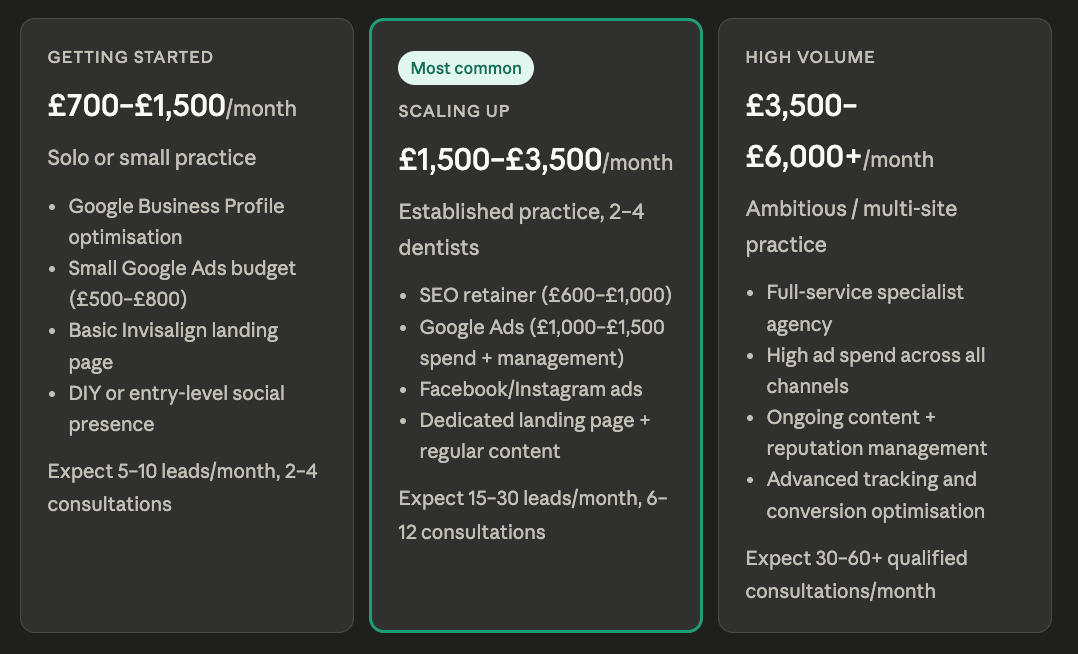
Several variables will push your Invisalign marketing costs up or down:
London and the South East are significantly more expensive than the rest of the UK for both paid advertising and SEO. A campaign that costs £1,500/month to deliver strong results in Sheffield might cost £3,000+ for equivalent results in Central London. This is simply a reflection of competition — more practices are bidding on the same keywords, which drives prices up.
Practices holding Invisalign Gold or Diamond Provider status tend to achieve faster SEO results and stronger conversion rates, because patients actively filter for experienced providers. This can justify higher upfront investment, as the conversion rate on your existing traffic will be better.
If your current website is slow, not mobile-optimised, or doesn't have a dedicated Invisalign page, you're effectively pouring water into a leaky bucket. Every pound you spend on advertising is fighting against a website that isn't converting. Fixing the foundation first is almost always the better decision.
A generalist agency charges the same whether they're running campaigns for a dental practice or a plumber. A dental specialist knows the nuances: GDC-compliant messaging, which treatment-specific keywords convert versus which waste budget, how to handle before-and-after photography within advertising guidelines, and what patient psychology drives a £4,000 treatment decision. The difference in outcomes between the two can be substantial.
Practices allocating their budget across coordinated campaigns combining organic SEO with targeted paid advertising deliver 3.2 times better ROI than single-channel approaches. The most effective split, based on industry data: 60% to SEO and content, 30% to paid search, 10% to social media and reputation management.
The general benchmark is 7–10% of annual turnover. A practice turning over £500,000 a year should typically invest £2,500–£4,000 per month. Practices actively looking to grow Invisalign revenue may benefit from investing above this threshold during a growth phase.
Yes, with realistic expectations. A smaller practice in a less competitive market can generate meaningful Invisalign revenue with a modest budget of £700–£1,500/month, provided the campaign is well-targeted and your consultation conversion process is solid.
Paid advertising can start generating enquiries within 7–14 days of launch. SEO typically takes four to six months in less competitive markets, up to twelve months in London. Most practices find the first 60–90 days is a bedding-in period, with consistent, reliable results from month three onwards.
Be cautious of agencies requiring 12-month contracts before they've demonstrated results. Better agencies offer 90-day trials or monthly rolling contracts after an initial setup period. Always ask for this before signing anything.
The General Dental Council and the Advertising Standards Authority have strict rules about dental marketing in the UK. You can't use phrases like "guaranteed results," feature unverified testimonials, or make comparative claims without substantiation. A dental-specialist agency builds compliance into its process; a generalist may not, putting your registration at risk.
Get in touch with our healthcare marketing expert