
You only pay what you spend on your Google Ads, no commission or hidden charges
New York and Los Angeles are both highly competitive dental markets, but patients in each city search, compare, and choose practices in very different ways. In New York, dental marketing often has to compete within dense neighborhoods where several practices may be just a few blocks apart. In Los Angeles, the challenge is often broader geographic competition, longer travel distances, and highly competitive cosmetic and specialty searches.
That difference changes how a dental practice should approach SEO, local search, paid advertising, content, reviews, and even its website messaging. A strategy that works well for a dentist in Manhattan may not deliver the same results in Beverly Hills, Santa Monica, or Downtown Los Angeles.
The strongest dental marketing strategies are built around the market, not simply the city name. This guide breaks down how dental marketing strategies in New York and Los Angeles differ, what patients in each market are looking for, and where practices should focus their efforts to stand out in two of the most competitive dental markets in the U.S.
Most patients don't ask a neighbor for a dentist anymore. They Google it. More than 70% of patients start their search for a new dentist online, which makes showing up in Google Search and the Local 3 Pack a major part of attracting new patients.
In major markets like New York and Los Angeles, that competition can also make paid search more expensive. Current 2026 dental Google Ads benchmarks put New York's average CPC at $11.77, about 50% above the national average, while Los Angeles sits at $11.38, about 45% above the national average.
That means the generic "spend $1,500 a month on Google Ads" advice may not deliver the same results in these markets. Your budget, targeting, keywords, and landing pages need to match the competition you're actually facing.
And paid search is only part of the picture. Strong local SEO strategies, an optimized Google Business Profile, useful treatment content, and genuine patient reviews all help a practice compete for local visibility.
In other words, New York and Los Angeles may both be competitive dental markets, but they don't require the same marketing playbook. Understanding that difference can help practices spend their time and marketing budget where it has the best chance of bringing in the right patients.
Here's the side by side breakdown most dentists want to see first.
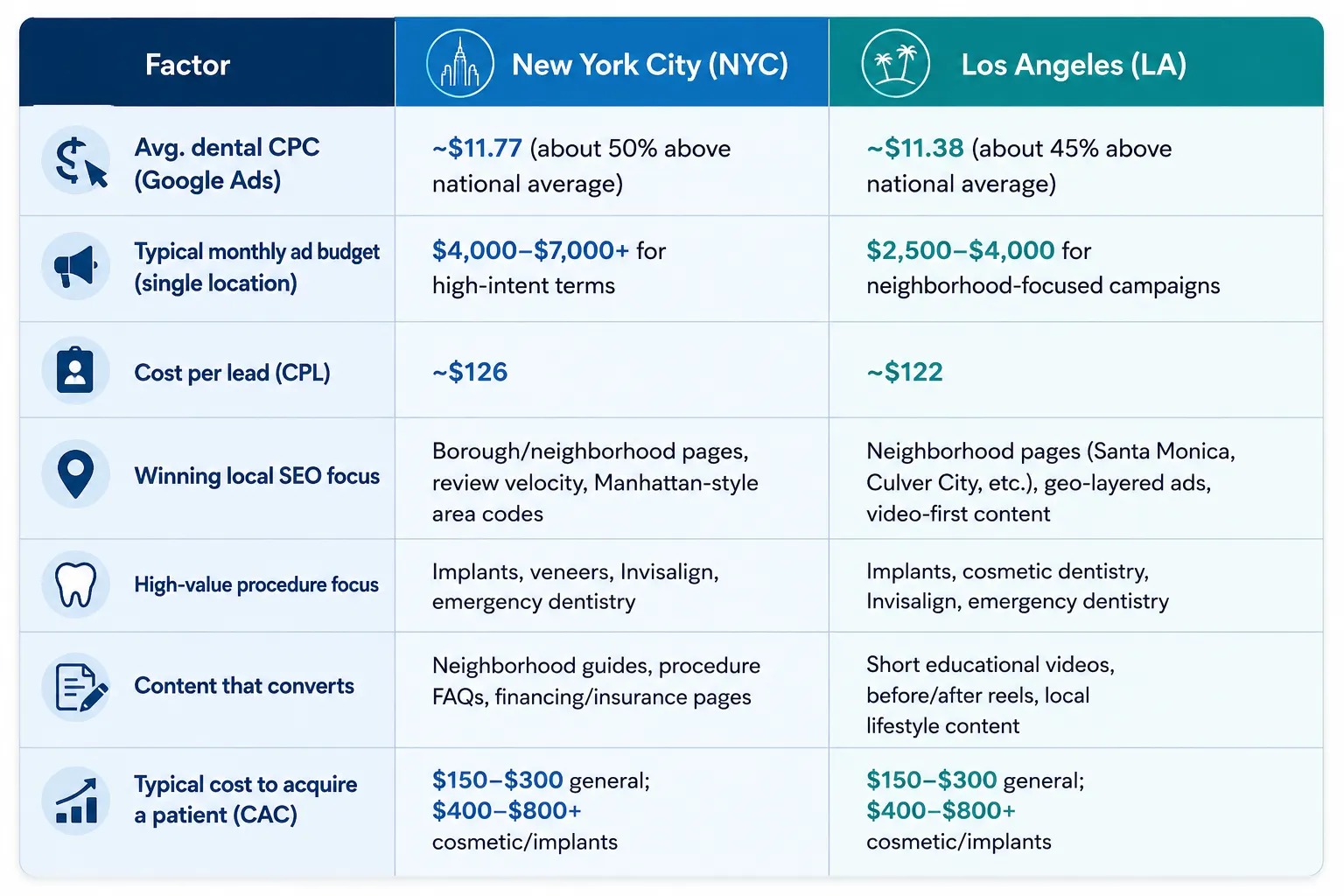
Both markets reward hyperlocal SEO, fast follow-up, useful content, and genuine patient reviews. NYC tends to need tighter borough and neighborhood targeting, while LA gives practices more room to compete through neighborhood-specific content, visual marketing, and geo-targeted campaigns.
Search habits in New York and Los Angeles reveal an important pattern that dental practices should pay attention to. Patients rarely rely on broad searches alone. They usually add a neighborhood, treatment, or specific concern to narrow down their options.
In New York, location-based searches often get very specific, with patients searching areas such as the Upper East Side, Midtown, Williamsburg, and Long Island City. In Los Angeles, similar searches focus on neighborhoods such as Santa Monica, Culver City, Pasadena, and Silver Lake. This makes neighborhood-focused content especially valuable in both markets.
Treatment and urgency also shape how patients search. Someone looking for an “emergency dentist near me” or “same day dentist” is usually much closer to booking than someone searching for the “best dentist near me.” Searches such as “dental implants cost NYC” or “Invisalign Los Angeles” show a different intent. These patients are comparing practices and looking for clear information before making a decision.
Practices that understand these search patterns can build content around the questions patients are actually asking. Location pages, treatment guides, pricing information, financing details, reviews, and easy booking options can all help turn those searches into real patient inquiries.
Local SEO becomes especially important in markets as competitive as New York and Los Angeles. Patients rarely search for a dentist using the city name alone. They often add a neighborhood, treatment, or specific need to narrow down their options.
New York City: Local visibility often comes down to borough and neighborhood relevance. Pages targeting areas such as the Upper East Side, Midtown, Williamsburg, and Long Island City can help practices connect with more specific searches. A complete Google Business Profile, fresh patient reviews, accurate location details, and locally relevant content all strengthen that presence.
Los Angeles: Neighborhood targeting matters just as much, but the market is spread across a much wider area. Practices can build stronger local relevance by creating useful pages for areas such as Santa Monica, Culver City, Pasadena, and Silver Lake. Local information, treatment specific content, reviews, and visual content can help reinforce that the practice genuinely serves the surrounding community.
The key difference is how local the strategy needs to become. NYC practices often compete within tightly packed neighborhoods, while LA practices may need to build visibility across a broader network of distinct local communities.
Google Ads is already competitive for dentists, and major markets like New York City and Los Angeles can push costs even higher. Current 2026 benchmark data puts average dental CPC at $11.77 in New York and $11.38 in Los Angeles, compared with a $7.85 national benchmark. That makes location, targeting, and lead quality especially important.
The cheapest click isn't necessarily the best click. Your ad, location targeting, landing page, and follow-up process all need to work together.
Focus on:
For practices competing in either market, Google Ads for dentists can provide immediate visibility while organic search efforts develop.
Multilingual marketing can be a real advantage in both New York and Los Angeles, especially for practices serving neighborhoods where patients regularly speak languages other than English at home.
New York City: Language needs can change quickly from one neighborhood to another. Queens and the Bronx, for example, have some of the city's highest shares of residents who speak a language other than English at home.
Los Angeles: The same opportunity exists across diverse communities throughout the city. Practices serving areas such as Koreatown, Boyle Heights, Thai Town, or Historic Filipinotown can make their marketing more accessible by reflecting the languages and communities they genuinely serve.
If your practice serves a multilingual community, consider translated treatment pages, bilingual patient resources, and language-specific advertising where there is real demand. Keep your Google Business Profile accurate and consistent, while using your website and campaigns to provide deeper multilingual information.
Is it more expensive to market a dental practice in NYC or LA?
Both are expensive, but for different reasons. NYC has the higher ceiling on general Google Ads CPC, largely because of patient density and strong DSO competition. LA can be especially expensive for cosmetic and premium neighborhood terms, driven by the city's strong cosmetic dentistry market. If you run a general or family practice, NYC may cost more overall. If you run a cosmetic-heavy practice, LA's premium terms can rival or exceed it.
Should a new practice in either city prioritize SEO or paid ads first?
Most agencies recommend running both simultaneously: paid ads for immediate visibility while organic SEO builds toward its typical 6–12-month payoff window. Relying on SEO alone in the first year can make it harder to keep the schedule full while your organic presence is still growing.
Does multilingual marketing really move the needle, or is it optional?
In both cities, it can be a strong opportunity if your practice sits in or near a diverse patient base. It can open the door to an underserved audience while making your practice more accessible to patients who prefer to search and learn in another language. The real opportunity depends on your location and local demand.
How long before a competitive-market dental SEO campaign shows real results?
Expect early movement in 3–4 months and more meaningful, compounding results in the 6–12 month range in both cities. Citywide terms can take longer, while neighborhood-specific and long-tail terms may gain traction sooner.
Our healthcare marketing expert will get in touch with you

.gif)