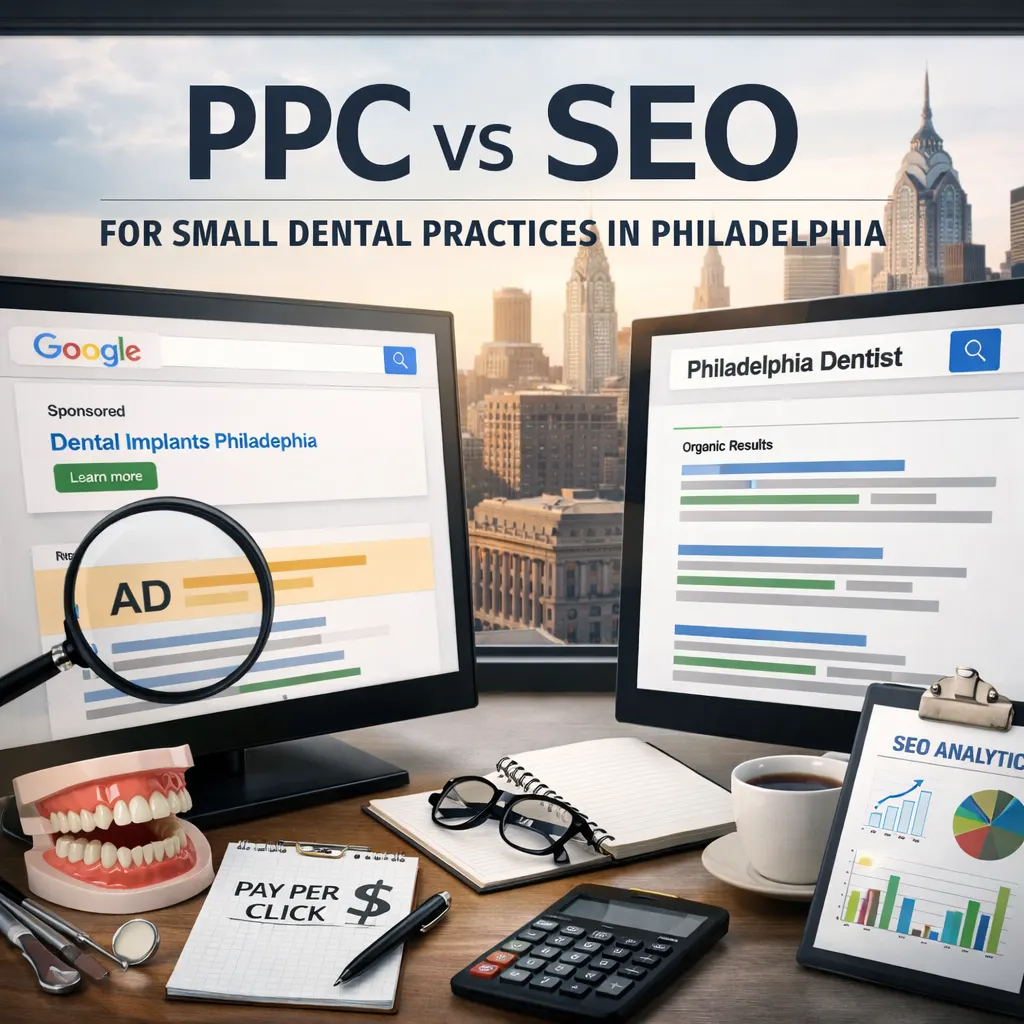
Small businesses are often tight on budget, and small dental practice owners in Philadelphia are no different. It's always a difficult choice for them to allocate marketing budgets between two powerful digital strategies, Pay-per-click (PPC) and search engine optimization (SEO). Both Pay-per-click (PPC) and search engine optimization (SEO) are well known for patient acquisition success. Pay-per-click (PPC) advertising delivers immediate visibility and instant patient leads, while search engine optimization (SEO) builds long-term organic authority and sustainable growth. Thus, it's important to understand when to implement each strategy or maybe have an effective combination. This plays an important role for independent practices to maximize their marketing investments. If not done carefully, it may lead to resource wastage in one of the East Coast's most competitive dental markets.
Philadelphia's metro area, with a population approaching 6.2 million and over 3,500 competing dental practices, creates intense pressure on small independents. Affluent neighborhoods like Center City, Rittenhouse Square, and the Main Line drive demand for high-value services such as implants and cosmetics. On the contrary, areas like Fishtown, Northeast Philly, and South Philly offer opportunities for family and general dentistry. In 2026 and beyond, AI is going to reshape search results and patient behaviors, favoring trusted, local providers. Hence, it is crucial to have the right blend of PPC and SEO for filling schedules predictably.
Dental PPC strategies, primarily through Google Ads, create instant visibility for small Philadelphia practices by placing targeted advertisements above organic search results. A new or struggling practice can appear immediately when potential patients search for urgent services like “emergency dentist Philadelphia,” specialty treatments such as “dental implants Center City,” or general queries like “dentist near me Fishtown.”
PPC campaigns deliver measurable results through precise targeting capabilities that reach specific demographics, geographic locations, and search intentions. Practices can geo-target within a 5-15 mile radius, layer income levels, device types, and even time-of-day bidding to capture high-intent patients actively seeking solutions, often during pain episodes or cosmetic research phases.
Cost considerations present both advantages and challenges for dental PPC implementation in Philadelphia. Keyword costs vary significantly, with general terms remaining more affordable while specialized procedures command premium prices. In 2026, the average cost-per-click (CPC) for dental keywords hovers around $7.85 nationally, but in competitive Philadelphia markets, it often ranges from $6.50 to $9.75 for general dentistry, climbing to $10–$20+ for Invisalign or cosmetics and $15–$35+ for implants in high-demand areas.
Small practices typically allocate monthly budgets of $2,000–$6,000, with realistic starting points at $2,500–$3,500 for meaningful volume. Local Service Ads (pay-per-lead model) offer an alternative, often at $40–$90 per qualified call, appearing prominently above traditional ads. Practices seeking faster traction often rely on Google Ads for dentists to capture urgent, high-intent searches.
Dental PPC requires continuous investment to maintain visibility. Once spending stops, patient acquisition from paid channels immediately ceases, creating dependency on ongoing budget allocation. This characteristic makes PPC ideal for seasonal promotions, new service launches, emergencies, or practices needing quick cash flow rather than long-term standalone growth.
Dental SEO services establish sustainable patient acquisition through organic search visibility that compounds over time. Small Philadelphia practices investing in comprehensive SEO experience and continuous patient discovery without per-click costs, creating long-term value that justifies initial optimization investments. Mature campaigns often generate 40-60% of new patient inquiries through organic results, including the dominant Local Pack (Google Maps + top 3).
Patient trust significantly favors organic search results over paid advertisements in dental decisions. Industry data shows that patients prefer clicking organic listings, perceiving them as more credible due to earned positions rather than purchased visibility. This trust translates to higher-quality patients who research thoroughly and commit to longer-term care.
Dental SEO encompasses technical optimization, local search dominance, and authoritative content creation. Efforts include perfecting Google Business Profiles (with photos, posts, and review management), developing educational content on topics like “dental implant costs in Philadelphia,” building citations from local directories, and earning backlinks from reputable sites. In 2026, AI Optimization (AIO) alongside traditional SEO helps content appear in generative summaries. Practices investing in dental SEO services in Philadelphia are better positioned to capture long-term local demand as search continues to evolve.
Time investment represents the primary challenge for dental SEO implementation. Significant ranking improvements typically require 3–6 months in less competitive neighborhoods (e.g., Northeast Philly) and 6–12+ months in saturated areas like Center City before generating substantial patient volume. This timeline can conflict with practices facing urgent revenue needs.
Monthly managed SEO costs for small Philadelphia practices range from $1,500 to $4,500, with most investing $2,000–$3,500 for comprehensive local strategies. Once rankings stabilize, maintenance drops, delivering compounding returns.
Dental marketing budgets demand careful allocation between immediate returns and long-term growth. PPC provides predictable cost-per-patient metrics, enabling precise planning and immediate ROI calculations. Practices can track exact acquisition costs and scale based on conversions and lifetime value (LTV), often $7,000–$10,000+ per patient for retained care.
Typical benchmarks show PPC cost per lead (CPL) at $50–$140 and cost per new patient (CAC) at $175–$350 (or higher in premium Philly areas). With strong conversion (8–12% click-to-lead, 40–60% lead-to-appointment), ROI can reach 3x–7x quickly.
SEO requires substantial upfront investment without guaranteed short-term timelines. However, successful campaigns generate compound returns, with long-term CAC often dropping to $80–$200 or less. Mature Philadelphia SEO efforts deliver 5x–15x+ ROI after year one, as organic traffic persists with lower ongoing costs.
Many small practices implement hybrid budget allocation, balancing immediate needs with sustainable growth. Recommended distribution typically allocates 60-70% toward SEO for long-term foundation building and 30-40% toward PPC for high-intent coverage and competitive defense. This balanced approach ensures steady patient flow while reducing future paid dependency.
Advanced attribution modeling reveals that patients often discover practices organically but convert through remarketing or PPC, highlighting the interconnected value of both strategies.
Dental PPC excels at capturing patients with immediate needs through time-sensitive targeting. Emergency services, same-day appointments, and high-value procedures like implants benefit from PPC's ability to intercept urgent searches. Geographic precision focuses budgets on patients within travel distance, while demographics target families for pediatric care or affluent groups for cosmetics.
SEO targets patients throughout extended research processes. Those comparing providers, seeking education on treatments, or evaluating options discover practices organically. This segment often yields higher LTV through stronger relationships and treatment acceptance. Practices enhance this journey through fast, conversion-focused websites supported by dental web design in Philadelphia that improves usability and trust.
Practices optimize PPC landing pages for quick bookings with clear calls-to-action, while SEO content builds trust with comprehensive information, FAQs, and before-and-after galleries.
Philadelphia's saturated market, with extreme income disparities and university influences (Penn, Drexel, and Temple), creates unique dynamics. Practices in competitive downtown areas face higher CPCs, while underserved neighborhoods allow faster SEO wins.
Local factors like SEPTA accessibility and neighborhood pride favor hyper-local SEO (e.g., “best dentist in Fishtown”). High competition from DSOs pushes independents toward niches: anxiety-free care, cosmetics in affluent suburbs, or community-focused general dentistry.
In 2026, AI-driven search and review velocity amplify both channels. Strong Google Business Profiles impact Local Pack dominance, crucial for ~45-60% of local clicks.
Top dental marketing partners implement analytics frameworks tracking key indicators: CAC, LTV, conversion rates, and channel-attributed revenue. Call tracking attributes inquiries, revealing high-performing keywords or content.
Quarterly reviews enable reallocation toward the best ROI sources. Integrated tools ensure no leads slip through, maximizing every marketing dollar.
Independent practices should adopt sequential strategies: Launch targeted PPC for immediate volume while building SEO foundations. New practices benefit from PPC-heavy approaches to establish presence; once stabilized, shift toward SEO to reduce dependency.
Established practices prioritize SEO to leverage reputation, maintaining strategic PPC for launches or defense.
The most successful small dental practices in Philadelphia implement integrated strategies that leverage PPC’s immediate visibility and SEO’s sustainable authority. Budget decisions should align with practice maturity, acquisition urgency, and long-term goals—not an either/or choice, but a complementary partnership.
In 2026's evolving landscape, the smart hybrid strategy—using PPC to accelerate growth while SEO builds an unshakeable foundation—delivers the best, most predictable results.
Our healthcare marketing expert will get in touch with you

.gif)