.png)
Most orthodontic practices are losing patients before the first phone call ever happens — not because of their clinical skill, but because they are invisible on Google. When a parent searches "orthodontist near me" or an adult Googles "Invisalign cost," the practices in the top three results capture the overwhelming majority of clicks. Everyone else competes for scraps.
Search engine optimisation (SEO) is what decides where you land. This guide breaks down exactly how SEO works for orthodontic practices — what matters, what is a waste of time, and how to turn organic search into a steady stream of high-value cases. It is written for orthodontists and practice managers who want a clear, actionable roadmap, not vague theory.
If you would rather have specialists handle this for you, Remedo offers dedicated orthodontist SEO services. But everything in this guide is something you can start applying today.
SEO for orthodontists is the practice of optimising your website and online presence so that your practice appears higher in Google search results when potential patients look for orthodontic treatment. It combines technical website improvements, content creation, local search optimisation, and reputation management to increase your visibility for the searches that matter most — terms like "braces near me," "Invisalign [city]," and "orthodontist for adults."
Unlike paid advertising, which stops the moment you stop paying, SEO builds a compounding asset. A page that ranks well continues attracting patients month after month at no incremental cost per click. For most orthodontic practices, it is the single highest-return marketing channel available over the long term.
You cannot simply apply general dental SEO advice to an orthodontic practice and expect results. The search landscape is fundamentally different in three ways.
The keywords are treatment-led, not service-led. General dentists rank for "dentist near me" and "dental checkup." Orthodontists compete for treatment-specific clusters with enormous volume and intent: Invisalign, clear aligners, metal braces, ceramic braces, and adult orthodontics. Each of these is its own keyword universe with its own competition.
The patient decision cycle is longer. Orthodontic treatment is a months-long, multi-thousand-pound commitment that changes a person's appearance. Patients research extensively, compare practices, and revisit your website several times before booking. Your SEO has to capture them at multiple stages, not just the final "book now" moment.
Local competition is fierce. Orthodontists compete in tightly defined geographic areas. Two practices five miles apart are direct rivals for the same Map Pack positions. This makes local SEO for orthodontists the highest-priority battleground for most practices.
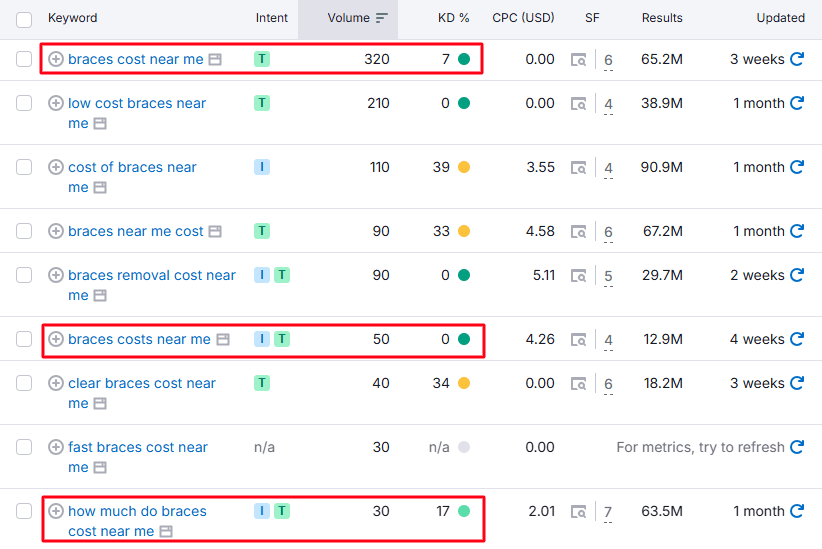
Everything in SEO starts with knowing what your future patients type into Google. For orthodontic practices, keywords fall into clear clusters:
The mistake most practices make is targeting only the high-competition head terms and ignoring the long-tail questions where patients are actually forming decisions. A solid approach to keyword research maps all four clusters and builds dedicated content for each. Aim for a keyword universe of 80–150 distinct terms.
On-page SEO is about making each page on your website unmistakably relevant to the keyword it targets — and compelling enough that visitors take action.

Key on-page elements for orthodontic pages:
A high-converting orthodontic page also needs the right design foundations. Our breakdown of must-have orthodontic website features covers what separates sites that convert from ones that just look nice.
For orthodontic practices, the Google Map Pack — the three local business listings that appear above organic results for location-based searches — is the most valuable real estate on the entire results page. Patients searching "orthodontist near me" see it first.
Winning local search requires:
Local SEO is different enough from organic SEO that it deserves a focused strategy. Our local SEO for orthodontists service is built specifically around these signals.
Beyond your treatment pages, content marketing captures patients earlier in their journey — when they are researching, not yet ready to book. This is where you build trust and authority.
The highest-value content topics for orthodontic practices answer the questions patients are already asking:
Each genuinely helpful article does double duty: it ranks for informational searches, and it builds the trust that converts a researcher into a patient. Practices that dominate orthodontic search are the ones that have built a real library of useful content, not just a handful of service pages.
Technical SEO is the layer most practices ignore — and the one that quietly caps everyone's rankings. It covers:
A technical audit is the right starting point for any serious SEO effort — it often reveals quick wins that lift rankings across the whole site.
SEO is a long game, and honesty matters here. Here is a realistic timeline:
Practices that treat SEO as a 12-month commitment rather than a 3-month trial see by far the best returns. The payoff is a cost per acquired patient that, by month 12, is typically a fraction of paid search.
The two are complementary, not competing. SEO builds long-term, compounding visibility but takes months to mature. Orthodontist Google Ads deliver immediate visibility and patient enquiries from day one, at a higher cost per acquisition.
The smartest approach for a growing practice: run Google Ads in the first six months to generate enquiries while SEO builds, then rebalance spend as organic rankings take over the high-volume terms. Relying on either alone leaves growth on the table.
Remedo is a specialist healthcare marketing platform that works exclusively with dental and medical practices. For orthodontists, we deliver full-service SEO — technical audits, keyword strategy, on-page optimisation, local SEO, and content production — all tracked against the outcome that matters: new patient enquiries from search.
If you want to stop losing patients to better-ranked competitors, our orthodontist marketing team can build a strategy specific to your practice and local market.
SEO for orthodontists is the process of optimising your website and online presence to rank higher in Google for searches like "braces near me" or "Invisalign [city]." It combines technical optimisation, content, local SEO, and reviews to attract more patients from organic search — without paying per click.
Initial ranking movements typically appear within three to four months. Meaningful traffic and enquiry growth usually builds between months five and nine, with full competitive authority taking nine to twelve months. The exact timeline depends on your starting point and local competition.
Start with treatment terms combined with your location — "Invisalign [city]," "braces [city]," "clear aligners near me." Then add cost and comparison searches ("how much does Invisalign cost," "Invisalign vs braces") and local "near me" terms. A complete strategy usually covers 80–150 keywords across treatment, local, and question clusters.
Both, used together. Google Ads deliver immediate enquiries while SEO builds. SEO produces compounding, lower-cost results over time. Most growing practices run paid ads in the first six months, then rebalance toward organic as rankings mature.
Basic local SEO — keeping your Google Business Profile complete and responding to reviews — is manageable in-house. Competitive SEO for high-value terms in a busy market requires technical work, content volume, and ongoing strategy that most practices find more effective to outsource to specialists.
For local searches, your Google Business Profile and review profile carry the most weight. For broader organic terms, it is a combination of relevant, well-structured content and a technically sound, fast website. The practices that win invest in both.
Our healthcare marketing expert will get in touch with you

.gif)