

You only pay what you spend on your Google Ads, no commission or hidden charges
Neighborhood marketing has always been one of the smartest ways for local businesses to grow, and dental practices are no exception. While it might sound tempting to market to an entire city, most patients aren't willing to drive across town for routine dental care. They're usually looking for a trusted dentist close to home, work, or their child's school.
That's why many of the fastest-growing practices don't try to dominate an entire city from day one. Instead, they focus on becoming the first choice in a handful of nearby neighborhoods. By building strong local visibility, earning reviews from nearby patients, and creating a recognizable presence where people actually live, they generate steady patient growth without spreading their marketing budget too thin.
In this guide, we're going to walk through the real differences between neighborhood and city-wide marketing, where each strategy wins, which types of dental practices should lean one way or the other, and, most importantly, why trying to market to everyone is one of the fastest ways to dilute your budget and lose patients to nearby competitors.
At first glance, they sound similar. After all, both are trying to attract more local patients. But the way they do it, and the results they produce are very different.
Citywide marketing means promoting your practice to everyone in an entire city or metro area, regardless of whether they live 5 minutes or 50 minutes from your office. Think citywide radio ads, billboards on the highway, generic "Best Dentist in [City]" Google Ads campaigns, or a Facebook ad set targeting the whole metro.
Neighborhood marketing (sometimes called hyperlocal marketing) means concentrating your time, budget, and messaging on the specific streets, ZIP codes, and communities immediately around your office, typically the three- to seven-mile radius where the overwhelming majority of your actual patients already live or work.
The difference is simple.
Citywide marketing is built around maximum reach.
Neighborhood marketing is built around maximum relevance.
For most independent dental practices, relevance almost always wins.
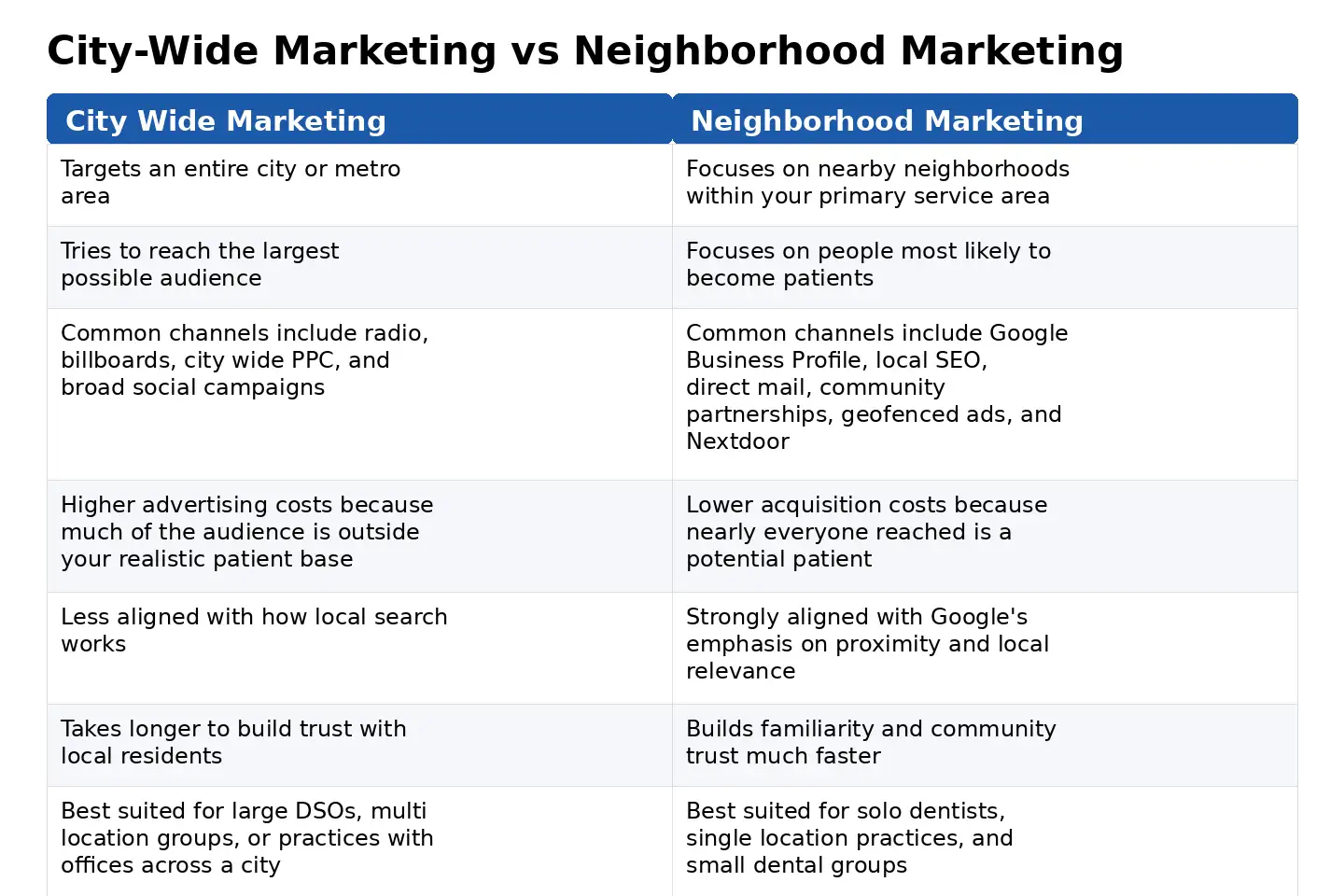
Citywide marketing rarely fails overnight. Instead, it quietly drains your budget. You might see more impressions or website visits, but new patient numbers barely move. Here's why.
Targeting a keyword like "dentist in Houston" means competing against every large dental group, multi-location DSO, and long-established practice in the city. Many of them have thousands of reviews, years of local authority, and much bigger marketing budgets.
Google ranks local businesses based on three main factors: relevance, distance, and prominence. A city-wide strategy leans heavily on prominence while overlooking distance. The reality is that patients searching nearby are far more likely to see and choose a practice that's closer to them.
Running ads across an entire city means paying to reach people who are too far away to become patients. Most won't drive past several other dental offices just to visit yours. That budget could be spent reaching people who actually live or work nearby.
Phrases like "Comprehensive Dental Care in [City]" could describe almost any practice. They don't stand out to Google or to patients. Content focused on specific neighborhoods, local landmarks, schools, or nearby communities feels far more relevant and builds stronger local trust.
Ranking for broad city-wide keywords can take months or even years in competitive markets. Neighborhood-focused keywords usually face much less competition, making them easier to rank for and far more cost-effective over time.
Google has made it clear that local rankings are based on three core factors: relevance, distance, and prominence. Understanding how they work helps explain why neighborhood marketing consistently outperforms broad city-wide campaigns.
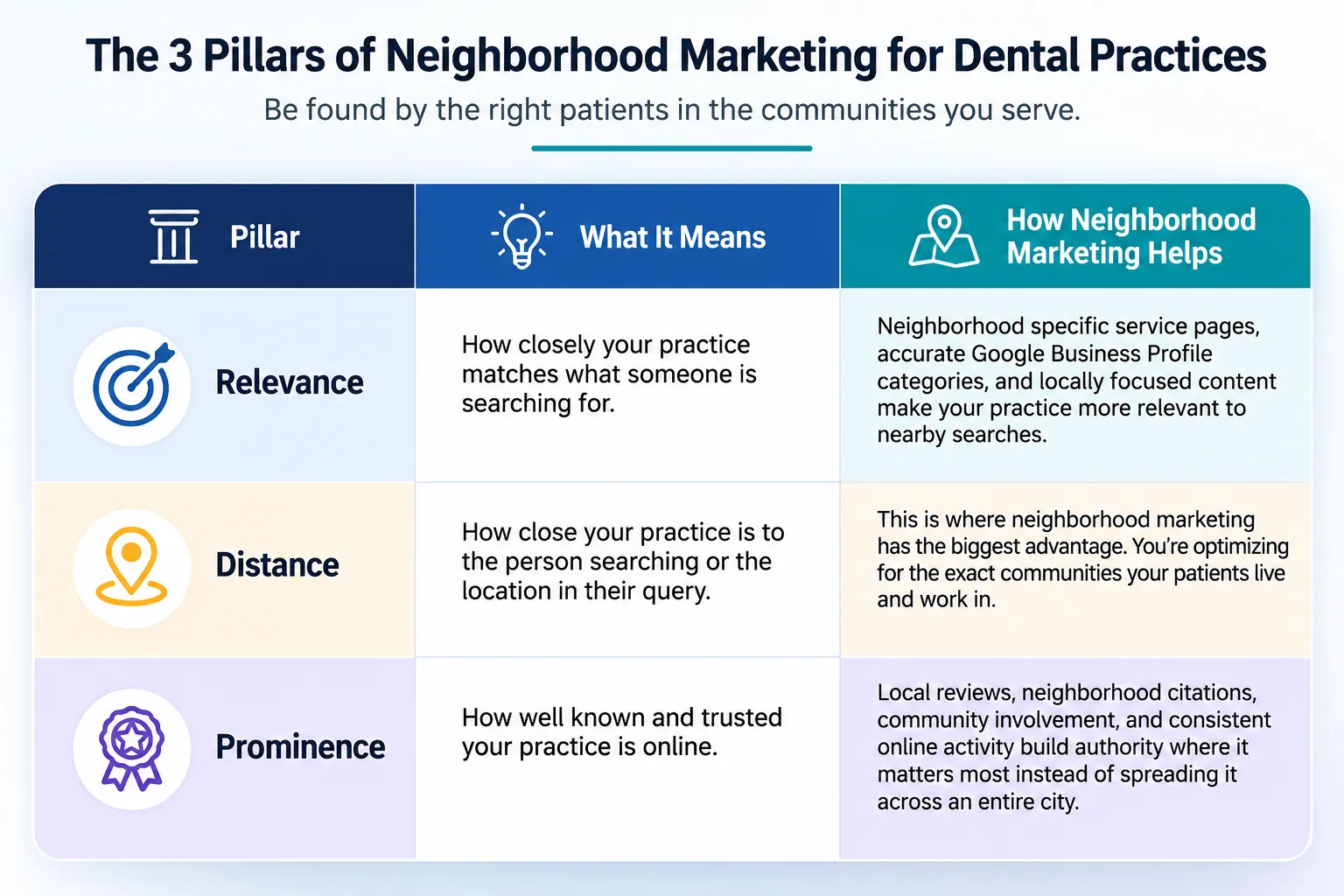
The biggest mistake many practices make is assuming they can simply outspend their competitors. In reality, you can't outspend proximity. A patient searching from a nearby neighborhood is far more likely to see and choose practices that Google considers both relevant and close by.
This is why neighborhood marketing works so well. Instead of competing with every dental practice across an entire city, you're strengthening the exact local signals Google uses to decide which practices deserve to appear in front of nearby patients.
If there's one thing we've learned from working with dental practices, it's this: you don't dominate a city overnight. You dominate the neighborhoods around you first. That's the strategy behind many of our strongest local SEO results, and it's the same pattern we'll walk through below.
Winning practices in competitive metros like Chicago and New York aren't relying on a single "Dentist in Chicago" page. They're building dedicated pages for individual neighborhoods, Lincoln Park, The Loop, Wicker Park in Chicago, and borough and neighborhood-specific pages across Manhattan, Brooklyn, Queens, the Bronx, and Staten Island in New York City.
Each page is optimized with:
Practical pattern to copy: Create one clean, genuinely useful page for every neighborhood or ZIP code you actually serve, not a thin, duplicated template with only the neighborhood name changed. Google can tell the difference, and so can patients.
Multiple dental marketing analyses of competitive metro markets point to the same conclusion. Your Google Business Profile (GBP) needs to be optimized at the ZIP code and neighborhood level, not just for the city. That includes accurate service area settings, neighborhood-relevant categories, geo-tagged photos, and Google Business Profile posts that reference specific local events or offers.
Big brand competitors will almost always have more total reviews than a smaller neighborhood practice. That's simply the reality. However, the data shows that review recency and a steady flow of new reviews matter more to both patients and Google's algorithm than one large collection of older reviews.
Practices that consistently ask every satisfied patient for a review tend to outperform practices that collected hundreds of reviews years ago and then stopped.
Competitor websites that dominate neighborhood searches are earning backlinks and mentions from local news outlets, neighborhood associations, youth sports sponsorships, local business directories, and nearby businesses, not just national dental directories.
These local signals strengthen prominence and are much harder for a city wide competitor to replicate quickly.
Even large Dental Service Organizations (DSOs) with dozens of locations are moving away from one-size-fits-all marketing.
The emerging best practice is to keep branding and clinical standards consistent across every location while allowing each office to build its own local identity, neighborhood content, and community presence.
Patients respond far better to a practice that feels like their neighborhood dentist than one that feels like another branch of a large chain.
The practices winning today aren't necessarily the ones with the biggest marketing budgets. They're the ones treating each neighborhood as its own market, with its own content, reviews, citations, and local relationships, rather than trying to blanket an entire city with one generic message.
Don't assume where your patients come from. Look at your patient data and map it. Most practices discover that 80% to 90% of their active patients live within a 5- to 10-mile drive, depending on the area. That's your real market, not the entire city.
Practical tip:
For each neighborhood you actually serve, create a page that includes:
Most importantly, don't create duplicate pages by simply changing the neighborhood name. Original, helpful content always performs better.
Set up a simple system where every happy patient receives a text or email asking for a Google review within 24 hours of their appointment, along with a direct review link. Consistency matters far more than volume. A steady stream of 3 to 5 new reviews each week is much more valuable than collecting 50 reviews all at once and then going silent.
A simple approach is to train your front desk to say:
"If you have a minute, we'd really appreciate a quick Google review. It helps other families in the neighborhood find us."
It's natural, low pressure, and surprisingly effective.
If you're running Google Ads or social ads, set your radius targeting to match your actual service area, typically 3 to 8 miles, depending on your location, instead of targeting the entire metro area.
By focusing on the neighborhoods around your practice, you can:
Neighborhood marketing isn't just about being visible online. Get involved in the community by sponsoring a local youth sports team, setting up a booth at neighborhood events, or partnering with nearby schools for dental health programs.
These activities build genuine local recognition, strengthen word of mouth, and create the kind of community trust that no amount of city-wide advertising can replace.
To appear for the local searches that actually bring new patients through your door, your keyword strategy needs to go beyond broad city terms. Focus on the neighborhoods, landmarks, and high-intent search phrases your ideal patients are already using when they're ready to book.
Here's a practical keyword structure you can build around.
Focus on your main treatments combined with the neighborhoods you serve.
These searches usually come from patients who are ready to book.
As voice search and AI-powered search continue to grow, patients are searching more naturally.
Many patients search using familiar places instead of neighborhood names.
Don't build your keyword list from scratch. Start with the searches people are already using to find your practice.
Review your Google Business Profile Performance insights and Google Search Console to identify the queries that already generate impressions and clicks. Then expand those keywords by adding neighborhood names, nearby landmarks, and high-intent modifiers. This approach is far more effective than chasing broad city-wide keywords with heavy competition.
Rankings alone don't pay the bills. Track the metrics that actually connect to booked appointments.
Track things like:
Set up simple call tracking and make it a habit to ask, "How did you hear about us?" at check-in. Within a few months, you'll have a clear and honest picture of exactly what's working and what isn't.
City-wide marketing tries to reach everyone. Neighborhood marketing focuses on becoming the trusted choice for the people most likely to visit your practice.
For most dental practices, that's exactly what Google's local search algorithm rewards. It's also what builds long-term relationships with patients who return year after year, recommend your practice to friends and neighbors, and bring their families back for future care.
Start by owning your neighborhood. Everything else becomes much easier from there.
For most independent and small-group dental practices, neighborhood marketing should be your primary strategy, not a secondary one. City-wide advertising can make sense for larger, multi-location groups building broader brand awareness, but it works best when it's built on top of a strong neighborhood presence, not used instead of it.
Most general dental practices attract the majority of their patients from within a 3 to 7 mile radius of the office. The ideal distance depends on your location. Urban practices often draw patients from a smaller area, while suburban and rural practices can successfully reach patients from farther away.
Google Business Profile improvements and consistent review generation can start showing results within 60 to 90 days. A broader local SEO strategy, including neighborhood pages, citations, and backlinks, usually takes 4 to 8 months to build momentum. The upside is that those results continue to grow while reducing your long-term cost per new patient.
Yes. Orthodontists, oral surgeons, pediatric dentists, and other specialists often attract patients from a larger area than general dentists. Even so, the same fundamentals apply. Strong local relevance, positive reviews, and community trust consistently outperform broad, untargeted marketing.
Not necessarily. Focus on creating dedicated pages for the neighborhoods, ZIP codes, or communities that generate most of your patients. Each page should include original content, reference local landmarks or schools where appropriate, and speak directly to that community instead of simply replacing the neighborhood name on the same page.
Get in touch with our healthcare marketing expert