Google LSA vs Google Ads for Dentists: Which One Brings Better ROI?
Choosing between Google LSA and Google Ads affects your cost per patient and ROI. This guide helps dentists and practice owners decide which platform fits their goals.




account
& revenue
terms
pages
call
Google has given dental practices more ways to advertise than ever � but more options doesn't always make decisions easier. Many practices ask: should we invest in Google Local Services Ads, Google Ads, or both?
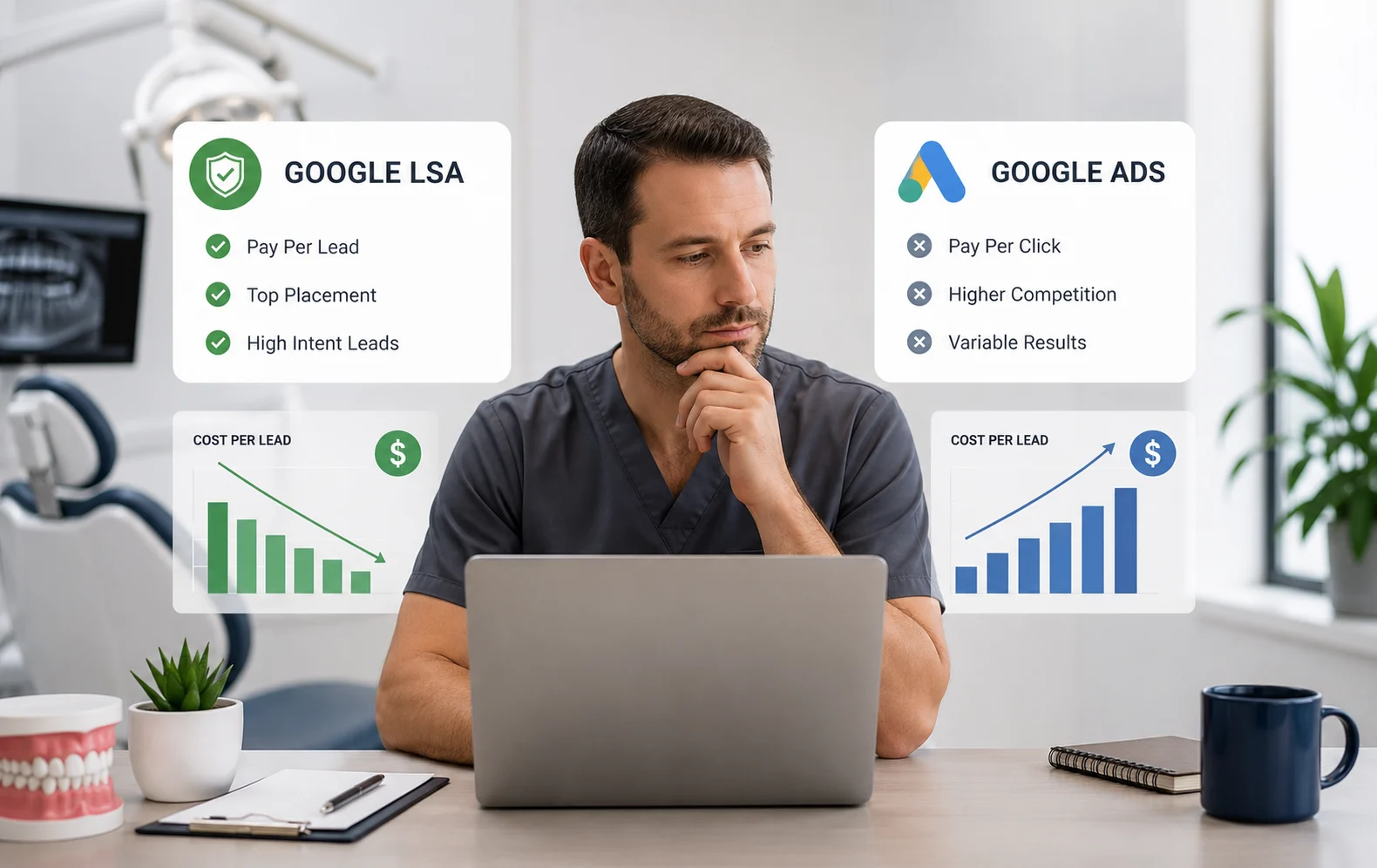
Both appear in Google search results, promise new patients, and increase visibility. But underneath, they work very differently � one is pay-per-click with keyword targeting, the other is pay-per-lead with verified trust signals. That difference directly affects lead quality, cost per acquisition, and overall ROI.
What Are Google LSA and Google Ads and How Are They Different?
Before map listings or organic results, Google now shows local dental practices with star ratings and a green Google Guaranteed badge � those are LSAs. Below them sit traditional pay-per-click Google Ads. Both place your practice at the top of Google, but they work completely differently.
Quick Breakdown
Google LSA uses a pay-per-lead model with Google's verification badge. Google Ads uses pay-per-click, offering deeper control over keywords, targeting, ad copy, and landing pages.
How Google Local Services Ads Work for Dentists
Getting Set Up
Google verifies your license, background, and insurance before awarding the Google Guaranteed badge � taking days to weeks.
How Your Ad Appears
LSAs appear above all other ads, showing your name, rating, hours, and a click-to-call button. On mobile, they dominate the screen.
How You Pay
You pay per lead � calls, bookings, or messages. Irrelevant leads can be disputed for a credit, keeping costs honest and predictable.
How Google Ads (Search) Works for Dentists
Keywords and Intent Targeting
You target searches like "dentist near me" or "Invisalign provider," controlling who sees your ads by zip code, device, or time of day.
Ad Formats and Landing Pages
Custom headlines, callouts, and sitelinks deliver rich information before a click. However, landing page quality directly affects whether clicks convert � a hidden cost many practices overlook.
How You Pay
Pay-per-click regardless of bookings. Competitive clicks range from $3�$50+, with management fees adding $500�$1,500/month on top of ad spend.
Not sure if your negative keyword list is doing its job?
We’ll review your last 90 days of search terms and show
you exactly where your budget is leaking — free, no
commitment.
Which Brings Better ROI: Google LSA or Google Ads?
Cost per lead alone is misleading. A new dental patient can generate significant lifetime value � making even a $150 lead potentially profitable. The real question is which platform delivers the right patient at the best long-term return.
- LSA excels for general dentistry, emergency appointments, and predictable new patient flow at lower acquisition costs.
- Google Ads excels for high-value procedures like implants, Invisalign, and cosmetic dentistry, where precise targeting and remarketing improve conversion rates significantly.
"
Pros and Cons of Each Platform
Google Local Services Ads
Advantages:
- Pay only for real leads, not clicks
- Top-of-page placement above regular ads
- Google Guaranteed badge builds immediate trust
- No website needed to run ads
- Built-in review integration boosts conversions
- Works extremely well on mobile
Limitations:
- Limited targeting � no keywords or demographics
- Can't customize ad copy or messaging
- Not ideal for procedure-specific campaigns
- Requires strong review profile to rank well
Google Ads (Search)
Advantages:
- Highly specific keyword and intent targeting
- Full control over ad copy and landing pages
- Remarketing capabilities for longer decision cycles
- Rich reporting and analytics
- Geographic targeting at zip code level
- Scales well for multi-location practices
Limitations:
- Pay for every click, converting or not
- Requires ongoing management expertise
- Agency fees add to total cost
- Needs a well-designed, fast-loading website
- Higher monthly spend needed for meaningful results
- Competition drives costs up in major markets
Get a personalized red‑flag report for your dental account
In 20 minutes, we’ll walk you through what your current agency is (and isn’t) doing — and what it’s costing you.
Which One Is Right for Your Dental Practice?
There's no universal winner. The better option depends on your goals, budget, growth stage, and the patients you want to attract.
LSA fits best if you:
- Want predictable lead costs without heavy management
- Have strong Google reviews and fast front desk responsiveness
- Need steady local visibility on a modest budget
Google Ads fits best if you:
- Market high-value procedures like implants or Invisalign
- Have optimized landing pages and work with a PPC specialist
- Want deeper targeting control and campaign-level reporting
Newer practices often see faster traction with LSA, while established practices with larger budgets benefit more from Google Ads precision.
Should Dentists Run Google LSA and Google Ads Together?
For many practices, yes � and that's usually where the best results happen. LSA and Google Ads serve different purposes and reach patients at different decision stages.
LSA captures patients ready to call now. Google Ads targets patients researching specific treatments like implants or cosmetic dentistry before booking. Running both keeps your practice visible across more of the patient journey instead of relying on a single lead source.
Many practices use LSA for steady daily enquiries while using Google Ads strategically for higher-value procedures. If you're newer to paid advertising, starting with LSA first is often the more predictable path before scaling Google Ads.
FAQs on Google LSA and Google Ads for Dentists
Do Google reviews affect my LSA ranking?
Yes. Your review rating and volume are among the biggest factors Google uses to rank LSA profiles. Consistently asking patients for reviews after appointments directly impacts lead volume over time.
Is Google Ads or LSA better for dental implants?
Google Ads is usually stronger for implants. Patients research costs and compare providers before contacting a practice, making keyword-targeted campaigns with dedicated landing pages far more effective.
Do I need a website to run Google LSA?
No. Patients can call, read reviews, and contact your practice directly through your Google Business Profile � making LSA an accessible starting point without a heavily optimized website.

1. You Cannot Access Your Own Google Ads Account
2. Reports Show Clicks, Not Patients
3. No Negative Keyword List
4. Traffic Goes to Your Homepage
5. They Don’t Know Your Cost Per Patient
6. No Call Tracking Configured
7. Budget Never Changes
8. Everything Runs in One Campaign
9. No A/B Testing Has Been Run
10. They Become Defensive on Direct Questions
What a High‑Performing PPC Agency Looks Like
Book a FREE Consultation
Book a FREE consultation
Our healthcare marketing expert will get in touch with you
.gif)





.png)