
Branding and marketing work together, but they do very different jobs for a dental practice. Branding shapes how patients see and remember your practice. Marketing is how you get that practice in front of them and give them a reason to take the next step.
If you're wondering, “Do I need branding or marketing to grow my dental practice?” The short answer is branding builds preference, while marketing builds reach.
A strong dental brand can make a practice feel trustworthy, familiar, and worth choosing. Marketing then puts that message in front of the right patients through search, ads, social media, content, email, and local channels.
The two shouldn't compete for attention or budget. They should work together. Your branding gives your marketing something worth remembering, while your marketing helps more of the right patients discover it.
In the sections ahead, we'll break down where branding ends and marketing begins for a dental practice, why both matter, and how they work together to attract the right patients. We'll also look at practical examples of how a practice can turn a clear brand into marketing that feels consistent, credible, and much easier for patients to remember.
Branding is how patients experience and remember your practice. It goes far beyond your logo, colors, or website design. It is the feeling patients get when they see your name, read your reviews, visit your website, or walk through your doors.
For a dental practice, branding helps patients understand:
In simple terms, branding gives your practice a recognizable personality and reputation. A well-defined dental practice branding strategy can help ensure that personality remains consistent across the patient journey.
Marketing is how you get that reputation in front of the right patients and encourage them to take action.
It includes dental SEO, Google Ads, social media, content, email marketing, local SEO, reviews, paid social, and other channels that help patients discover your practice.
For example, if your practice is known for gentle care for anxious patients, marketing helps you reach someone searching for a "sedation dentist near me for dental anxiety in Boston".
Marketing answers a different question: “How do we reach the patients we want to treat?”
So the simplest way to think about it is branding builds recognition and trust. Marketing turns that recognition into visibility, inquiries, and appointments.
The difference becomes much clearer when you look at what each one is trying to achieve. Branding shapes how patients see your practice. Marketing puts that practice in front of the patients you want to reach.
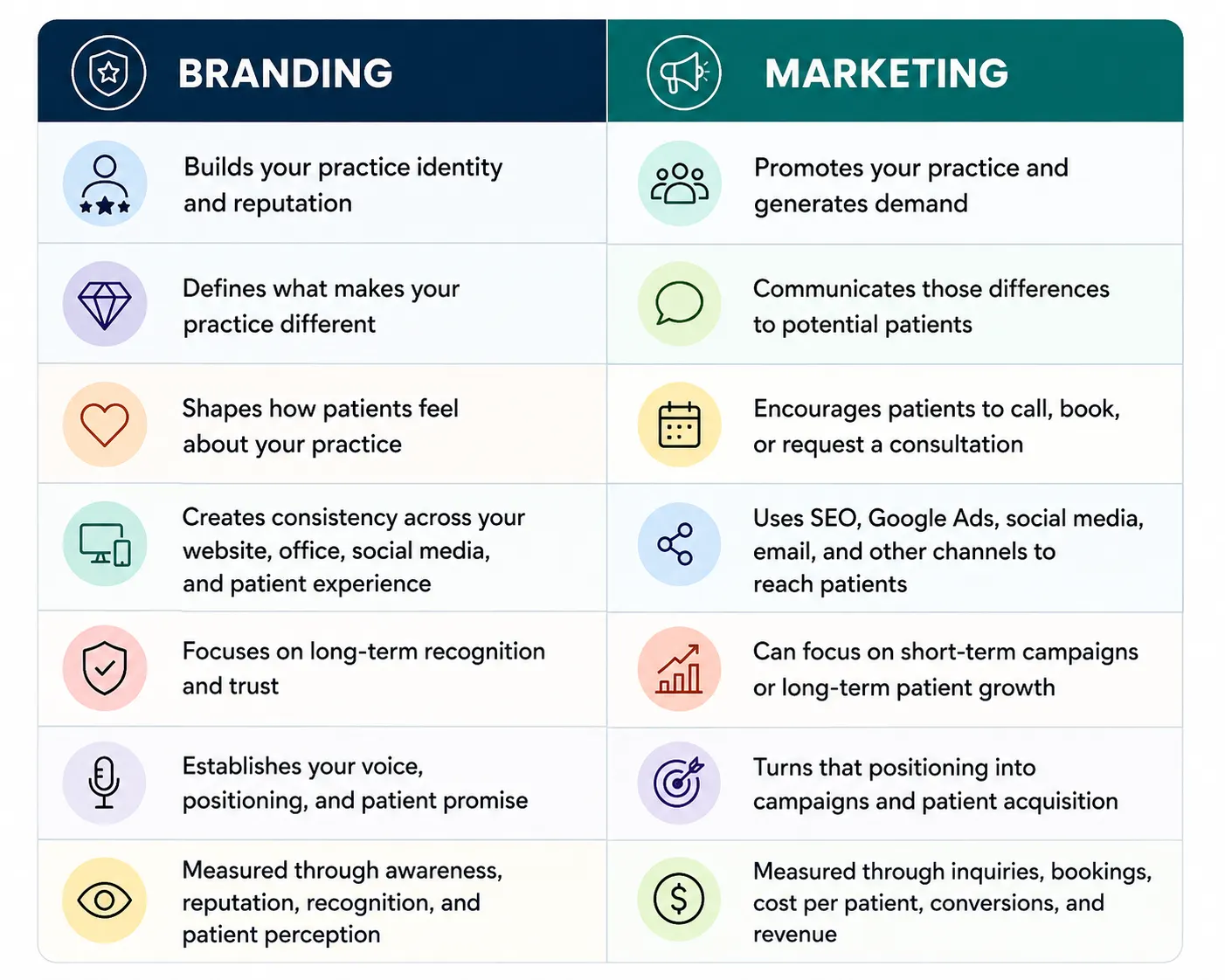
For example, a practice might build its brand around calm, judgment-free care for anxious patients. That positioning stays consistent whether someone sees the practice on Google, Instagram, or inside the office.
Marketing then takes that message into the market. A Google Ads campaign might target “sedation dentist near me,” while SEO content answers questions about dental anxiety and sedation. Social media might show the team, office environment, and patient experience.
So, for a dental practice, the relationship is fairly simple:
Branding gives patients a reason to remember and trust you. Marketing gives them a reason to find and contact you.
It’s easy to look at branding and marketing as two separate jobs. One feels creative. The other feels more measurable. But for a dental practice, they work much better together.
Think about what happens when someone searches for a dentist. They might find you through Google, click your website, check your reviews, look at your photos, and then visit your Instagram before deciding whether to call.
Every one of those touchpoints is shaping their opinion of your practice.
That is where branding and marketing start to overlap.
For example, imagine your practice wants to become known for comfortable, judgment-free dentistry for anxious patients. Branding establishes that promise. Your website, SEO content, Google Ads, reviews, and social media then reinforce it wherever potential patients encounter your practice.
So, you don't really have to choose between branding and marketing.
Branding gives patients a reason to remember you. Marketing gives them a reason to find you. And when both tell the same story, your practice becomes much easier to choose.
Even good practices can get this part wrong. Usually, it isn't because they're doing everything badly. It's because branding and marketing are handled separately, without considering how patients experience the practice as a whole. Here are some of the mistakes worth avoiding.
A new logo can make your practice look fresher. But branding goes much further than that.
If your website still sounds the same, your social media feels disconnected, and patients get a completely different experience at the front desk, you've changed the logo, not the brand.
How to fix it: Look at the full patient journey, from the Google search to the follow-up after an appointment. Make sure every step feels like the same practice.
Getting more people to your website won't help if they can't quickly understand why they should choose you.
Slow pages, unclear services, weak calls to action, outdated information, and few trust signals can turn good ad traffic into missed opportunities.
How to fix it: Strengthen your dental website, landing pages, and Google Business Profile before increasing your ad budget.
Your Instagram might feel warm and approachable while your website sounds formal and corporate. Your ads might then use completely different messaging.
Patients may not consciously point this out, but inconsistency can make the practice feel less established.
How to fix it: Create a simple brand guide covering your colors, fonts, photography style, key messages, and a few rules for how your practice should sound.
Reviews do more than help your local visibility. They show potential patients what it actually feels like to be treated by your team.
A patient deciding between two dentists may care just as much about comments describing the staff, communication, comfort, and overall experience as they do about your list of treatments.
How to fix it: Ask appropriate patients for honest feedback, make review requests part of your normal process, and respond thoughtfully to reviews. A consistent review management process can also help practices monitor and strengthen their online reputation.
Marketing needs resources to produce meaningful results. Branding does too.
A practice can't expect consistent SEO, paid advertising, content, social media, website improvements, and reputation building while treating marketing as something to fund only when there is money left over.
How to fix it: Set a realistic annual budget for both brand development and patient acquisition. Then prioritize the channels that support your actual growth goals. Reviewing your dental marketing budget can help put those investments into perspective.
Every few months, there is a new channel, platform, or AI tool promising to change dental marketing.
Some are useful. But none of them can fix a practice with unclear positioning, a weak website, inconsistent messaging, or poor patient follow-up.
How to fix it: Get the fundamentals right first. Build a recognizable brand, a strong website, a well-managed Google Business Profile, useful content, and a reliable review process. Then add newer channels when they genuinely make sense.
Before deciding how much to spend, look at what your practice is missing. If patients do not recognize or trust your brand, branding may come first. If the brand is strong but visibility is low, marketing deserves more of the budget.
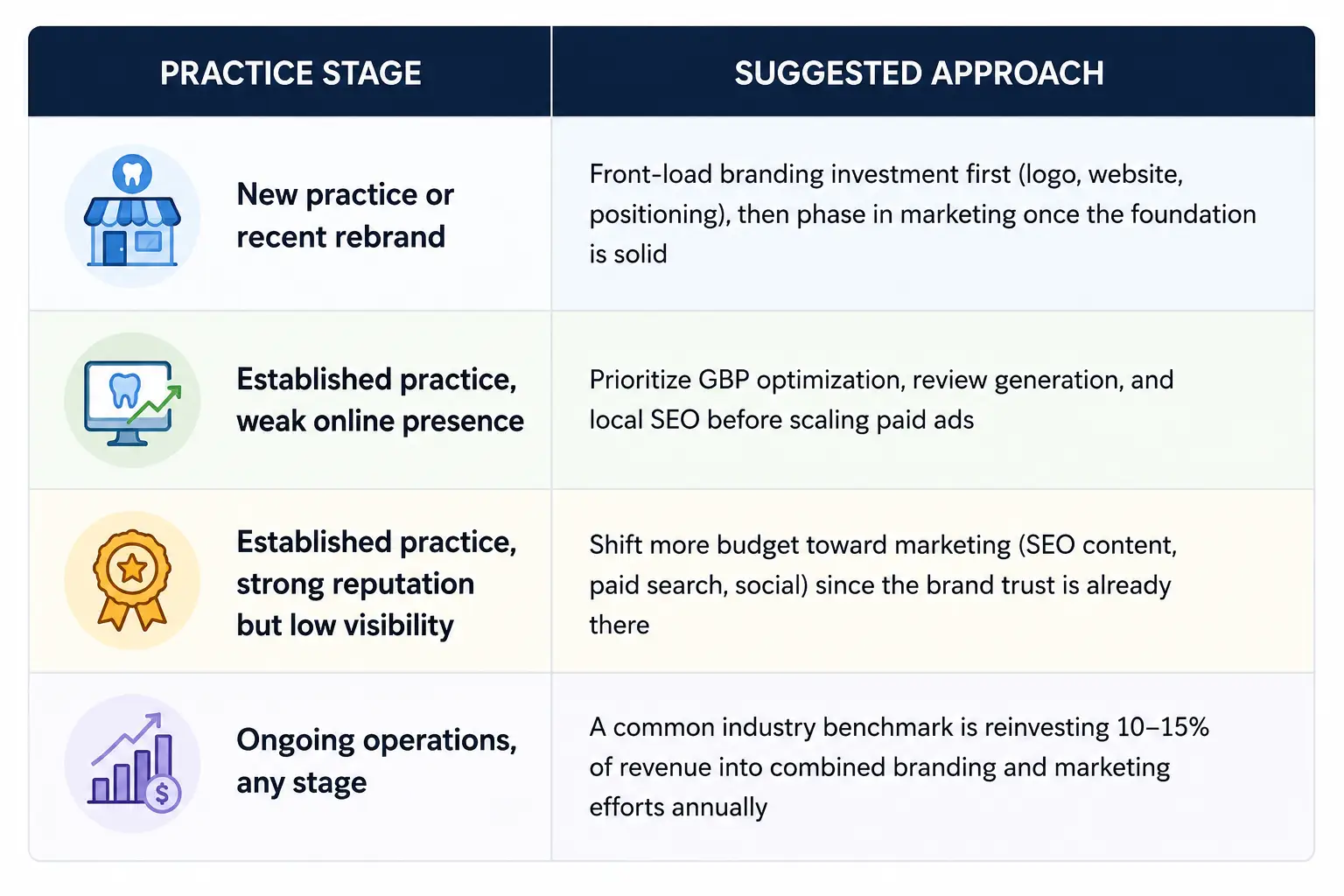
If your marketing feels like it’s “not working,” pause and ask whether the problem is actually a branding problem in disguise. It could be a dated website, inconsistent messaging, or a weak review profile. Before assuming you simply need to spend more on ads, make sure your brand gives potential patients a strong reason to choose your practice.
Branding and marketing are not competing priorities, and they are not the same thing. Branding defines who you are. Marketing helps people find you. One builds trust and recognition. The other builds visibility and demand. Overlook either one, and you risk leaving new patients and revenue on the table.
Fortunately, you do not have to fix everything at once. Start by identifying which side of the equation is weaker in your practice right now. Are potential patients struggling to find you, or are they finding you but choosing another practice? That answer can tell you where to focus first.
When branding and marketing work together, your practice can do more than attract new patients. It can build stronger trust, create a better patient experience, encourage more recommendations, and give patients a reason to choose your practice over the competition.

.svg)

Dr. Ruchir Mehra has spent nearly a decade at the crossroads of clinical insight and cutting-edge technology, reshaping how dental practices think, operate, and grow. He brings a rare fusion of medical precision and AI-driven innovation, helping practices and DSOs move from instinct to intelligence, and from scattered operations to scalable, compliance-first growth engines that perform.
Our healthcare marketing expert will get in touch with you

.gif)