
Every dental practice reaches a point where marketing starts becoming too important to leave to chance. That’s usually when the same question comes up: should you hire an in-house marketing team or work with a dental marketing agency? It sounds like a simple choice, but it can affect everything from your monthly overhead and access to specialist skills to how quickly you can launch campaigns and turn marketing into actual patient growth.
Neither option is automatically better. An in-house team can give you closer day-to-day control and a deep understanding of your practice. An agency can bring a wider range of expertise without requiring you to build an entire department from scratch. For some growing practices, a hybrid approach ends up being the smartest fit.
There is no one-size-fits-all answer, either. A new single-location practice may need a very different setup from an established practice, a cosmetic-focused office, or a growing DSO. This guide breaks down the real costs, practical tradeoffs, and common pros and cons of both approaches, along with the hybrid option many growing practices overlook. Let’s get into it.
For most growing dental practices, starting with a specialist dental marketing agency is more practical than building a full in-house team from day one. You get access to multiple skills, from SEO and Google Ads to content, web strategy, and analytics, without taking on several full-time salaries.
As your practice grows, a hybrid model can make more sense. You might keep a marketing coordinator or manager in-house to handle brand direction, internal communication, and day-to-day priorities while your agency handles specialist execution.
For larger practices, multi-location groups, and DSOs with substantial, consistent marketing investment, building a senior in-house team can eventually make financial and operational sense.
The important part is timing. Don't build a team simply because your practice is growing. Build one when the workload, budget, and need for internal control justify it. The right setup for a new dental office will look very different from what works for a busy multi-location practice.
An in-house dental marketing team means hiring and managing your own people to handle areas such as SEO, Google Ads, content, social media, website updates, reputation management, and reporting. The biggest advantage is control. Your team is close to the dentists, understands the practice, and can move quickly when priorities change.
The catch is that dental marketing needs several different skill sets. One person rarely excels at technical SEO, paid search, content, social media, website conversion, and analytics at the same time. If you hire one generalist, you may get coverage across everything without getting deep expertise in the areas that actually drive patient growth.
And then there is the cost.
A realistic in-house setup for a growing single-location practice might include:
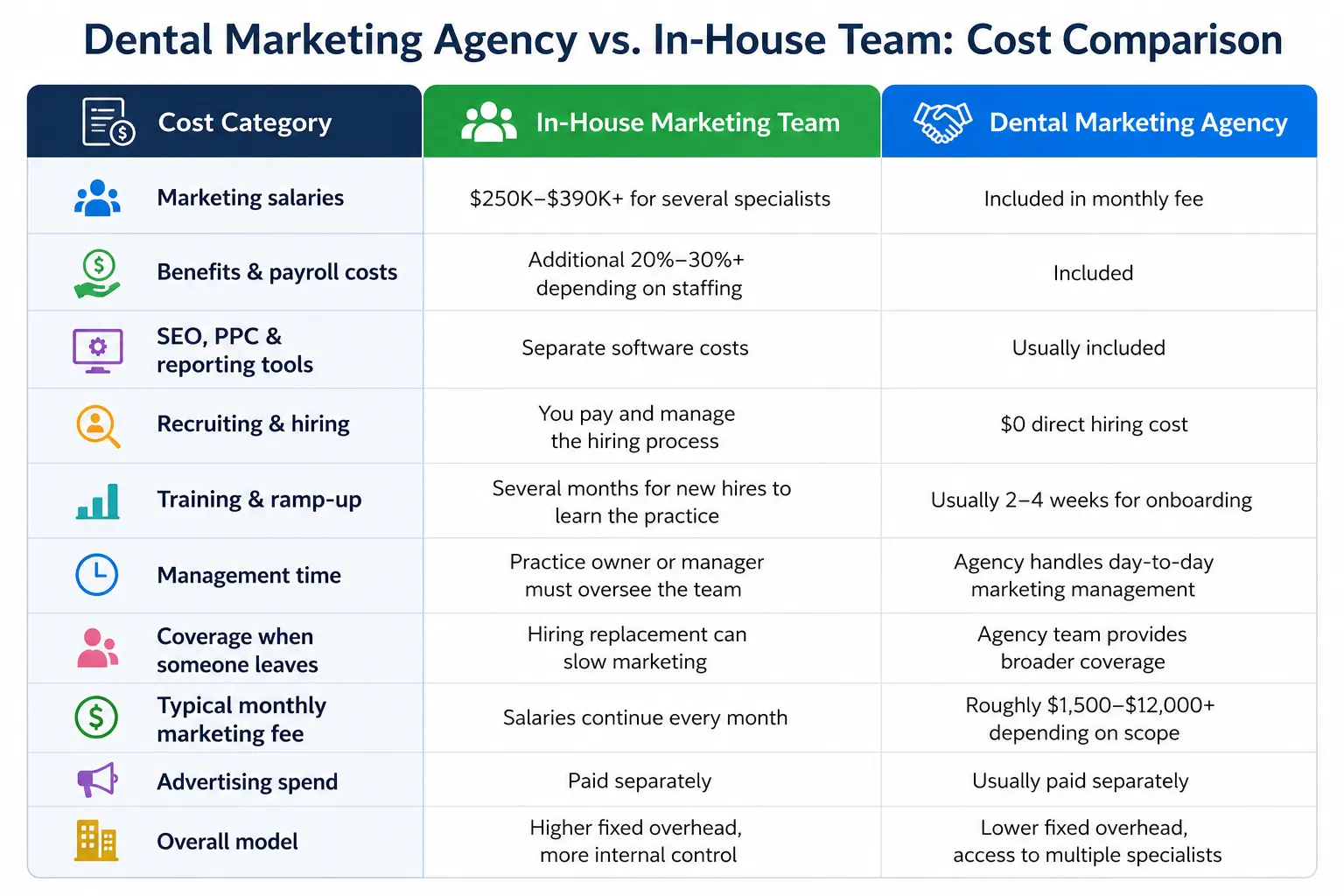
That can put base salaries around $250K–$390K per year before benefits, payroll taxes, software, training, and other overhead. You may also need tools for SEO, reporting, call tracking, design, scheduling, and CRM management.
However, you don't necessarily need all of these roles in-house. That's the important part.
When you look at an in-house team, the salaries are easy to see. The other costs tend to show up later.
The real cost of in-house marketing isn't just the payroll. It's also the time, training, management, and gaps you take on to make that team work.
A dental marketing agency gives you access to a team of specialists without having to build the whole team yourself. Depending on the agency, that may include dental SEO, Google Ads, local SEO, content, website strategy, reputation management, and reporting.
That can be useful when a practice needs several skills but doesn't have enough work to justify a full-time specialist in every area. Instead of hiring separately for SEO, paid ads, content, and web support, you can bring those skills together under one engagement.
But the dental experience matters. Marketing a dental practice isn't the same as marketing a restaurant, e-commerce brand, or local service business. Patient search behavior, treatment value, reviews, insurance, local competition, and appointment conversion all affect how the strategy should work.
For practices evaluating how much to allocate across different marketing activities, a clear dental marketing budget can also help determine whether hiring individual specialists makes financial sense.
Typical agency fees can vary considerably, but a practical range is
Advertising spend is often separate from the agency fee, so it should be considered when comparing total marketing costs.
The bigger advantage isn't simply the monthly price. It's getting access to several areas of expertise without taking on the salaries, hiring, training, tools, and management that come with building the same capabilities internally.
The numbers make the difference easier to see. These are practical recent benchmarks for dental practices, based on typical staffing, software, and agency costs. Use them as planning ranges rather than fixed quotes, since the actual cost depends on your team size, services, and growth goals.
There isn't one setup that works for every practice. The right choice depends on your revenue, growth plans, internal bandwidth, and how much marketing expertise you already have:
✓ Your practice revenue is between $400K and $800K.
✓ You don't have the bandwidth to hire and manage a team member.
✓ You need specialized expertise (implants, orthodontics, pediatric dentistry, etc.).
✓ You want to scale quickly without scaling headcount.
✓ You prefer to focus on clinical work and let someone else handle marketing.
✓ You're open to the learning curve of onboarding an external team.
✓ You want access to advanced tools and technology
✓ Your practice revenue is $1M+.
✓ You have the management capacity to hire and lead someone.
✓ You value deep practice knowledge and continuity.
✓ You're willing to invest in hiring a professional (not just assigning to existing staff).
✓ You want direct accountability and control.
✓ You're in it for the long term and willing to let someone ramp up over 12-18 months.
✓ You have multiple locations or service lines that benefit from coordinated marketing.
✓ Your practice is $600K-$1.5M in revenue.
✓ You want the specialization of an agency and the continuity of in-house
✓ You have an existing coordinator who can learn marketing.
✓ You need agencies for certain specialties but in-house for general marketing.
A hybrid model can be particularly useful when your internal team owns strategy while external specialists handle areas such as search engine optimization that require ongoing technical expertise.
For a growing dental practice, the agency versus in-house decision really comes down to where you are today, what you need help with, and how much marketing you can realistically manage internally.
If you don't have enough work to justify several full-time specialists, a dental marketing agency can give you access to SEO, paid ads, content, local SEO, website strategy, and reporting without building an entire department. If your practice has reached the point where marketing needs dedicated leadership every day, an in-house team may make more sense. A hybrid approach can work well when you want someone internally to own the direction while specialists handle the areas that require deeper expertise.
For practices that rely heavily on paid acquisition, having access to dedicated Google Ads expertise for dentists can be another factor when comparing the depth of an external team with what a small internal team can realistically manage.
The same applies to content and website work. An external team can provide specialized support for dental content marketing and help maintain the steady execution needed to support long-term growth.
Don't choose the model that simply sounds more impressive. Choose the one your practice can afford, manage, and grow with. And whichever route you take, make sure the people handling your marketing understand dentistry, your local market, and what actually turns searches into booked and kept appointments.
For larger practices and DSOs, the decision can change as the organization grows. A dedicated DSO marketing strategy may require more coordinated systems, resources, and oversight than a single-location practice needs, making the right balance between internal and external expertise especially important.

.svg)

Dr. Ruchir Mehra has spent nearly a decade at the crossroads of clinical insight and cutting-edge technology, reshaping how dental practices think, operate, and grow. He brings a rare fusion of medical precision and AI-driven innovation, helping practices and DSOs move from instinct to intelligence, and from scattered operations to scalable, compliance-first growth engines that perform.
Our healthcare marketing expert will get in touch with you

.gif)