.png)
Ask ten London dental practice owners how much they should invest in SEO, and you will usually hear one of two things: either “we’re spending a little and seeing nothing,” or “we’re spending thousands and still not fully sure what’s actually working.” The real problem is not always the budget itself, it is the lack of clarity around what a small dental practice genuinely needs to compete in London’s crowded local search market.
Some practices invest £300 a month and expect page-one rankings in Chelsea, Wimbledon, or Canary Wharf within weeks. Others overspend on bloated SEO packages packed with reports but very little real patient growth. Both situations usually come down to the same issue: guessing instead of planning around actual patient acquisition data and local competition.
The truth is that SEO investment for a small dental practice in London should be based on competitiveness, treatment goals, location demand, and how many new patients your practice realistically wants to attract each month, not random agency pricing pages.
This guide breaks down what small dental practices in London are actually spending on SEO in 2026, what those budgets usually include, how pricing changes depending on your area and treatments, and how to calculate an SEO investment that makes financial sense for your clinic instead of simply draining marketing budget.
London is not a typical local market. With over 3,500 registered dental practices across the capital and some of the most digitally active consumers in the country, competition for new patient attention is intense. A practice in a quieter market might rank well with modest effort. In London, especially in highly competitive boroughs like Kensington, Islington, Wandsworth, or Southwark, ranking for anything meaningful requires a genuine and sustained investment.
The reward for getting it right, however, is proportionally larger. London patients spend more on private dentistry than any other region in the country. The average value of a new private patient in London, when accounting for their full treatment journey, is often north of £850, while cosmetic and implant patients are usually worth considerably more. A single strong ranking for searches such as “dental implants [borough]” or “Invisalign [area]” can generate returns that exceed the monthly SEO investment many times over. ractices that improve their borough-specific SEO visibility often find that even a handful of high-value treatment enquiries can justify their entire SEO budget.
National dental brands and corporate groups invest heavily in digital marketing and SEO. However, local independent practices can still outperform them by building stronger local relevance, reviews, and neighbourhood-focused visibility.
In most London boroughs, the biggest competition usually comes from nearby practices that have already been investing in SEO, Google Maps optimisation, and content marketing consistently for several years.
For many dental searches, patients contact practices directly from Google Maps before even visiting a website. Appearing in the local top 3 map results can significantly increase calls, enquiries, and appointment bookings.
Platforms like Doctify, NHS listings, and healthcare directories often dominate search results in London. Practices with strong review profiles across these platforms usually gain more visibility and patient trust.
While competition across London is high, many boroughs and neighbourhoods still have clear SEO gaps. Some practices are poorly optimised for specific treatments, local searches, or patient concerns. Small dental practices that identify these opportunities early often achieve strong long-term growth without needing the biggest marketing budget.
Before looking at budget tiers, it helps to understand what SEO spending actually pays for. When you engage an SEO agency or specialist, you're typically buying a combination of technical work, content creation, local citation management, link building, and ongoing optimisation. The ratio of these activities shifts depending on budget and what your practice needs most.
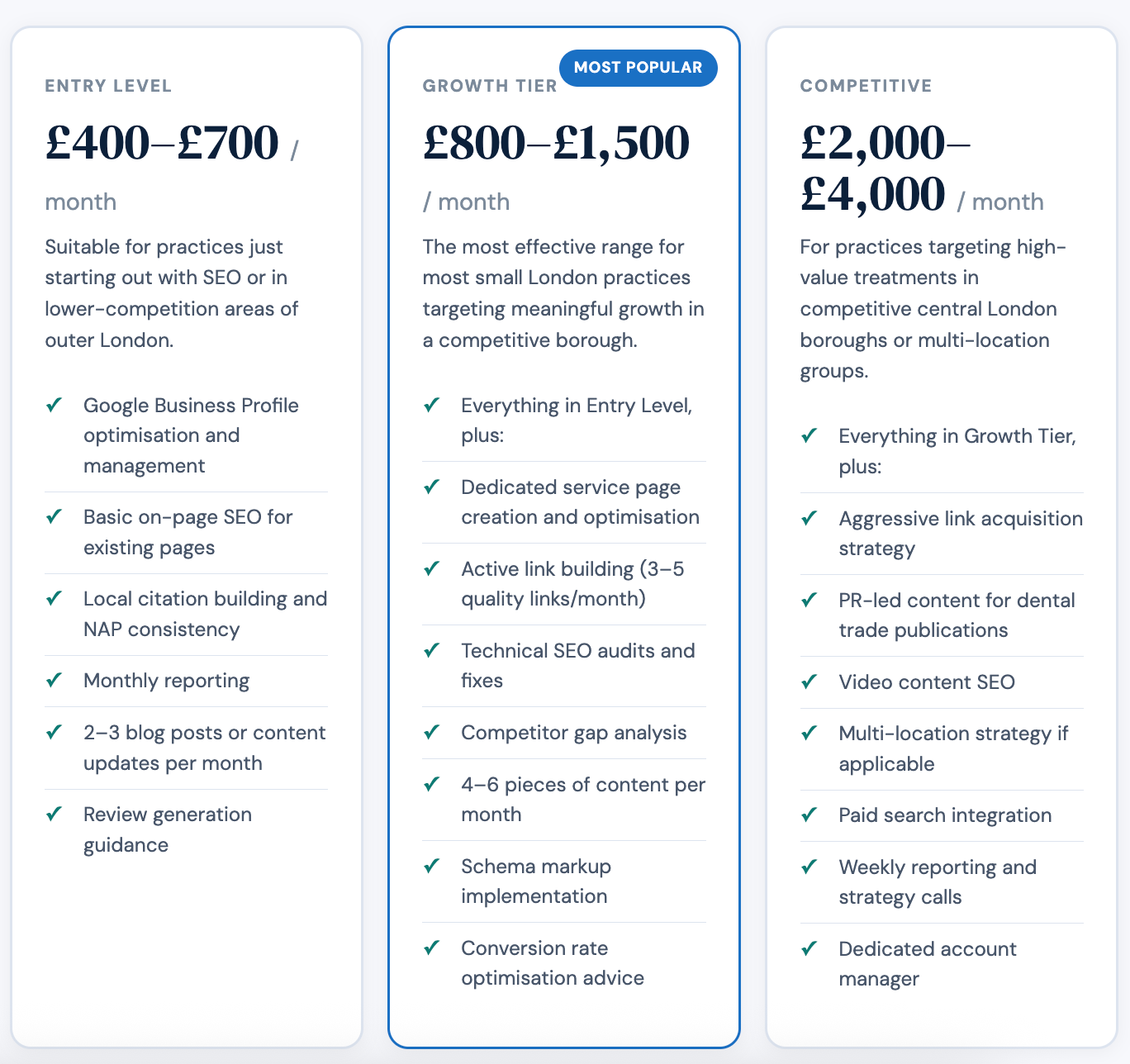
Budget tiers only make sense when you understand what results they can realistically generate, and over what timeframe. The following is based on genuine outcomes for London dental practices, not agency marketing material.
Timeline to results: 4–8 months for Local Pack improvements; 8–14 months for meaningful organic ranking movement.
Realistic outcomes: At this budget, the most achievable outcomes are improvements in your Google Maps rankings, better visibility for your practice name and location-specific searches, and a modest increase in website traffic. You are unlikely to rank for high-competition keywords like "dental implants London", but you can rank well for "[your borough] dentist" and long-tail queries like "emergency dentist [postcode area]."
Best suited for: Practices in outer London boroughs (Bromley, Sutton, Havering, Enfield), practices that have never done any SEO and have obvious quick wins available, and practices primarily focused on NHS or routine private care rather than high-value cosmetic treatments.
When investing in Entry Level dental SEO (£400–£700/month) in London, smart budget allocation matters most. At this stage, your SEO provider should prioritise Google Business Profile optimisation, local SEO, and location-focused visibility improvements first, as these usually deliver the fastest and most cost-effective results for small London dental practices.
Timeline to results: 3–5 months for Local Pack improvements; 6–10 months for first-page organic rankings on mid-competition keywords.
Realistic outcomes: This is the budget tier where London dental practices start to see genuine, compounding returns. Dedicated service pages for Invisalign, dental implants, teeth whitening, and composite bonding will begin ranking in borough-level searches. Your Google Business Profile should be in or near the Local Pack for primary treatment keywords. Blog content and FAQ pages will start capturing long-tail search traffic. Link building begins to lift your domain authority meaningfully.
What good looks like at this level: In a mid-competition London borough, a practice investing £1,000–£1,200 per month consistently for 12 months should expect to rank on page one for 15–25 local keyword targets and see 40–80% growth in organic traffic from their starting point. Regularly measuring local search performance can help practices understand which SEO activities are producing the strongest returns.
Best suited for: Practices offering a range of private treatments, practices in inner London boroughs, any practice that has invested in its website and wants to now drive traffic to it, and those wanting to grow specific high-value treatment pipelines like Invisalign or implants.
At this budget, insist on dedicated service pages for every treatment you want to grow. Generic homepage optimisation is not enough in a London borough, each treatment needs its own page, its own keyword targeting, and its own content strategy.
Timeline to results: 3–6 months for Local Pack dominance; 6–12 months for first-page rankings on competitive central London terms.
Realistic outcomes: At this level, you're competing for the most visible positions in some of the most competitive dental markets in the country. Practices spending at this tier should expect to rank for high-value terms like "dental implants [area]," "Invisalign London," and cosmetic dentistry terms that generate significant private patient revenue. You should also expect a consistent Local Pack presence across multiple treatment categories and neighbouring boroughs.
Best suited for: Practices with a high proportion of cosmetic and specialist treatment revenue, multi-location practices, any practice in central London boroughs (Westminster, Kensington & Chelsea, City of London), and practices looking to establish themselves as the premium option in their area within 12–18 months.
If you are working with a limited budget, and most independent London dental practices are, where you spend first matters just as much as how much you spend. Too many practices jump straight into blogs, backlinks, or fancy SEO packages before sorting the basics. That is a bit like decorating the waiting room while the front door is still stuck shut.
If your budget is tight, this is where your money should go first. A properly optimised Google Business Profile can do more for local patient enquiries than almost anything else early on. Accurate services, updated photos, reviews, posts, opening hours, and Q&As all help your practice appear more often in Google Maps and Local Pack searches.
For many London practices, this is the quickest route to more calls without spending thousands on marketing. Most of the work is either your own time or a relatively small one-off agency task, but the impact can often be seen within a couple of months.
There is no point pouring money into SEO if your website is slow, clunky, or difficult for Google to understand. Before anything else, make sure your site loads properly on mobile, has no broken pages, uses the correct page titles and descriptions, and includes proper schema markup.
Think of this as fixing the plumbing before turning the taps on. Without strong technical foundations, every future SEO investment works harder for less return.
A single homepage trying to rank for every treatment under the sun rarely works in London anymore. Patients search for very specific treatments, and Google expects dedicated pages for them.
If Invisalign, implants, composite bonding, or emergency dentistry are growth areas for your practice, each one needs its own properly optimised page targeting those exact searches. For smaller practices, it is usually smarter to focus first on the treatments bringing the highest value or biggest growth opportunity.
Reviews are not just about reputation anymore, they directly influence both rankings and patient trust. In London especially, patients compare reviews quickly before deciding who to call.
The good news is this does not need a huge budget. A simple system using post-appointment texts, QR codes at reception, and staff verbally asking patients can steadily build review volume month after month. Done consistently, this becomes one of the most valuable long-term assets your practice owns.
Your practice name, address, and phone number should match everywhere online, including Google, Apple Maps, Yell, Bing Places, Doctify, and other dental directories.
It sounds boring, but inconsistent details quietly damage local rankings. Google likes certainty. If one directory says “Dental Care Wimbledon” and another says “Wimbledon Dental Care Ltd”, mixed with different phone numbers or addresses, trust drops. This is mostly a one-time tidy-up job, but it makes a noticeable difference locally.
Once the foundations are sorted, this is where long-term SEO growth really starts building momentum. Helpful blogs, FAQs, treatment guides, and local dental content gradually increase your authority and visibility over time.
Alongside that, earning links from trusted local organisations, dental directories, and publications helps strengthen your website’s credibility in Google’s eyes. Practices moving away from outdated advertising methods often find that content-driven visibility delivers more sustainable patient acquisition. This stage takes patience, but it is often what separates practices that rank briefly from those that dominate local search results year after year.
SEO costs for dental offices in London can vary significantly depending on your location, competition level, growth goals, and the current state of your online presence. A small family practice in Wimbledon will not require the same investment as a cosmetic or implant-focused clinic competing in Central London. Understanding these factors helps practices set a more realistic SEO budget from the beginning.
Practices located in highly competitive areas such as Westminster, Kensington, Chelsea, or Canary Wharf usually require a larger SEO investment than practices in outer boroughs like Wimbledon, Bromley, Sutton, or Ealing. The stronger the local competition, the more ongoing optimisation and authority-building work is needed to rank consistently.
General dental searches are typically less competitive than high-value private treatment keywords. Practices targeting searches related to:
- Dental implants
- Invisalign
- Composite bonding
- Cosmetic dentistry
- Emergency dental care
usually need stronger content strategies, dedicated treatment pages, and more aggressive local SEO efforts.
A technically strong website reduces the amount of foundational SEO work required. However, practices with:
- slow-loading websites,
- poor mobile usability,
- outdated page structures,
- weak treatment content,
- or missing local optimisation
often need additional upfront SEO work before meaningful growth can happen.
SEO investment also depends on how quickly you want results and how aggressively you want to grow. A practice aiming for steady local visibility will require a very different strategy compared to a clinic trying to dominate competitive London searches for cosmetic or specialist treatments.
Dental-focused SEO agencies generally charge more than general marketing providers because they understand:
- patient search behaviour,
- healthcare compliance,
- treatment-led SEO,
- local dental competition,
- and conversion-focused patient journeys.
Practices seeking specialist SEO support for London clinics often benefit from more targeted strategies and stronger long-term ROI. Specialist experience often leads to better long-term ROI and fewer wasted marketing costs.
Some SEO campaigns also include:
- PPC advertising,
- social media marketing,
- content creation,
- reputation management,
- email marketing,
- and conversion tracking.
The more integrated the campaign becomes, the higher the monthly investment usually is.
Month 1–2
Your Google Business Profile should be fully optimised, technical website issues fixed, and core service pages either created or improved.
If this work is unclear, ask your SEO provider for a detailed task list rather than a generic monthly report.
Month 3–4
You should begin noticing early movement in Google Maps visibility, more GBP calls, increased review activity, and better visibility for long-tail local searches.
If calls and profile engagement are completely flat, your local SEO work may not be getting enough attention.
Month 5–6
Organic traffic should start trending upwards, and mid-competition keywords should begin moving towards page one. Service pages and content should also start generating more visibility.
If rankings have not improved at all by this point, your content strategy or link-building activity may be too weak for your market.
Month 9–12
This is usually when SEO becomes commercially noticeable. Practices should begin seeing stronger first-page rankings, more consistent Google Maps visibility, and regular organic patient enquiries.
Take your monthly SEO spend and divide it by the average value of a new private patient’s first visit. That tells you how many new patients SEO needs to generate each month just to break even.
Most well-managed local dental SEO campaigns in London begin generating noticeable increases in organic visibility, Google Maps engagement, and patient enquiries within 6–12 months, with many practices seeing a 2–4× return before repeat visits, long-term treatment plans, and patient lifetime value are even factored in.

.svg)

Harsh Bansal has spent 15 years pioneering, scaling, and redefining what dental marketing and data can truly unlock. He is at the forefront of AI-driven dental growth, helping more than 8,000+ dental practices and DSOs worldwide attract more patients, strengthen their market presence, and gain the financial clarity needed to drive sustainable growth.
Our healthcare marketing expert will get in touch with you


.gif)