

You only pay what you spend on your Google Ads, no commission or hidden charges
Your best patients are not always searching from the postcode where your practice sits. They could be a few streets away, across the neighborhood, or just outside your usual service area, searching for an implant dentist, Invisalign provider, or emergency appointment. That makes location targeting more than simply adding nearby postcodes to your website. With the right postcode data, you can see where demand is coming from, which treatments people are looking for, and which areas are genuinely worth your attention. It gives your SEO strategy a sharper local focus without turning every nearby postcode into another thin location page.
This article looks at how dental practices can use postcode insights to find those pockets of demand and put their marketing efforts in the right places.
Zip code SEO is the practice of optimizing your website, Google Business Profile, and local listings to help your dental practice appear when nearby patients search for services in specific areas. That might be:
Instead of trying to rank across an entire metro area, you focus on the specific locations where your ideal patients live, work, and search for dental care, then build a stronger local presence in those areas.
Broad city searches put your practice up against almost every dentist in the area. Zip code and neighborhood searches narrow the field, helping you reach patients in the locations you actually want to serve.
Patients rarely choose a dentist at random. They usually search for care close to home, work, or somewhere along their daily route. That makes location a big part of how your practice gets found online.
They search by location. Searches such as "dentist Brooklyn Heights," "family dentist Bishop Arts Dallas," or "dentist near me" tell Google that location matters. Your practice needs to show up in the areas where your ideal patients are actually searching.
Google weighs relevance, distance, and prominence. You cannot change where your office is located, but you can strengthen your relevance and local visibility in the ZIP codes around your practice.
As a result, you stop trying to rank everywhere and start building visibility in the ZIP codes that can actually bring patients through your doors.
A ZIP code tells you more than where a patient lives. It can give your dental practice a clearer picture of the local community and the demand around your office.
When evaluating a ZIP code, look at signals such as
Together, these signals can show you where people live, work, travel, and search for dental care, helping you identify ZIP codes worth targeting with your local SEO strategy.
The 5-Step Framework for Choosing Locations Worth Targeting
Use these five steps to narrow down the ZIP codes and neighborhoods most worth your dental practice’s SEO attention.
Your existing patient data can tell you which ZIP codes already matter to your practice. Look at where your patients come from, how many patients each area brings in, and which locations generate the most revenue. This gives you a much stronger starting point than choosing locations based on assumptions.
Group your patient data by ZIP code and identify your top 10 to 15 areas by patient volume and revenue. Keep the information secure and use ZIP codes only for this analysis.
Then check your local visibility in those areas. Pay particular attention to:
If patients are already willing to travel to your practice from a particular ZIP code, stronger local visibility can help you reach more patients from that same area.
With location targeting, not every postcode or neighborhood deserves the same effort. Instead of spreading your SEO work evenly, focus on areas where search demand, competition, and patient intent make the opportunity worthwhile.
A simple way to assess this is to compare three common keyword patterns. Service and city terms usually have higher search volume but tougher competition, while neighborhood and postcode searches tend to be more specific and can attract patients who are closer to booking.
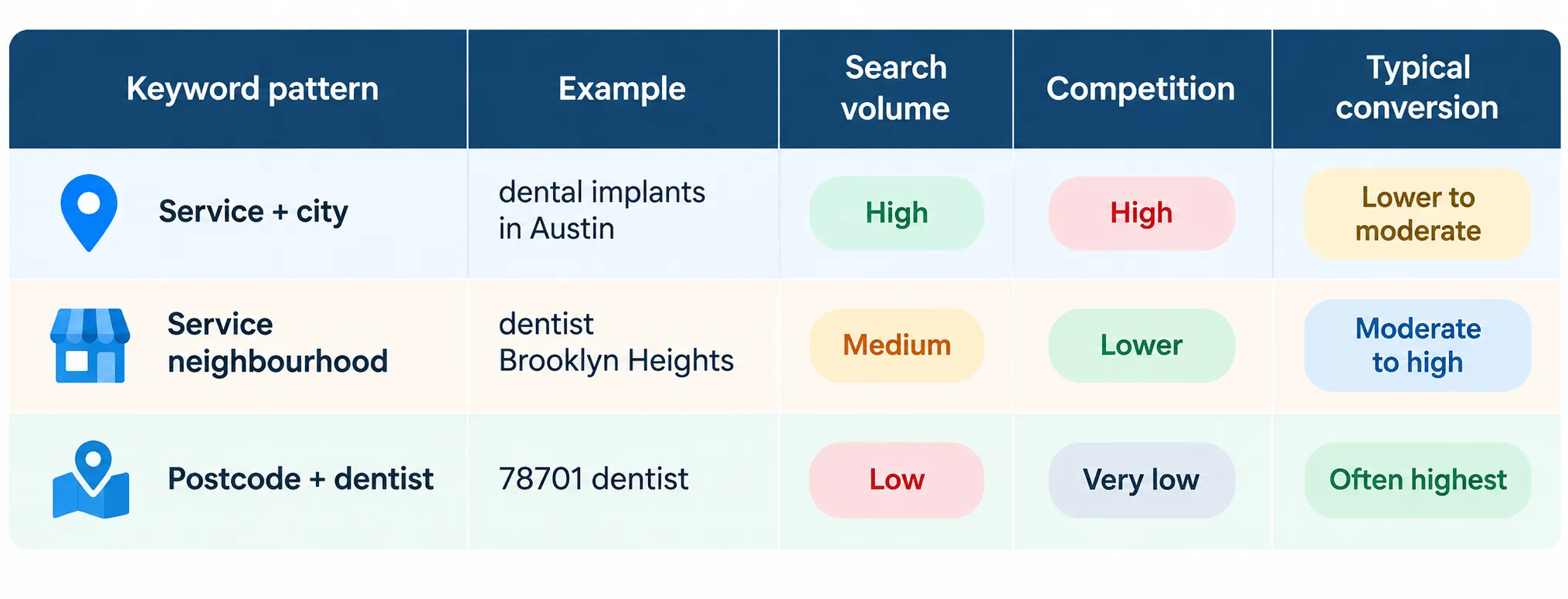
The opportunity is often in those smaller, highly specific searches. A search term like “78701 dentist” may not generate much traffic, but it can come from someone searching within a precise area and already looking for a dental practice. These searches are easy to overlook, which can make them useful targets when the local competition is thin.
You can find these opportunities using Google Keyword Planner, Google Search Console, and even Google's autocomplete and “People also ask” results. Rather than getting caught up in exact search-volume figures, look for patterns that show where patients are searching and where competing practices have weak visibility.
Different services attract patients from different distances. Someone will drive 45 minutes for the best implant surgeon, but they won't drive 15 minutes for a routine cleaning. Use that to guide your targeting.
Match your services to the right areas:
Each location has a different patient profile. Use local data such as income, age, household size, population, and nearby businesses to understand who lives and works there, then match your marketing to the patients you want to attract.
Before targeting a location, take a quick look at the practices already ranking there. A 15-minute competitor check can tell you whether the area has room for your practice to compete.
Here’s what to check:
The whole point behind this analysis is to identify the gaps in their service pages, location content, reviews, and profile activity.
For this, you can use tools like Ahrefs, Semrush, or Ubersuggest if you want a deeper look at their rankings.
Gaps such as Thin location pages, incomplete profiles, fewer reviews, or weak service content can signal an opportunity. If the area is packed with established practices, strong content, fresh reviews, and large marketing budgets, it may take more work to break through.
You can't target every location at once, so start with the areas most likely to bring a return. Focus your time and budget on a few locations first, then expand as you see results.
A simple way to organize them:
A good starting point is two to four priority zip codes or neighborhoods per office. Go deep there first, see what works, and then expand.
You don't need to rank for every ZIP code in your city. You need to be visible in the ones that can actually bring patients through your doors.
Pincode SEO gives you a practical way to find those areas. Look at search demand, patient profiles, travel distance, and the competition around your practice. Then build your local SEO efforts around the locations that make the most sense for the services you want to grow.
Start close, learn what works, and expand from there. Because in dental SEO, owning the right few neighborhoods can matter far more than showing up everywhere.
Our healthcare marketing expert will get in touch with you


.gif)