
You only pay what you spend on your Google Ads, no commission or hidden charges
Most sedation dentists ask this question, hoping for a simple answer: SEO or Google Ads? Pick one, set the budget, and start bringing in patients. The reality is a little more nuanced. For a sedation dentistry practice, SEO and Google Ads are not really competing channels. They reach patients at different moments, with different levels of urgency, cost, and long-term value. The practices that grow consistently are usually not the ones that picked the “right” channel. They are the ones that understand how anxious patients search, what makes them trust a sedation dentist, and when each channel makes the most sense.
This guide is built around that decision. It looks at the search behavior behind sedation dentistry, the difference between high-intent searches like “sedation dentist near me” and broader research searches, and how SEO and Google Ads can work together to turn those searches into real appointment opportunities. By the end, you’ll have a clearer idea of which channel to lead with, when to use both, and how to make your marketing budget work harder.
Generic “SEO vs. Google Ads” advice misses something important about sedation dentistry: patients aren't simply shopping for a service. They're looking for reassurance.
Someone searching for a sedation dentist may already be anxious about pain, needles, past dental experiences, or simply getting through the appointment. Before they call, they often want to know what sedation options you offer, whether the dentist treats anxious patients, how the process works, whether it's safe, what recovery involves, and what the visit will actually feel like.
That changes how both channels perform.
Google Ads can put your practice in front of someone searching for help right now, such as “sedation dentist near me” or “dentist for severe dental anxiety.” SEO takes longer, but it gives you the space to answer the questions that help an anxious patient feel comfortable choosing you.
In other words, ads can capture the search. SEO can help earn the trust behind the booking. A focused sedation dentistry marketing strategy can bring these different patient needs and marketing channels together.
A sedation dentistry patient rarely goes from Google search to appointment in one straight line. They may find your practice through an ad, read your sedation page, check your reviews, look at the dentist's credentials, and come back a few days later through organic search before finally calling.
That extra research matters because sedation patients are often making an emotional decision as much as a clinical one. They want to feel confident that the practice understands dental anxiety and will make the experience feel safe and manageable.
This is where SEO and Google Ads can easily get misunderstood. A Google Ads click that doesn't produce an immediate booking isn't necessarily wasted. That patient may return later after reading your FAQs or checking your reviews. Likewise, an SEO page ranking for “sedation dentistry for dental anxiety” may not generate a call that day, but it could be the page that finally convinces someone to book.
So don't judge either channel only by the last click. Look at the full patient journey: search, research, trust, contact, and appointment. That's where the real value of your sedation marketing starts to show.
There are two types of patient demand worth understanding when deciding between SEO and Google Ads.
Existing demand comes from patients already looking for help. They might search for “sedation dentist near me,” “dentist for dental anxiety,” or “IV sedation dentist.” These patients already have a problem and are actively exploring their options. Google Ads can put your practice in front of them immediately, while SEO works to earn that visibility over time.
Latent demand is different. These patients may be anxious about the dentist or overdue for treatment, but they aren't searching for sedation dentistry yet. They may be reading about dental anxiety, watching dental videos, or simply putting off treatment. Search alone can't reach everyone in this group. Educational content, social media, reviews, and other discovery channels can help bring the issue to their attention.
This distinction matters because SEO and Google Ads are both strongest at capturing existing search demand. If your practice has little visibility or patients aren't actively searching for your specific service, simply putting more money into either channel won't create demand from thin air.
For a sedation practice, the smarter approach is usually to capture high-intent searches while building the trust and awareness that turn hesitant patients into future bookings.
If you're deciding between SEO and Google Ads for a sedation practice, it's easy to reduce the question to “Which one gets more patients?” But sedation dentistry works differently from many other dental services.
A patient searching for a “sedation dentist near me” may be ready to call today. Another may spend weeks researching sedation options, reading reviews, checking whether the dentist treats anxious patients, and looking at what the appointment will actually involve. Your marketing needs to reach both.
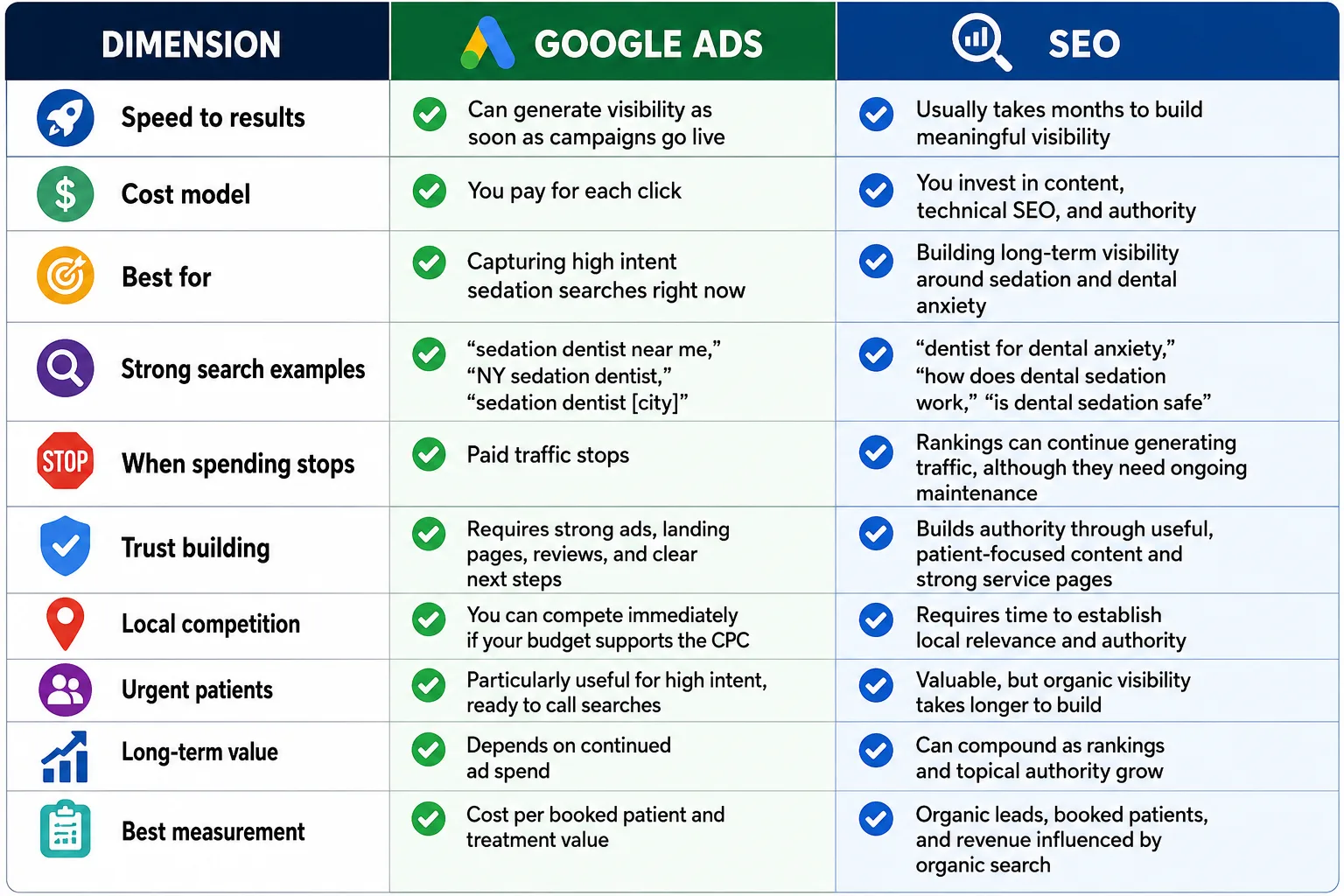
There’s no single CPC for sedation dentistry across the U.S. Costs vary by city, keyword, competition, and season.
What matters more is what the patient is actually searching for.
Someone searching “sedation dentist near me” is likely ready to contact a practice. Someone searching “how does dental sedation work?” is still researching.
That’s where the two channels play different roles:
For example, a patient may click your ad for “sedation dentist near me,” compare your reviews and credentials, leave, and return a few days later through your organic result.
That’s why the real metric isn't clicks or leads alone. Track qualified inquiries, booked appointments, kept appointments, and treatment value.
In short: Google Ads can create faster demand capture. SEO builds a longer-term patient pipeline. The strongest sedation practices use both for different stages of the decision.
For a sedation dental practice, SEO and Google Ads shouldn't be treated as an either/or decision. They work best when each has a clear role in the patient journey.
Google Ads is your speed-and-demand capture engine. It can put your practice in front of someone searching “sedation dentist near me,” “IV sedation dentist,” or “dentist for dental anxiety.”
It is especially useful when you want faster inquiries, need to fill open appointments, or are launching a new sedation service.
It also gives you valuable search data. If patients repeatedly search terms like “sedation dentist for severe dental anxiety," those searches can shape your SEO and content strategy.
For practices looking to build a stronger paid search campaign, Google Ads for dentists can provide a useful foundation for targeting high-intent searches.
SEO plays the longer game. Sedation patients often have more questions before they commit.
They may search:
Useful pages that answer these questions can build trust before the patient ever picks up the phone. This makes patient education an important part of creating useful organic content for patients who need more information before booking.
If you need patients quickly, Google Ads can start capturing existing demand sooner.
But don't wait to begin SEO.
Start building your sedation service pages, local landing pages, FAQs, and educational content alongside your paid campaigns. Then use your real Google Ads search term data to see exactly what potential patients are asking.
As your organic rankings improve, you can become less dependent on paying for every high-intent click.
Keep Google Ads focused on areas where speed matters most, such as urgent searches, new services, competitive local terms, and gaps in organic visibility.
Think of it as a relay, not a rivalry: Google Ads helps you capture patients today. SEO helps you keep attracting them tomorrow.
Sedation SEO works when your website answers anxious patients’ biggest questions and makes taking the next step feel easy.
Google Ads can bring sedation patients faster, but only if you're paying for searches that show real intent.
There isn't one right answer for every sedation practice. Your best mix depends on how established your practice is, how competitive your market is, and how quickly you need new patients.
You’re a new practice building demand.
Start with tightly targeted Google Ads for searches such as “sedation dentist near me” and “dentist for anxious patients in [city].” At the same time, build your sedation SEO foundation so organic visibility can grow while paid campaigns generate early inquiries.
You already have steady patient demand:
Put more emphasis on SEO. Build useful pages around sedation options, dental anxiety, safety, costs, treatments, and common patient questions. Keep Google Ads running for high-intent searches and gaps where organic rankings are still developing.
You specialize heavily in sedation dentistry:
Build a dedicated sedation content hub rather than treating sedation as one paragraph on your general services page. Your SEO should answer the questions anxious patients ask before booking, while Google Ads captures those already looking for help.
You need patients quickly:
Google Ads has the advantage because you can start appearing for relevant searches almost immediately. Send those clicks to a dedicated sedation landing page with clear reassurance, reviews, credentials, and one obvious next step.
You’re planning long-term growth:
SEO deserves consistent investment. Rankings take time, but useful content can continue bringing qualified traffic without paying for every visit. Use paid search alongside it for immediate demand, new services, competitive keywords, and testing.
Whatever stage you’re in:
Don't judge either channel by clicks alone. Track qualified inquiries, booked sedation consultations, kept appointments, and treatment value. That tells you which channel is actually helping your practice grow. Building strong patient trust alongside search visibility can make both paid and organic traffic more valuable.
Our healthcare marketing expert will get in touch with you


.gif)