.png)
Every dental practice has felt the pressure. Post more. Get more followers. Chase the next viral Reel. Keep up with the latest social media trend.
For a long time, bigger numbers were seen as proof that your marketing was working. More followers meant more success. More likes meant more visibility. Today, that couldn't be further from the truth.
A practice with 20,000 followers can still struggle to fill its schedule, while another with a much smaller audience consistently attracts new families every week. The difference isn't the size of the audience. It's how that audience engages with your practice and whether your content builds enough trust for someone to book an appointment.
The real value of social media isn't found in vanity metrics. It's found in the conversations you start, the confidence you build, and the patients who choose your practice because of what they saw online.
Let's look at the social media metrics that actually tell you whether your marketing is growing your practice or simply growing your follower count.
Let's start with a simple definition, because this term gets thrown around a lot.
A vanity metric is any number that looks impressive but has little or no connection to new patient appointments or practice revenue. Follower count is the classic example. It grows over time, looks good on your profile, and is often the first number people notice. That's exactly why it's so easy to mistake it for success.
The problem is that follower count rarely tells the whole story.
That's why social media works differently for dental practices than it does for influencers or national brands. The goal isn't to build the biggest audience. It's to build trust with local families who are already looking for a dentist. Following a well-planned dental social media strategy helps practices focus on meaningful engagement instead of vanity metrics.
Instead of asking, "How many followers do we have?" start asking, "How many of the right people are engaging with our content, visiting our website, and contacting our practice?"
That one shift in thinking changes how you measure every social media result that follows.
Here are the metrics that deserve your attention, starting with the people discovering your practice and ending with the patients actually contacting your office.
Reach is the number of unique people who see your content. Unlike impressions, it doesn't count the same person viewing your post multiple times.
Why it matters for local visibility: The metrics tell you whether you are actually expanding beyond your existing audience and getting in front of new, potentially local, prospective patients. A post can have high impressions from the same 300 people seeing it repeatedly, which looks fine on paper but does nothing to grow your patient base.
What a healthy pattern looks like: steady or gradually increasing reach across weeks, rather than one viral spike followed by silence. Consistency in reach, tied to consistent posting, is a far better sign of algorithm health than any single big number.
This covers likes, comments, shares, saves, story replies, and video completion rate, measured as a percentage of the people who actually saw the post.
Why shares and saves often matter more than likes: A like takes a fraction of a second and costs the viewer nothing. A save means someone found your content useful enough to want to find it again, for example, a parent bookmarking your "how to get a toddler to brush without a fight" video. A share means someone found it valuable enough to send to a specific person, making it one of the strongest trust signals a piece of content can earn. Social media platforms increasingly reward saves and shares over passive likes when deciding how widely to distribute a post.
How engagement shows resonance: A high engagement rate on educational or reassurance-focused content, such as what a filling actually feels like or what your child's first visit looks like, tells you that content is connecting with parents and is worth repeating. A high engagement rate driven purely by a giveaway simply tells you people like free things, which is a very different signal. Applying proven audience engagement techniques can further improve shares, saves, and meaningful interactions with prospective patients.
When someone taps through from a post to your profile, they are doing more than simply scrolling past. They are actively curious about your practice and want to learn more.
Why this matters for specific service lines: Profile visits are a particularly useful early signal for practices offering cosmetic dentistry, Invisalign, dental implants, emergency care, or family dentistry because these are higher-consideration decisions. A prospective Invisalign patient rarely books on the spot. They browse your profile, look at before and after photos, check your reviews, explore your content, and often come back more than once before ever calling or sending a message.
Track how many people leave your social media posts and visit your website, especially your service pages, contact page, or online booking page, instead of simply staying inside the app.
How to track it properly: Use UTM tracking (tagged links added to anything you post) alongside GA4 (Google Analytics 4) to see, inside your website analytics, exactly how many visitors arrived from Instagram, Facebook, or TikTok, which pages they viewed, and whether they completed a booking action. Google's free Campaign URL Builder generates these tags in under a minute, and once they're set up, you never have to think about them again.
Measure the number of phone calls, contact forms, direct messages, and appointment requests your practice receives from social media. For most dental practices, this is the metric that matters most and the one most commonly left untracked.
How to connect activity to booked consultations: Every direct message asking about insurance or availability, every contact form submitted through a link in your bio, and every phone call mentioning social media is a hand-raiser, someone actively considering an appointment. A simple habit closes the gap here: log every serious inquiry (platform, date, question, and outcome) in a shared spreadsheet, and train the front desk to ask every new patient how they heard about your practice. Within a month, you'll have an honest picture of how many new patient inquiries your social media is actually generating.
Social media and your Google Business Profile are more connected than most practices realize, so keep an eye on your reviews and encourage new ones regularly. Optimizing your Google Business Profile alongside your social media presence creates a stronger local marketing strategy.
How social activity influences reviews: A practice that posts consistently and engages warmly with comments often sees more patients willing to leave a review afterward, simply because the relationship already feels familiar. Track not only your star rating but also your review velocity, including how many new reviews you receive each month and how recent those reviews are. Both review recency and review volume play an important role in how trustworthy your practice appears to someone comparing your social media profiles with your Google Business Profile. If you want to increase review volume, these tips on how to get more Google reviews can help encourage satisfied patients to share their experiences.
Measure how much it costs to generate a new lead and, more importantly, how much it costs to book a new patient. This becomes essential once you start running paid social campaigns, but it's also useful for organic social media if you want to understand the value of your team's time and effort.
Cost per lead = Total marketing spend ÷ Number of leads generated
Cost per booked appointment = Total marketing spend ÷ Number of appointments actually booked
Why this matters: A campaign might generate plenty of low-cost leads but very few actual appointments. On paper it looks successful, but in reality it's costing far more than you think. That's why every dental practice should track both cost per lead and cost per booked appointment, not just one or the other.
Track how effectively your social media brings existing patients back to your practice, not just how many new patients it attracts.
How this works in practice: Hygiene reminders, recall campaigns for overdue patients, and simple "we miss seeing you" posts can significantly improve patient reactivation. This is one of the most overlooked uses of social media because most practices focus almost entirely on attracting new patients. Yet keeping an existing patient is almost always more cost-effective than acquiring a new one, making patient retention and reactivation a metric every practice should monitor closely. Combining social media with automated patient follow-ups helps practices consistently reconnect with existing patients and improve retention.
Different platforms reward different behaviors, and different service lines perform better on different platforms. Use this table as your quick reference.
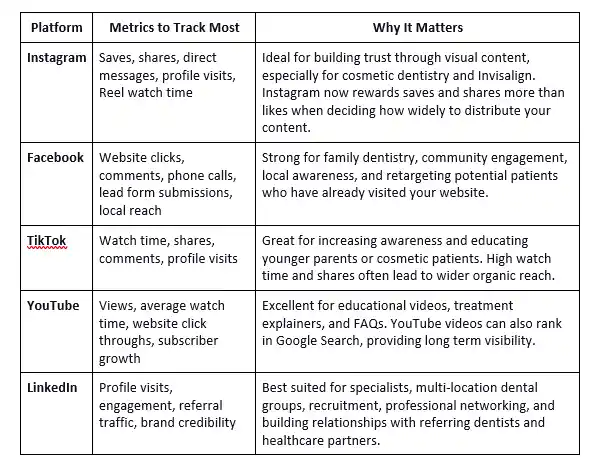
Here is the basic patient journey that every tracking setup needs to follow:
See post → visit profile → click to website → read service page → book appointment.
Most practices can only see the first step or two of this journey. Closing that gap is what turns social media from a "nice to have" into a channel you can actually defend with numbers.
Track these metrics every month for each platform:
Looking at these numbers side by side quickly answers the most important question: Is social media actually growing the practice, or just generating activity? If you're unsure how to evaluate performance, learn how to measure social media ROI using practical tracking methods that connect marketing efforts to business outcomes.
If someone sees a post, doesn't act immediately, and then books three weeks later after finally searching your name on Google, that post still deserves credit. Dental decisions are rarely impulsive. Judging a single post's success by whether the phone rang that same day will consistently undervalue your best educational and trust-building content, which tends to work on a delay.
Dentist social media KPIs worth tracking are not the ones that look best on a screenshot. They are the ones that connect a scroll to a phone call, a save to a booked consultation, and a comment thread to a five-star review.
Start with reach, engagement quality, and website clicks. Build up to calls, forms, and booked appointments. Layer in cost per lead if you're running paid campaigns and patient retention if you want social media working just as hard for your existing patients as it does for attracting new ones. Use the monthly reporting template in Section 8 to keep your tracking consistent, and revisit your platform mix from Section 4 every few months as algorithms and patient behavior continue to evolve.
Do this consistently, and within a few months you'll know far more about what's actually driving new patients from social media than most practices in your area ever will, because they'll still be chasing follower counts while you're measuring the numbers that actually fill chairs.

.svg)

Dr. Ruchir Mehra has spent nearly a decade at the crossroads of clinical insight and cutting-edge technology, reshaping how dental practices think, operate, and grow. He brings a rare fusion of medical precision and AI-driven innovation, helping practices and DSOs move from instinct to intelligence, and from scattered operations to scalable, compliance-first growth engines that perform.
Our healthcare marketing expert will get in touch with you


.gif)