
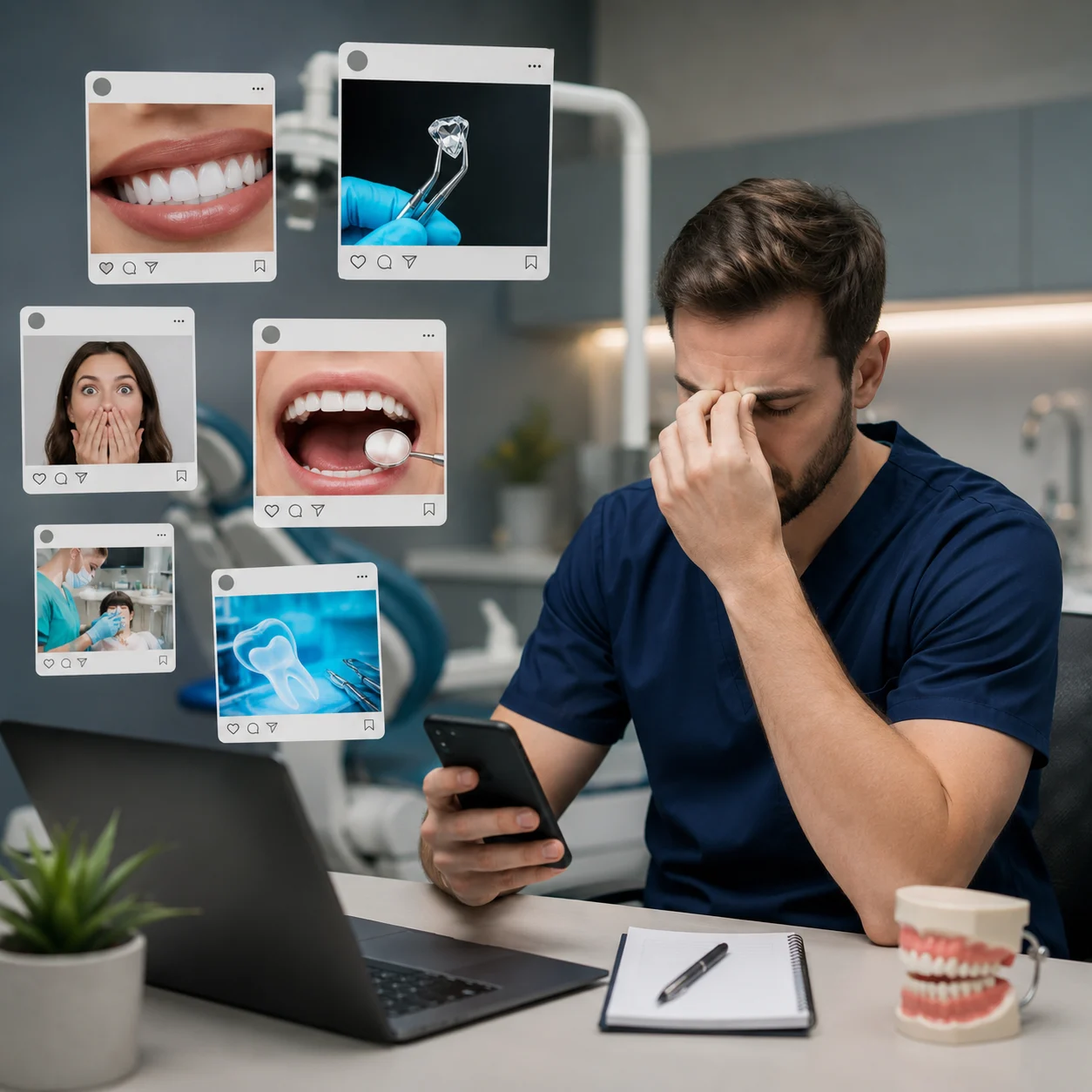
What makes patients stop trusting a dental practice on social media? After analyzing the social media strategies of over 1,000 dental practices around the world, one thing became remarkably clear. It isn't the lack of content that hurts engagement. It's the type of content being shared.
Some posts build credibility, strengthen patient trust, and encourage appointments. Others quietly reduce engagement, damage perception, and make your practice look no different from every other dental office in the feed.
The difference often comes down to a few common mistakes that many practices don't even realize they're making.
Understanding what patients no longer engage with is just as important as knowing what they do. The practices seeing the strongest results on social media aren't necessarily posting more content. They're posting content that feels more authentic, more relevant, and far more valuable to the people they want to attract.
So, before you create your next post, it might be worth asking one simple question: Would this make you trust your own practice if you were seeing it for the very first time? The answers often reveal more than the analytics ever will. Let's look at the types of posts that are helping practices grow, and the ones that may be quietly holding them back.
That's genuinely the most serious mistake, and it's where many HIPAA violations begin.
Patient photos, videos, X-rays, treatment details, or any information that could identify a patient should never be posted without specific, written authorization. A verbal "yes" during an appointment isn't enough, and neither is your standard treatment consent form. Social media and marketing require a separate patient authorization.
What this has actually cost dental practices:
What to post instead:
Before-and-after photos are some of the highest-performing content dental practices share on social media. Smile transformations, Invisalign results, and veneer cases can build trust and attract new patients. The problem isn't the type of content. It's posting it without:
A photo doesn't need a patient's name attached to qualify as protected health information (PHI). If the image, either on its own or combined with your caption, could reasonably identify the patient, written authorization is required. If you're unsure about the best practices for taking compliant treatment photos, read our guide on how to capture before-and-after photos of patients.
What to do instead:
Create a simple system to track patient marketing consent. Even a basic spreadsheet can work. Record the patient's name, the date they signed the authorization, and exactly which photos or videos they've approved for use. Before any before-and-after photo goes live, take a few seconds to verify the consent. That quick check can help prevent a costly HIPAA violation.
Through continued acknowledgements and public apologies about a patient's treatment, many dentists and even social media marketing teams managing DSOs unknowingly make this mistake far more often than they realize. It usually comes from good intentions. They simply want to respond professionally and show they care.
Imagine a patient leaves a Google review saying, "[Dr. Name] fixed my cavity and the numbing shot barely hurt!" Your first instinct might be to reply, "We're so glad your filling went smoothly!"
Unfortunately, that response can create a HIPAA issue. By replying that way, you've publicly confirmed the person is your patient and acknowledged details of their treatment, even though they mentioned them first. A patient's decision to share their own experience does not give you permission to confirm or discuss it publicly. If you're looking for compliant ways to handle online feedback, here's a guide on responding to negative reviews while protecting patient privacy.
Experts suggest healthcare providers should think carefully about patient privacy before responding to online reviews because social media is never the appropriate place to discuss a patient's care, even when the review is positive.
What to do instead:
If a review mentions treatment details or raises a concern, avoid discussing it publicly. Instead, invite the reviewer to contact your office directly so the conversation can continue privately.
Never confirm someone is your patient, repeat treatment details, or apologize in a way that acknowledges specific care. Even a reply such as, "We're sorry your crown didn't fit properly," can disclose protected health information and create a HIPAA compliance risk.
Extractions, root canals in progress, bleeding gums, suction tubes, and other graphic procedure footage may seem like an easy way to grab attention on social media. Sometimes it does. But it's rarely the kind of attention your practice wants.
One of the biggest reasons people avoid visiting the dentist is dental anxiety. Graphic content can reinforce those fears rather than build confidence. Instead of showcasing your expertise, it often leaves patients feeling uncomfortable or discouraged from booking an appointment. As many dental marketing experts point out, not every procedure belongs on social media. Patients respond far better to professionalism, reassurance, and results than they do to graphic clinical footage. For more ideas on creating engaging, patient-friendly content, explore these video marketing tips for dentists.
There's also a well-known example that the industry shouldn't forget. A dentist in Alaska filmed and shared a tooth extraction while riding a hoverboard without the patient's proper authorization. What started as a viral social media stunt resulted in an investigation, additional legal charges, and ultimately a lengthy prison sentence. The takeaway goes beyond patient consent. Chasing shock value can quickly attract the wrong kind of attention.
What to post instead:
Clean, completed results. "Getting ready for the day" shots of your sterilization setup (patients love seeing this, it builds trust without gore). Short, calm explainer videos of what a procedure feels like, not graphic footage of what it looks like mid-treatment.
Patients come to social media looking for reassurance, trust, and confidence. They don't come looking for content that makes them more nervous about visiting the dentist.
The smiling, suspiciously symmetrical family in matching outfits, the too-perfect dentist headshot that's actually a stock model; your patients can spot these instantly, and they quietly erode trust.
Even worse, some practices use stock photos before and after transformation that were never their own patients, which not only looks inauthentic but can also create misleading advertising concerns.
Practices that continue recycling the same stock imagery every competitor uses rarely fill their schedules or create meaningful differentiation. According to dental marketing research, generic content often signals a generic or even absent practice personality. Building an authentic social presence is one of the core principles of Instagram marketing for dentists.
What to do instead:
Use real photos of your team, your office, and your patients with proper written consent. Even photos taken on a smartphone often outperform polished stock photography because authenticity is one of the strongest trust signals patients look for when choosing a dental practice.
"You wouldn't believe the patient I had today." Posts like these, even without mentioning a patient's name, can quickly become a problem. They may reveal enough details for someone to identify the patient, especially in a small community or a niche area of dentistry. Just as importantly, they make your practice appear unprofessional to prospective patients.
This doesn't apply only to your practice's social media accounts. Personal accounts matter too. If a hygienist, dental assistant, or front desk team member posts about a "nightmare patient" on their personal Instagram or Facebook, and that patient can be identified from the details shared, your practice could still be implicated.
What to do instead:
Create a simple social media policy that covers both your practice's official accounts and your team's personal social media. Make sure everyone understands that removing a patient's name isn't enough. If a post could identify a patient in any way, it shouldn't be shared. Review the policy with every team member and have them sign it.
Your dental practice page is not the place to weigh in on elections, religious holidays framed as endorsements, or divisive social issues — even ones you feel strongly about. Marketing guidance for dental practices is consistent on this: avoid political or religious content because it risks alienating current or future patients over something entirely unrelated to your clinical care.
This doesn't mean your team can't have personal opinions; it means the practice's shared voice should stay focused on what unites your patient base: healthy smiles, not political ones.
"Guaranteed painless!" "This whitening treatment works instantly, every time!" "Zero risk!" If you see another dentist posting claims like these, don't assume it's a strategy worth copying. Claims like these aren't just poor marketing practice. They can also violate state advertising laws.
In New York, for example, the General Business Law requires advertising claims to be truthful and not misleading, and that applies just as much to social media as it does to traditional advertising. Heavily edited before-and-after photos can fall into the same trap if they misrepresent what the treatment actually achieved.
What to post instead:
Use honest, specific language. Instead of "guaranteed results," try "Results vary by case. Here's what a typical Invisalign timeline looks like." Instead of "pain-free," try "We use [specific technique] to help keep patients comfortable throughout treatment." Confidence without overpromising builds more trust, not less.
Trending TikTok sounds, movie clips, or copyrighted graphics used without permission can trigger takedowns, copyright strikes, or, in rarer cases, legal claims. The ADA's own social media guidance specifically flags this. Don't post copyrighted or trademarked content without permission or proper citation.
What to post instead:
Stick to platform-licensed trending audio. Most in-app sound libraries are pre-cleared for commercial use, although you should always check the platform's terms. You can also use your own original footage or licensed stock content from platforms that grant commercial rights.
Tagging a patient on social media might seem like a friendly gesture, but it can quickly become a privacy issue. Even a simple post such as "Thanks for coming in today, [Patient Name]!" publicly confirms that someone is a patient at your practice, and that's health information they may not want shared with everyone in their social network. The same applies when you geotag a patient or encourage them to appear in a post without their clear permission. Even if the post doesn't mention any treatment or clinical details, it can still reveal more than the patient intended to share.
What to post instead:
Fix: Never tag a patient by name or social media account unless you have specific, separate permission to do so. Even then, ask for permission each time rather than assuming a blanket approval given months ago still applies.
Publicly criticizing another local practice, a former associate, or an ex-employee might feel satisfying in the moment, especially if you genuinely feel wronged. But to a prospective patient scrolling your page for the first time, it just reads as unprofessional. They're trying to decide if they can trust you with their care, and public sniping doesn't exactly scream "trustworthy." There's also a real legal risk here: if any of the claims are exaggerated or disputed, you could be looking at a defamation complaint on top of the reputational damage.
What to post instead:
Let your content, your patient experience, and your reviews do the competing. Nobody has ever chosen a dentist because that dentist was better at insulting the practice down the street.
As AI image tools become more widely used, some practices have started creating synthetic before-and-after images or AI-generated reviews to fill content gaps. This is one shortcut you should never take. Fake reviews and testimonials are explicitly regulated by the FTC, and if patients or competitors discover that your results have been fabricated or digitally altered, the damage to your credibility can be far greater than any short-term engagement those posts generate.
What to post instead:
Use AI to help with captions, content ideas, scheduling, or editing your writing, but never to create fake clinical results or patient reviews. If you make AI-enhanced edits to a real patient photo, such as color correction or cropping, that's generally fine. However, if the editing changes the clinical appearance or treatment outcome, disclose it clearly rather than presenting it as an unedited result.
If you're looking for ethical, engaging content that builds trust instead of risking compliance issues, explore these dental social media post ideas to keep your social channels active and patient-focused.

.svg)

Dr. Ruchir Mehra has spent nearly a decade at the crossroads of clinical insight and cutting-edge technology, reshaping how dental practices think, operate, and grow. He brings a rare fusion of medical precision and AI-driven innovation, helping practices and DSOs move from instinct to intelligence, and from scattered operations to scalable, compliance-first growth engines that perform.
Our healthcare marketing expert will get in touch with you

.gif)